Espinha Gisele, Osaki Juliana Harumi, Costa Erico Tosoni, Forti Fabio Luis
Laboratory of Signaling in Biomolecular Systems, Department of Biochemistry, Institute of Chemistry, University of Sao Paulo, 05508-000 Sao Paulo, SP, Brazil.
Centro de Oncologia Molecular, Hospital Sirio Libanes, 01308-060 Sao Paulo, SP, Brazil; Ludwig Institute for Cancer Research (LICR), 01509-010 Sao Paulo, SP, Brazil.
Oxid Med Cell Longev. 2016;2016:2696952. doi: 10.1155/2016/2696952. Epub 2015 Dec 28.
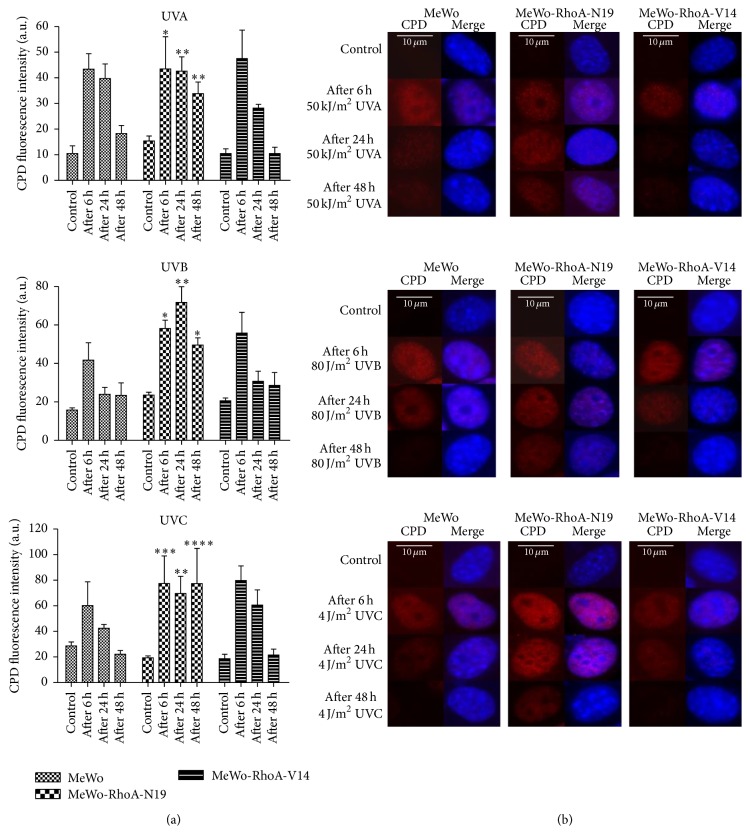
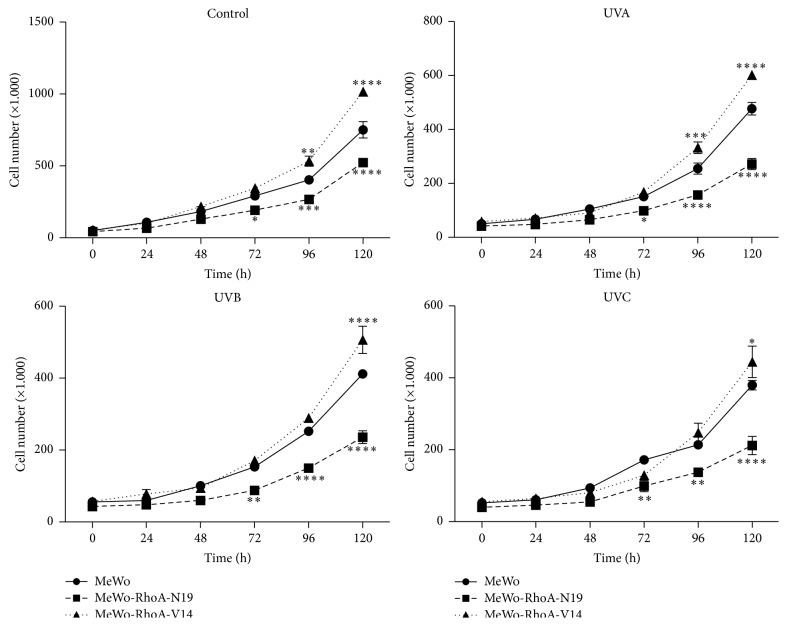
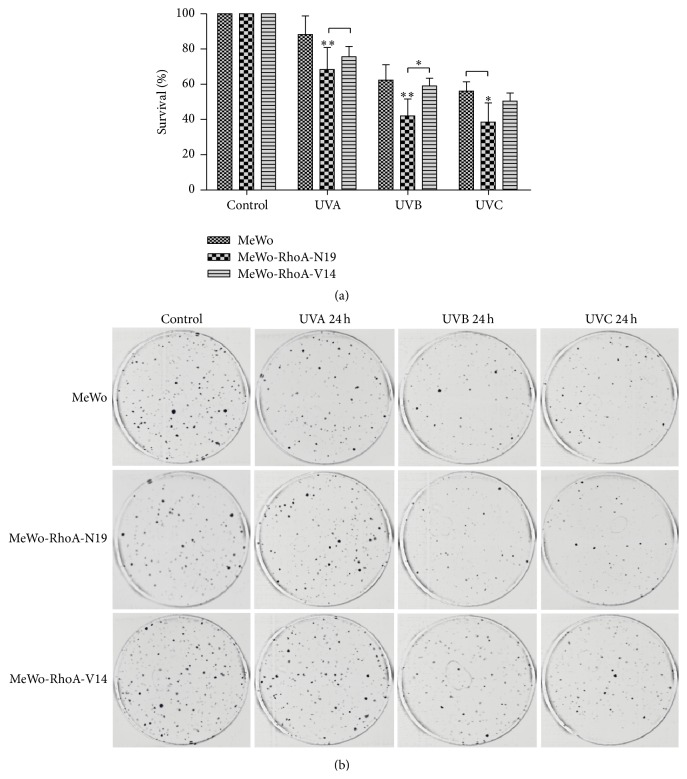
Ultraviolet radiation is the main cause of DNA damage to melanocytes and development of melanoma, one of the most lethal human cancers, which leads to metastasis due to uncontrolled cell proliferation and migration. These phenotypes are mediated by RhoA, a GTPase overexpressed or overactivated in highly aggressive metastatic tumors that plays regulatory roles in cell cycle progression and cytoskeleton remodeling. This work explores whether the effects of UV on DNA damage, motility, proliferation, and survival of human metastatic melanoma cells are mediated by the RhoA pathway. Mutant cells expressing dominant-negative (MeWo-RhoA-N19) or constitutively active RhoA (MeWo-RhoA-V14) were generated and subjected to UV radiation. A slight reduction in migration and invasion was observed in MeWo and MeWo-RhoA-V14 cells but not in MeWo-RhoA-N19 cells, which presented inefficient motility and invasiveness associated with stress fibers fragmentation. Proliferation and survival of RhoA-deficient cells were drastically reduced by UV compared to cells displaying normal or high RhoA activity, suggesting increased sensitivity to UV. Loss of RhoA activity also caused less efficient DNA repair, with elevated levels of DNA lesions such as strand breaks and cyclobutane pyrimidine dimers (CPDs). Thus, RhoA mediates genomic stability and represents a potential target for sensitizing metastatic tumors to genotoxic agents.
紫外线辐射是导致黑素细胞DNA损伤和黑色素瘤发生的主要原因,黑色素瘤是人类最致命的癌症之一,由于细胞不受控制的增殖和迁移而导致转移。这些表型由RhoA介导,RhoA是一种在高侵袭性转移性肿瘤中过表达或过度激活的GTP酶,在细胞周期进程和细胞骨架重塑中发挥调节作用。这项研究探讨了紫外线对人转移性黑色素瘤细胞的DNA损伤、运动性、增殖和存活的影响是否由RhoA途径介导。生成了表达显性负性(MeWo-RhoA-N19)或组成型活性RhoA(MeWo-RhoA-V14)的突变细胞,并对其进行紫外线辐射。在MeWo和MeWo-RhoA-V14细胞中观察到迁移和侵袭略有减少,但在MeWo-RhoA-N19细胞中未观察到,MeWo-RhoA-N19细胞表现出与应力纤维断裂相关的低效运动性和侵袭性。与显示正常或高RhoA活性的细胞相比,紫外线显著降低了RhoA缺陷细胞的增殖和存活,表明对紫外线的敏感性增加。RhoA活性的丧失还导致DNA修复效率降低,DNA损伤水平升高,如链断裂和环丁烷嘧啶二聚体(CPD)。因此,RhoA介导基因组稳定性,是使转移性肿瘤对基因毒性药物敏感的潜在靶点。