Jeong Seonhyang, Lee Jandee, Kim Daham, Seol Mi-Youn, Lee Woo Kyung, Jeong Jong Ju, Nam Kee-Hyun, Jung Sang Geun, Shin Dong Yeob, Lee Eun Jig, Chung Woong Youn, Jo Young Suk
From the Departments of Internal Medicine (SJ, DK, WKL, DYS, EJL, YSJ) and Surgery (JL, M-YS, JJJ, K-HN, WYC), Open NBI Convergence Technology Research Laboratory, Severance Hospital, Yonsei Cancer Center, Yonsei University College of Medicine, Seoul, South Korea; and Department of Gynecological Oncology, Bundang CHA Medical Center, CHA University, Gyeonggi-do, South Korea (SGJ).
Medicine (Baltimore). 2016 Jan;95(4):e2592. doi: 10.1097/MD.0000000000002592.
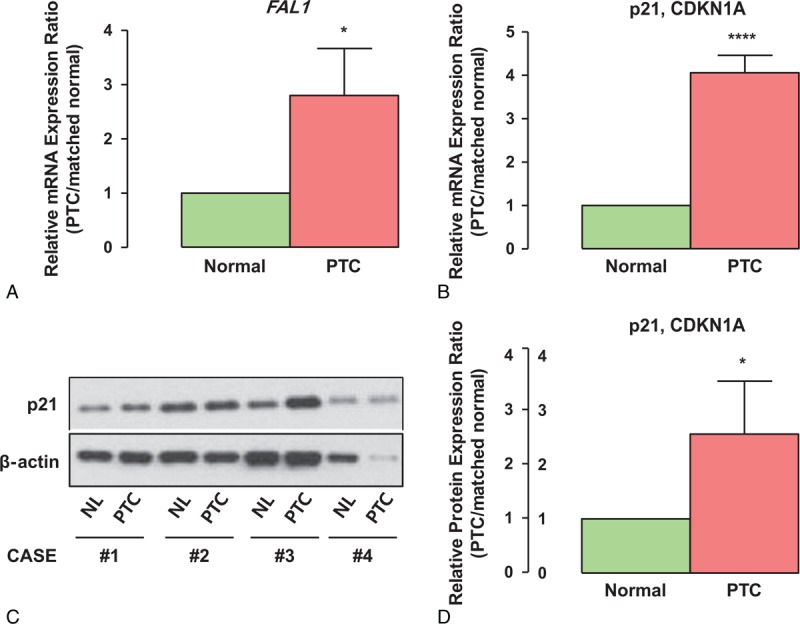
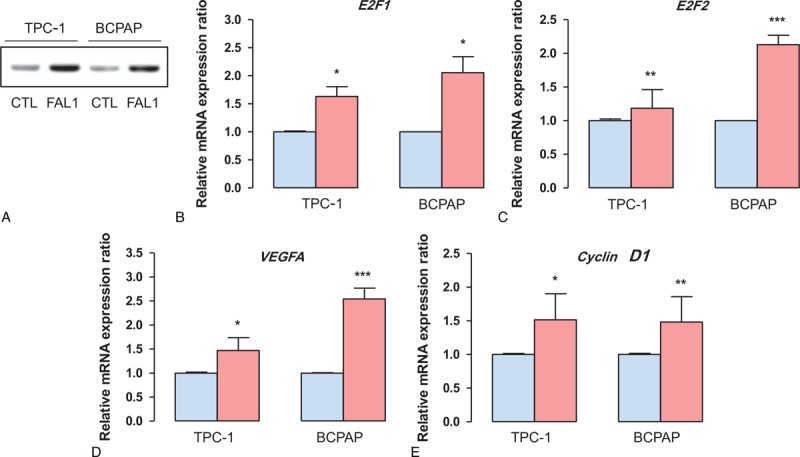
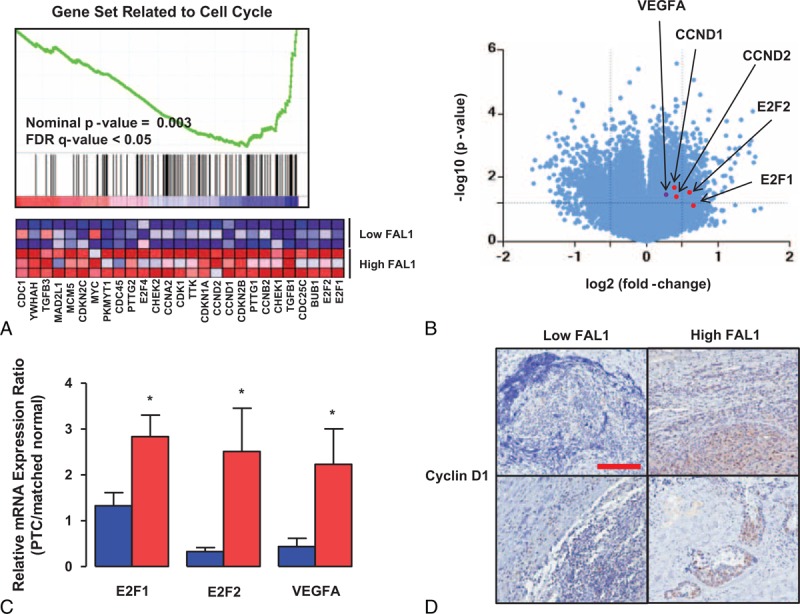
Recent functional genomic studies revealed that the oncogenic activity of focally amplified lncRNA on chromosome 1 (FAL1, ENSG00000228126) contributes to tumor growth by p21 repression in human cancers. However, the expression of FAL1 was not investigated in papillary thyroid cancer (PTC). We aimed to determine if FAL1 was up-regulated in PTC compared to paired contralateral normal thyroid tissues, and to investigate the potential targets of this lncRNA and its clinicopathological significance in PTC. We analyzed FAL1 and p21 expression levels in 100 PTC samples and matched normal thyroid tissue by qRT-PCR. Using lncRNA microarray data from the Gene Expression Omnibus (accession no. GSE61763), we explored potential targets of FAL1 by Gene Set Enrichment Analysis, followed by verification by qRT-PCR in our PTC samples. A cross-sectional observational study was conducted to investigate the relationship between patients' clinicopathological features and FAL1 expression. FAL1 expression was significantly higher in PTC than in paired normal thyroid tissues (paired t test, P < 0.001). p21 mRNA expression was also increased, not decreased, in PTC, and had no correlation with FAL1 expression (r = 0.0897, P = 0.4002). Gene Set Enrichment Analysis, using publicly available microarray data, indicated that a gene set related to the cell cycle, including E2F transcription factors 1 and 2, and cyclin D1, was coordinately enriched among samples with high FAL1 expression. A volcano plot showed that E2F1, E2F2, and VEGFA mRNAs were increased in the high FAL1 samples. In clinicopathological analyses, multifocality was more frequently observed in PTC patients with high FAL1 (P = 0.018). Multivariate analysis showed that high FAL1 expression increased the risk of multifocality (after adjustment for clinical variables, OR = 4.019, CI = 1.041-11.020, P = 0.043). FAL1 may have a role in cell-cycle progression and may be associated with aggressive tumor behavior in PTC.
近期的功能基因组学研究表明,1号染色体上局部扩增的长链非编码RNA(FAL1,ENSG00000228126)的致癌活性通过抑制p21促进人类癌症的肿瘤生长。然而,尚未对甲状腺乳头状癌(PTC)中FAL1的表达进行研究。我们旨在确定与配对的对侧正常甲状腺组织相比,FAL1在PTC中是否上调,并研究该长链非编码RNA的潜在靶标及其在PTC中的临床病理意义。我们通过qRT-PCR分析了100例PTC样本和配对的正常甲状腺组织中FAL1和p21的表达水平。利用来自基因表达综合数据库(登录号GSE61763)的长链非编码RNA微阵列数据,我们通过基因集富集分析探索FAL1的潜在靶标,随后在我们的PTC样本中通过qRT-PCR进行验证。进行了一项横断面观察性研究,以调查患者临床病理特征与FAL1表达之间的关系。FAL1在PTC中的表达显著高于配对的正常甲状腺组织(配对t检验,P<0.001)。PTC中p21 mRNA表达也升高而非降低,且与FAL1表达无相关性(r = 0.0897,P = 0.4002)。利用公开可用的微阵列数据进行的基因集富集分析表明,与细胞周期相关的基因集,包括E2F转录因子1和2以及细胞周期蛋白D1,在FAL1高表达的样本中协同富集。火山图显示,FAL1高表达样本中E2F1、E2F2和VEGFA mRNA增加。在临床病理分析中,FAL1高表达的PTC患者更常出现多灶性(P = 0.018)。多变量分析表明,FAL1高表达增加了多灶性风险(校正临床变量后,OR = 4.019,CI = 1.041 - 11.020,P = 0.043)。FAL1可能在细胞周期进程中起作用,并且可能与PTC中的侵袭性肿瘤行为相关。