Villegas Vallejos Marcelo Alejandro, Padial André Andrian, Vitule Jean Ricardo Simões
Hori Consultoria Ambiental, Curitiba, Paraná, Brazil.
Departamento de Botânica, Universidade Federal do Paraná, Curitiba, Paraná, Brazil.
PLoS One. 2016 Feb 3;11(2):e0147058. doi: 10.1371/journal.pone.0147058. eCollection 2016.
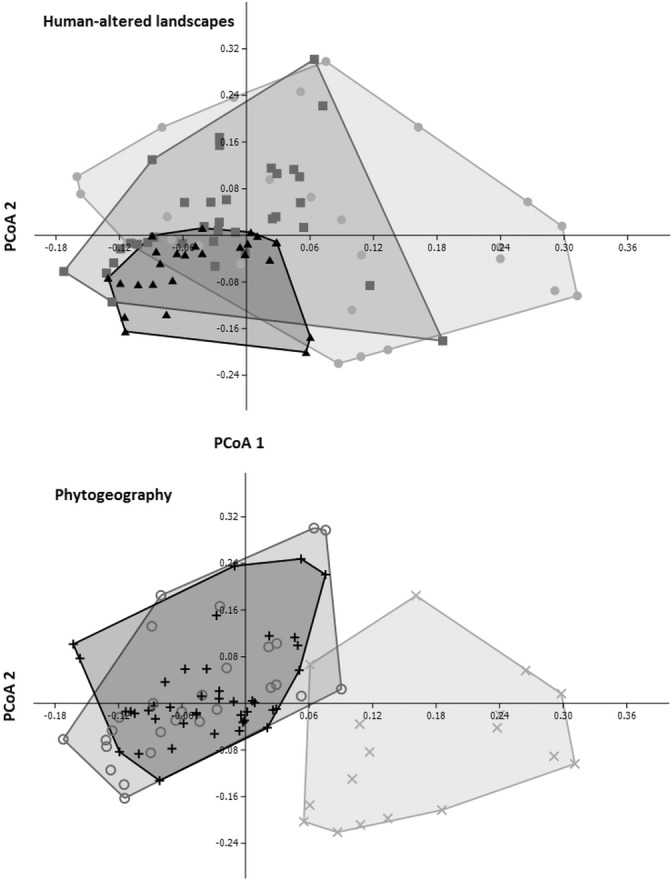
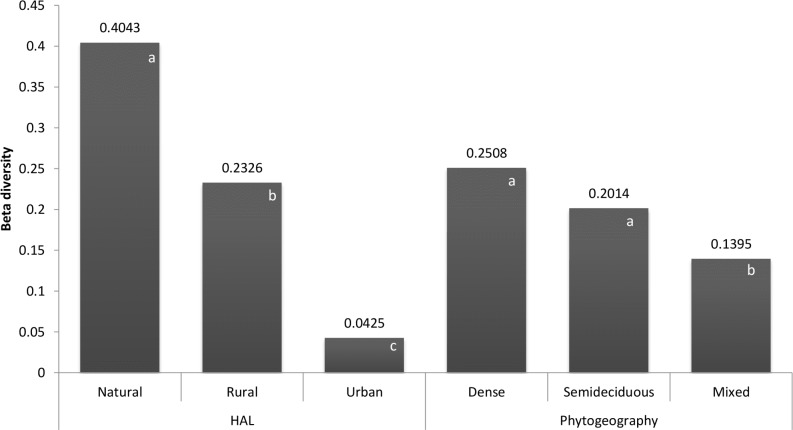
The increasing number of quantitative assessments of homogenization using citizen science data is particularly important in the Neotropics, given its high biodiversity and ecological peculiarity, and whose communities may react differently to landscape changes. We looked for evidence of taxonomic homogenization in terrestrial birds by investigating patterns of beta diversity along a gradient of human-altered landscapes (HAL), trying to identify species associated with this process. We analyzed bird data from 87 sites sampled in a citizen science program in the south Brazilian Atlantic Forest. Regional-scale taxonomic homogenization was assessed by comparing beta diversity among sites in different HALs (natural, rural or urban landscapes) accounting for variation derived from geographical distance and zoogeographical affinities by georeferencing sites and determining their position in a phytogeographical domain. Beta diversity was calculated by multivariate dispersion and by testing compositional changes due to turnover and nestedness among HALs and phytogeographical domains. Finally, we assessed which species were typical for each group using indicator species analysis. Bird homogenization was indicated by decreases in beta diversity following landscape changes. Beta diversity of rural sites was roughly half that of natural habitats, while urban sites held less than 10% of the natural areas' beta diversity. Species composition analysis revealed that the turnover component was important in differentiating sites depending on HAL and phytogeography; the nestedness component was important among HALs, where directional species loss is maintained even considering effects of sampling effort. A similar result was obtained among phytogeographical domains, indicating nested-pattern dissimilarity among compositions of overlapping communities. As expected, a few native generalists and non-native urban specialists were characteristic of rural and urban sites. We generated strong evidence that taxonomic homogenization occurs in the south Brazilian Atlantic Forest as a result of a directional and nested species loss, with the resultant assemblages composed of few disturbance-tolerant birds.
鉴于新热带地区生物多样性高且生态独特,其群落可能对景观变化有不同反应,利用公民科学数据对同质化进行的定量评估数量不断增加,这在新热带地区尤为重要。我们通过研究沿人类改变景观(HAL)梯度的β多样性模式,寻找陆地鸟类分类同质化的证据,试图识别与这一过程相关的物种。我们分析了巴西大西洋森林南部一个公民科学项目中87个采样点的鸟类数据。通过比较不同HAL(自然、农村或城市景观)中各采样点的β多样性来评估区域尺度的分类同质化,通过对采样点进行地理定位并确定其在植物地理区域中的位置,考虑地理距离和动物地理亲缘关系所产生的变异。通过多变量离散度以及测试HAL和植物地理区域之间由于周转率和嵌套性导致的组成变化来计算β多样性。最后,我们使用指示物种分析评估每组中的典型物种。景观变化后β多样性降低表明鸟类同质化。农村采样点的β多样性大约是自然栖息地的一半,而城市采样点的β多样性不到自然区域的10%。物种组成分析表明,周转率成分在根据HAL和植物地理学区分采样点方面很重要;嵌套成分在HAL之间很重要,即使考虑采样努力的影响,定向物种丧失仍在持续。在植物地理区域之间也得到了类似结果,表明重叠群落组成之间存在嵌套模式差异。正如预期的那样,一些本地通才和非本地城市特化物种是农村和城市采样点的特征。我们提供了有力证据,表明巴西大西洋森林南部由于定向和嵌套的物种丧失而发生分类同质化,最终的组合由少数耐干扰鸟类组成。