Nixon Mark, Stewart-Fitzgibbon Randi, Fu Jingqi, Akhmedov Dmitry, Rajendran Kavitha, Mendoza-Rodriguez Maria G, Rivera-Molina Yisel A, Gibson Micah, Berglund Eric D, Justice Nicholas J, Berdeaux Rebecca
Department of Integrative Biology and Pharmacology, University of Texas Health Science Center, Houston, TX 77030, USA.
Department of Integrative Biology and Pharmacology, University of Texas Health Science Center, Houston, TX 77030, USA; Program in Cell and Regulatory Biology, The University of Texas Graduate School of Biomedical Sciences at Houston, Houston TX 77030, USA.
Mol Metab. 2015 Nov 6;5(1):34-46. doi: 10.1016/j.molmet.2015.10.004. eCollection 2016 Jan.
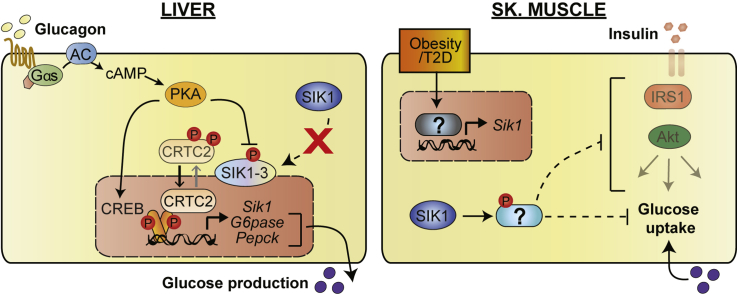
Insulin resistance causes type 2 diabetes mellitus and hyperglycemia due to excessive hepatic glucose production and inadequate peripheral glucose uptake. Our objectives were to test the hypothesis that the proposed CREB/CRTC2 inhibitor salt inducible kinase 1 (SIK1) contributes to whole body glucose homeostasis in vivo by regulating hepatic transcription of gluconeogenic genes and also to identify novel SIK1 actions on glucose metabolism.
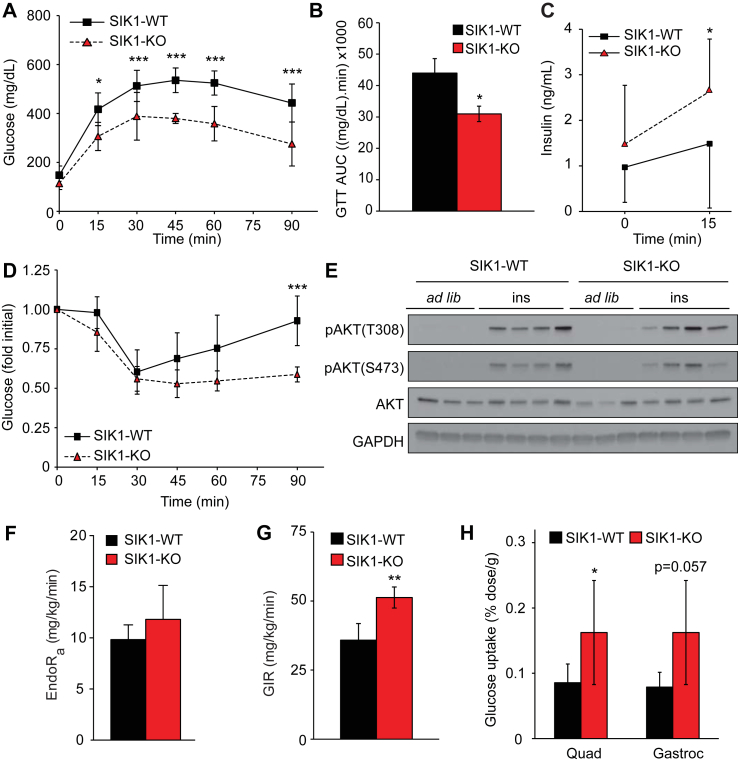
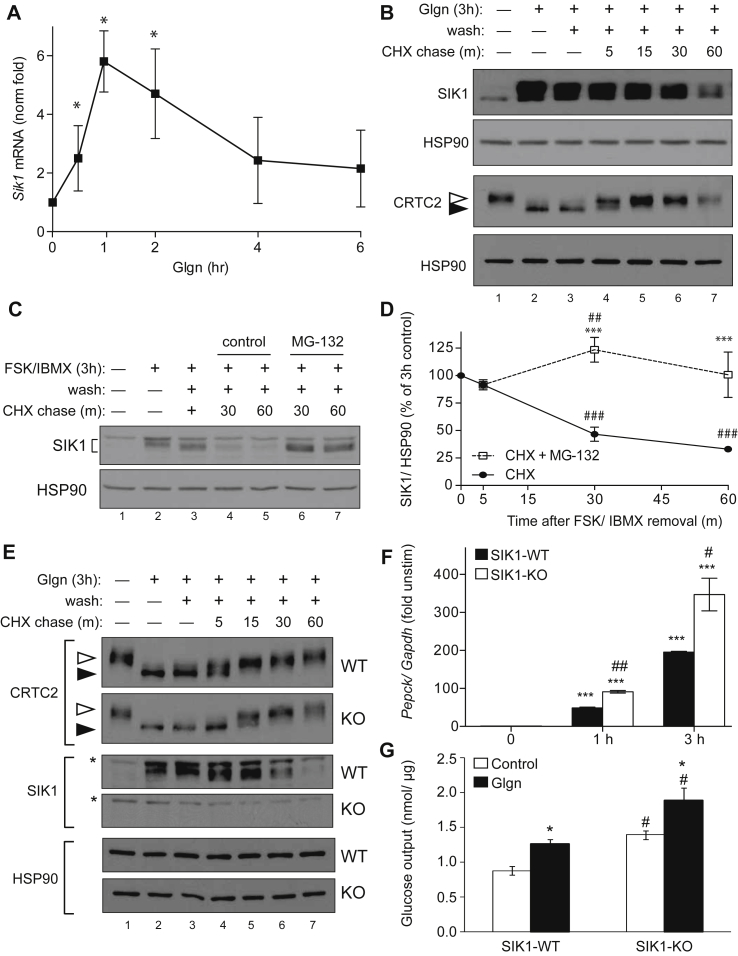
We created conditional (floxed) SIK1-knockout mice and studied glucose metabolism in animals with global, liver, adipose or skeletal muscle Sik1 deletion. We examined cAMP-dependent regulation of SIK1 and the consequences of SIK1 depletion on primary mouse hepatocytes. We probed metabolic phenotypes in tissue-specific SIK1 knockout mice fed high fat diet through hyperinsulinemic-euglycemic clamps and biochemical analysis of insulin signaling.
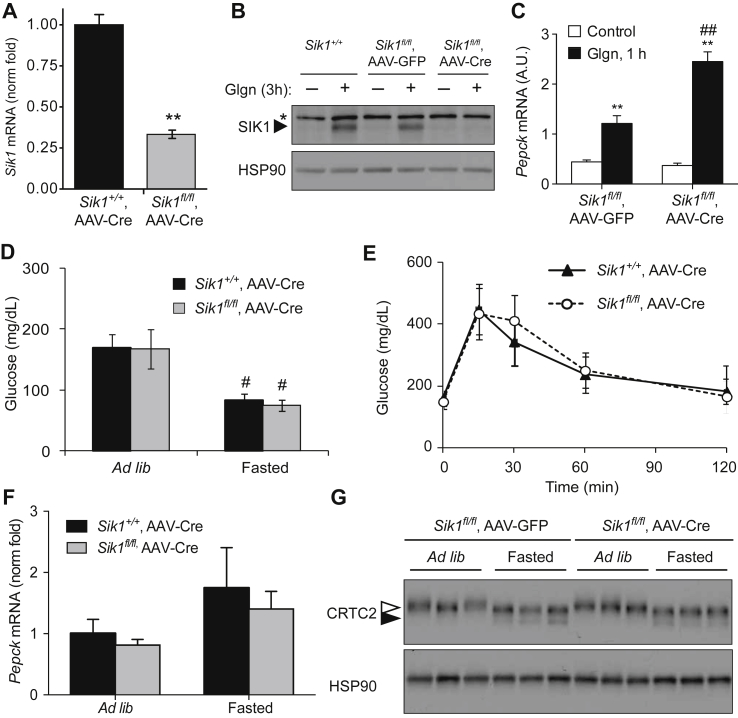
SIK1 knockout mice are viable and largely normoglycemic on chow diet. On high fat diet, global SIK1 knockout animals are strikingly protected from glucose intolerance, with both increased plasma insulin and enhanced peripheral insulin sensitivity. Surprisingly, liver SIK1 is not required for regulation of CRTC2 and gluconeogenesis, despite contributions of SIK1 to hepatocyte CRTC2 and gluconeogenesis regulation ex vivo. Sik1 mRNA accumulates in skeletal muscle of obese high fat diet-fed mice, and knockout of SIK1 in skeletal muscle, but not liver or adipose tissue, improves insulin sensitivity and muscle glucose uptake on high fat diet.
SIK1 is dispensable for glycemic control on chow diet. SIK1 promotes insulin resistance on high fat diet by a cell-autonomous mechanism in skeletal muscle. Our study establishes SIK1 as a promising therapeutic target to improve skeletal muscle insulin sensitivity in obese individuals without deleterious effects on hepatic glucose production.
胰岛素抵抗会导致2型糖尿病和高血糖,原因是肝脏葡萄糖生成过多以及外周葡萄糖摄取不足。我们的目标是检验以下假设:所提出的CREB/CRTC2抑制剂盐诱导激酶1(SIK1)通过调节糖异生基因的肝脏转录,在体内有助于全身葡萄糖稳态,并且还要确定SIK1在葡萄糖代谢方面的新作用。
我们创建了条件性(floxed)SIK1基因敲除小鼠,并研究了全身、肝脏、脂肪或骨骼肌Sik1基因缺失动物的葡萄糖代谢。我们检测了SIK1的cAMP依赖性调节以及SIK1缺失对原代小鼠肝细胞的影响。我们通过高胰岛素-正常血糖钳夹和胰岛素信号的生化分析,探究了高脂饮食喂养的组织特异性SIK1基因敲除小鼠的代谢表型。
SIK1基因敲除小鼠在正常饮食条件下可存活且血糖基本正常。在高脂饮食条件下,全身SIK1基因敲除动物对葡萄糖不耐受具有显著的保护作用,血浆胰岛素增加且外周胰岛素敏感性增强。令人惊讶的是,尽管SIK1在体外对肝细胞CRTC2和糖异生调节有作用,但调节CRTC2和糖异生并不需要肝脏SIK1。Sik1 mRNA在肥胖高脂饮食喂养小鼠的骨骼肌中积累,在骨骼肌中敲除SIK1,而不是在肝脏或脂肪组织中敲除,可改善高脂饮食条件下的胰岛素敏感性和肌肉葡萄糖摄取。
在正常饮食条件下,SIK1对血糖控制并非必需。在高脂饮食条件下,SIK1通过骨骼肌中的细胞自主机制促进胰岛素抵抗。我们的研究将SIK1确立为一个有前景的治疗靶点,可改善肥胖个体的骨骼肌胰岛素敏感性,而对肝脏葡萄糖生成无有害影响。