Dickson Glenda J, Bustraan Sophia, Hills Robert K, Ali Akbar, Goldstone Anthony H, Burnett Alan K, Linch David C, Gale Rosemary E
Department of Haematology, University College London Cancer Institute, London, UK.
Department of Haematology, Cardiff University School of Medicine, Cardiff, UK.
Br J Haematol. 2016 Feb;172(4):573-80. doi: 10.1111/bjh.13873. Epub 2015 Dec 21.
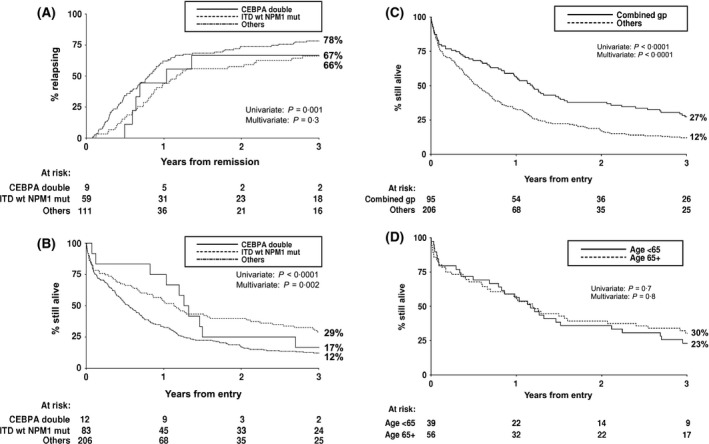
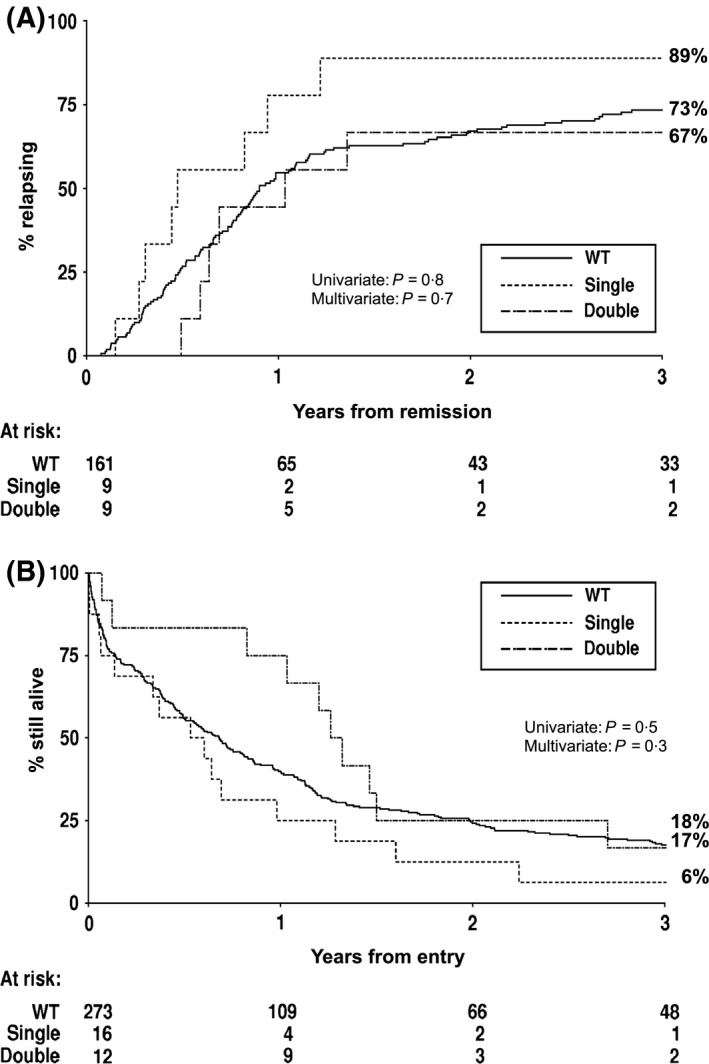
Older adult patients (≥60 years) with acute myeloid leukaemia (AML) are generally considered to be poor-risk and there is limited information available regarding risk stratification based on molecular characterization in this age group, particularly for the double-mutant CEBPA (CEBPA(DM) ) genotype. To investigate whether a molecular favourable-risk genotype can be identified, we investigated CEBPA, NPM1 and FLT3 status and prognostic impact in a cohort of 301 patients aged 60 years or more with intermediate-risk cytogenetics, all treated intensively. Overall survival (OS) at 1 year was highest in the 12 patients (4%) that were CEBPA(DM) compared to the 76 (28%) with a mutant NPM1 and wild-type FLT3 (NPM1(MUT) FLT3(WT) ) genotype or all other patients (75%, 54%, 33% respectively), with median survival 15·2, 13·6 and 6·6 months, although the benefit was short-term (OS at 3 years 17%, 29%, 12% respectively). Combination of the CEBPA(DM) and NPM1(MUT) FLT3(WT) genotype patients defined a molecular group with favourable prognosis (P < 0·0001 in multivariate analysis), with 57% of patients alive at 1 year compared to 33% for all other patients. Knowledge of genotype in older cytogenetically intermediate-risk patients might influence therapy decisions.
老年急性髓系白血病(AML)患者(≥60岁)通常被认为预后较差,关于该年龄组基于分子特征进行风险分层的信息有限,尤其是对于双突变CEBPA(CEBPA(DM))基因型。为了研究是否可以识别出分子预后良好的基因型,我们调查了301例60岁及以上具有中等风险细胞遗传学特征且均接受强化治疗的患者队列中的CEBPA、NPM1和FLT3状态及其预后影响。与76例(28%)具有NPM1突变且FLT3野生型(NPM1(MUT) FLT3(WT))基因型的患者或所有其他患者(分别为75%、54%、33%)相比,12例(4%)CEBPA(DM)患者的1年总生存期(OS)最高,中位生存期分别为15.2、13.6和6.6个月,尽管这种获益是短期的(3年OS分别为17%、29%、12%)。CEBPA(DM)和NPM1(MUT) FLT3(WT)基因型患者的组合定义了一个预后良好的分子组(多因素分析中P < 0.0001),1年时57%的患者存活,而所有其他患者为33%。了解细胞遗传学中等风险老年患者的基因型可能会影响治疗决策。