Nam Kyung Wook, Bae Yong Chan, Nam Soo Bong, Kim Joo Hyung, Kim Hoon Soo, Choi Young Jin
Department of Plastic and Reconstructive Surgery, Pusan National University School of Medicine, Busan, Korea.
Department of Plastic and Reconstructive Surgery, Pusan National University School of Medicine, Busan, Korea.; Biomedical Research Institute, Pusan National University Hospital, Busan, Korea.
Arch Plast Surg. 2016 Jan;43(1):59-65. doi: 10.5999/aps.2016.43.1.59. Epub 2016 Jan 15.
In East Asia, the foot is the most common site of cutaneous melanoma. The purpose of this study was to investigate the differences between cutaneous melanoma of the foot and melanomas of other sites.
We studied 52 patients who underwent surgical treatment for cutaneous melanoma of the foot from September 2000 to January 2015. Through a retrospective review of their medical records, we collected data relating to their sex, age, histopathological subtype, Clark level, tumor thickness, lymph node involvement, stage, and survival rate, and we compared these parameters to those of 61 patients treated for melanoma of other sites. Moreover, we analyzed the surgical procedures, complications, and mortality rates associated with cutaneous melanoma on various parts of the foot.
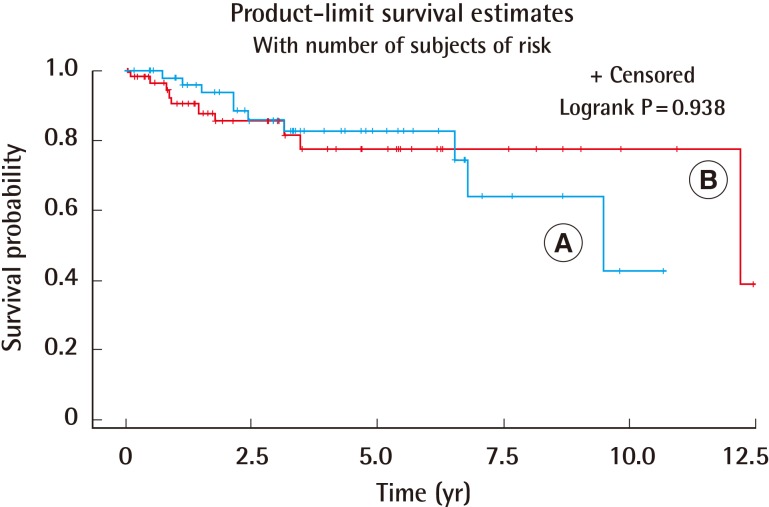
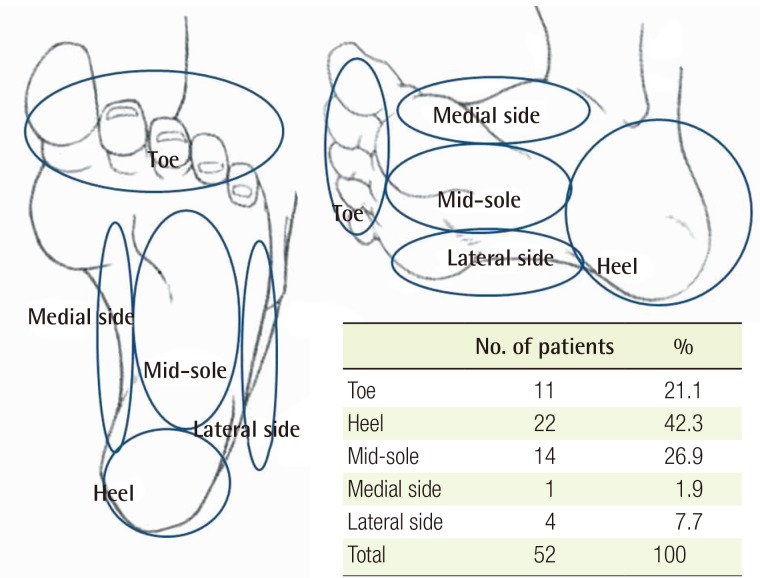
Melanoma of the foot differed from other melanomas only in the histopathological subtype. Other clinical features, including survival rate, did not differ significantly between the two groups heel was the most common site of melanoma of the foot (22 cases, 42.3%). The method of reconstruction varied depending on the region involved.
A comparison of melanoma of the foot to other melanomas showed that melanoma of the foot was associated with a significantly different distribution of histological subtypes. Consistent with previous findings, we found that the acral lentiginous subtype was the most common among melanomas of the foot. Furthermore, in contrast with previous studies, we did not find a worse prognosis or lower survival rate for melanoma of the foot in comparison with other melanomas.
在东亚地区,足部是皮肤黑色素瘤最常见的发病部位。本研究旨在探讨足部皮肤黑色素瘤与其他部位黑色素瘤之间的差异。
我们研究了2000年9月至2015年1月期间接受足部皮肤黑色素瘤手术治疗的52例患者。通过回顾性查阅他们的病历,我们收集了有关他们的性别、年龄、组织病理学亚型、克拉克分级、肿瘤厚度、淋巴结受累情况、分期和生存率的数据,并将这些参数与61例接受其他部位黑色素瘤治疗的患者的参数进行了比较。此外,我们分析了与足部不同部位皮肤黑色素瘤相关的手术程序、并发症和死亡率。
足部黑色素瘤与其他黑色素瘤的差异仅在于组织病理学亚型。两组之间的其他临床特征,包括生存率,没有显著差异。足跟是足部黑色素瘤最常见的发病部位(22例,42.3%)。重建方法因受累区域而异。
足部黑色素瘤与其他黑色素瘤的比较表明,足部黑色素瘤的组织学亚型分布存在显著差异。与先前的研究结果一致,我们发现肢端雀斑样痣亚型在足部黑色素瘤中最为常见。此外,与先前的研究相反,我们没有发现足部黑色素瘤与其他黑色素瘤相比预后更差或生存率更低。