Sakurai Takuma, Yoshiga Daigo, Ariyoshi Wataru, Okinaga Toshinori, Kiyomiya Hiroyasu, Furuta Junya, Yoshioka Izumi, Tominaga Kazuhiro, Nishihara Tatsuji
Division of Infections and Molecular Biology, Department of Health Promotion, Kyushu Dental University, 2-6-1 Manazuru, Kokurakita-ku, Kitakyushu, Fukuoka, 803-8580, Japan.
Division of Oral and Maxillofacial Surgery, Department of Science of Physical Functions, Kyushu Dental University, 2-6-1 Manazuru, Kokurakita-ku, Kitakyushu, Fukuoka, 803-8580, Japan.
BMC Res Notes. 2016 Feb 5;9:68. doi: 10.1186/s13104-016-1892-y.
The tumor cells were needed to rearrange the extracellular matrix (ECM) and reorganize their cytoskeleton to facilitate the cell motility during the tumor invasion. The proinflammatory cytokine interleukin-17A (IL-17A) is reported to up-regulate tumor invasiveness via ECM degradation by matrix metalloproteinases (MMPs). However the precise effects of IL-17A-dependent invasion remain to be characterized. The aim of this study was to elucidate the mechanisms underlying IL-17A-induced MMP-3 expression in the human synovial sarcoma cells HS-SY-II.
HS-SY-II cells were incubated with IL-17A. In some experiments, the cells were pre-incubated with an anti-IL-17 receptor polyclonal antibody (IL-17R Ab) or inhibitors for signaling cascade prior to addition of IL-17A. The expression of MMP-3 was determined by real-time reverse-transcription polymerase chain reaction (RT-PCR) and western blotting. IL-17R expression in HS-SY-II cells was assessed by immunofluorescence microscopy, while the phosphorylation of signaling molecules was measured by western blotting.
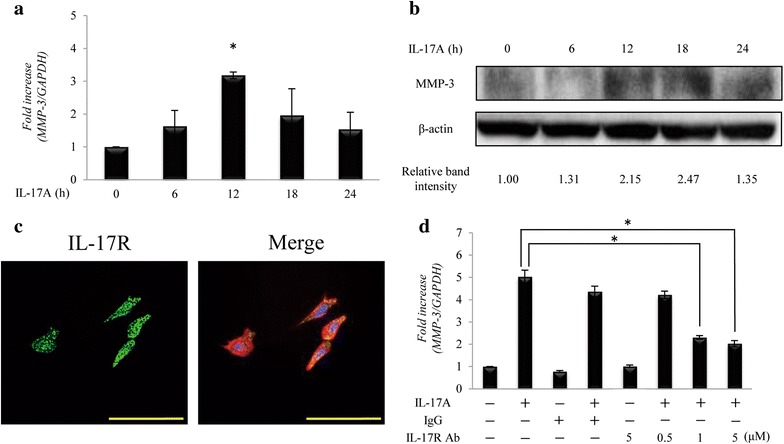
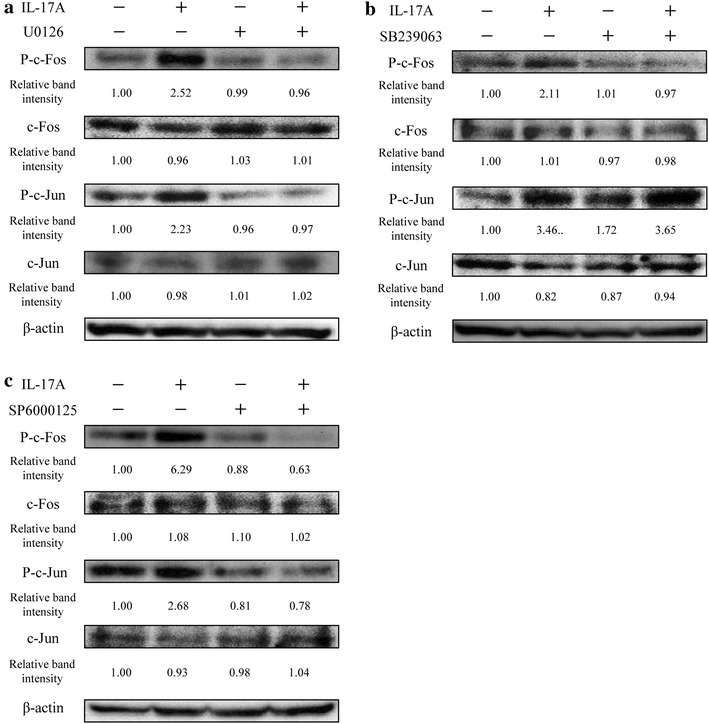
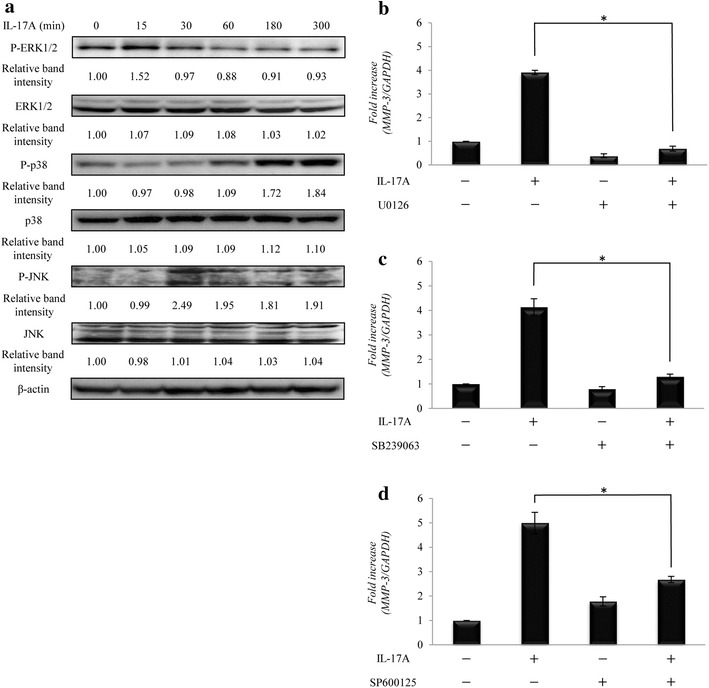
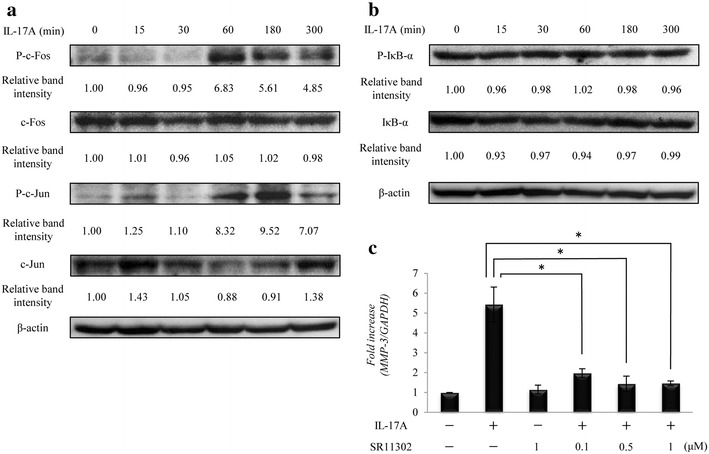
IL-17A increased MMP-3 mRNA and protein expression. HS-SY-II cells express the IL-17R on their surface and blockage of IL-17A-IL-17R binding by IL-17R Ab suppressed IL-17A-mediated induction of MMP-3. IL-17A induced the phosphorylation of three components of the mitogen-activated protein kinase (MAPK) pathway including extracellular signal-regulated kinase 1/2 (ERK1/2), p38 MAPK, and c-Jun NH2-terminal kinase (JNK). Pre-treatment of the cells with inhibitors of ERK1/2, p38 MAPK, and JNK attenuated the IL-17A-induced phosphorylation of activator protein-1 (AP-1) subunits and the expression of MMP-3 mRNA.
Our results indicate an essential role for MAPKs in the induction of MMP-3 in synovial sarcoma cells, through AP-1 activation.
肿瘤细胞需要重新排列细胞外基质(ECM)并重组其细胞骨架,以促进肿瘤侵袭过程中的细胞运动。据报道,促炎细胞因子白细胞介素-17A(IL-17A)通过基质金属蛋白酶(MMPs)降解ECM来上调肿瘤侵袭性。然而,IL-17A依赖性侵袭的确切作用仍有待阐明。本研究的目的是阐明IL-17A诱导人滑膜肉瘤细胞HS-SY-II中MMP-3表达的机制。
将HS-SY-II细胞与IL-17A孵育。在一些实验中,在添加IL-17A之前,将细胞与抗IL-17受体多克隆抗体(IL-17R Ab)或信号级联抑制剂预孵育。通过实时逆转录聚合酶链反应(RT-PCR)和蛋白质印迹法测定MMP-3的表达。通过免疫荧光显微镜评估HS-SY-II细胞中IL-17R的表达,同时通过蛋白质印迹法测量信号分子的磷酸化。
IL-17A增加了MMP-3 mRNA和蛋白质的表达。HS-SY-II细胞在其表面表达IL-17R,IL-17R Ab阻断IL-17A-IL-17R结合可抑制IL-17A介导的MMP-3诱导。IL-17A诱导了丝裂原活化蛋白激酶(MAPK)途径的三个组分的磷酸化,包括细胞外信号调节激酶1/2(ERK1/2)、p38 MAPK和c-Jun NH2末端激酶(JNK)。用ERK1/2、p38 MAPK和JNK抑制剂预处理细胞可减弱IL-17A诱导的活化蛋白-1(AP-1)亚基的磷酸化和MMP-3 mRNA的表达。
我们的结果表明,MAPKs通过激活AP-1在滑膜肉瘤细胞中诱导MMP-3的过程中起重要作用。