Gray Andrea, Marrero-Berrios Ileana, Weinberg Jonathan, Manchikalapati Devasena, SchianodiCola Joseph, Schloss Rene S, Yarmush Joel
Department of Biomedical Engineering, Rutgers, The State University of New Jersey, Piscataway, NJ, USA.
Department of Anesthesiology, New York Methodist Hospital, Brooklyn, NY, USA.
Int Immunopharmacol. 2016 Apr;33:48-54. doi: 10.1016/j.intimp.2016.01.019. Epub 2016 Feb 6.
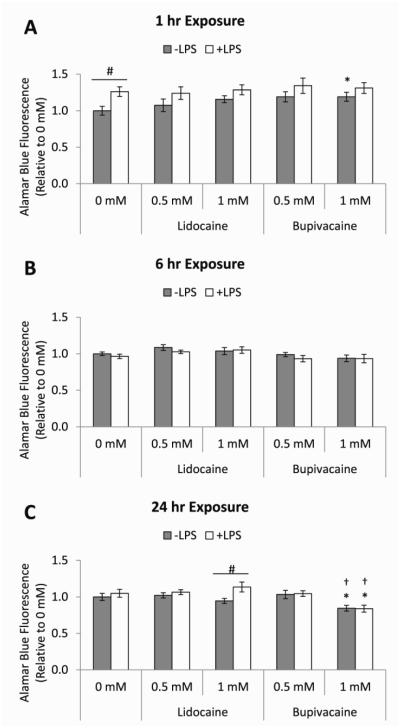
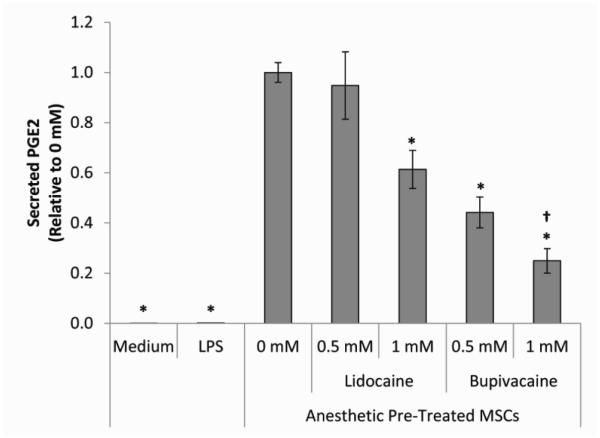
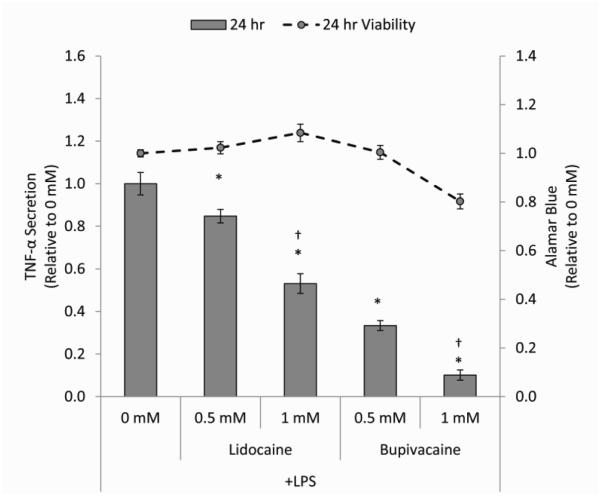
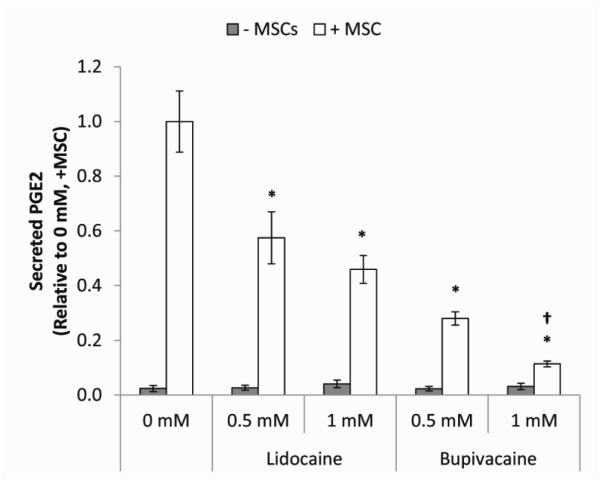
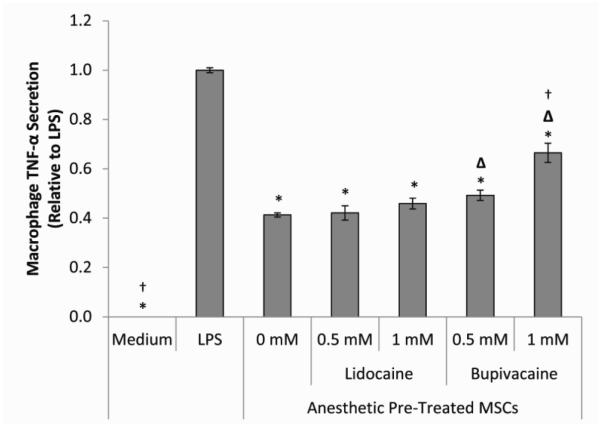
Administering local anesthetics (LAs) peri- and post-operatively aims to prevent or mitigate pain in surgical procedures and after tissue injury in cases of osteoarthritis (OA) and other degenerative diseases. Innovative tissue protective and reparative therapeutic interventions such as mesenchymal stromal cells (MSCs) are likely to be exposed to co-administered drugs such as LAs. Therefore, it is important to determine how this exposure affects the therapeutic functions of MSCs and other cells in their target microenvironment. In these studies, we measured the effect of LAs, lidocaine and bupivacaine, on macrophage viability and pro-inflammatory secretion. We also examined their effect on modulation of the macrophage pro-inflammatory phenotype in an in vitro co-culture system with MSCs, by quantifying macrophage tumor necrosis factor (TNF)-α secretion and MSC prostaglandin E2 (PGE2) production. Our studies indicate that both LAs directly attenuated macrophage TNF-α secretion, without significantly affecting viability, in a concentration- and potency-dependent manner. LA-mediated attenuation of macrophage TNF-α was sustained in co-culture with MSCs, but MSCs did not further enhance this anti-inflammatory effect. Concentration- and potency-dependent reductions in macrophage TNF-α were concurrent with decreased PGE2 levels in the co-cultures further indicating MSC-independent macrophage attenuation. MSC functional recovery from LA exposure was assessed by pre-treating MSCs with LAs prior to co-culture with macrophages. Both MSC attenuation of TNF-α and PGE2 secretion were impaired by pre-exposure to the more potent bupivacaine and high dose of lidocaine in a concentration-dependent manner. Therefore, LAs can affect anti-inflammatory function by both directly attenuating macrophage inflammation and MSC secretion and possibly by altering the local microenvironment which can secondarily reduce MSC function. Furthermore, the LA effect on MSC function may persist even after LA removal.
围手术期和术后使用局部麻醉药(LAs)旨在预防或减轻外科手术中的疼痛,以及骨关节炎(OA)和其他退行性疾病患者组织损伤后的疼痛。诸如间充质基质细胞(MSCs)等创新性的组织保护和修复性治疗干预措施,可能会与LAs等联合使用的药物接触。因此,确定这种接触如何影响MSCs和其他细胞在其靶微环境中的治疗功能非常重要。在这些研究中,我们测量了LAs、利多卡因和布比卡因对巨噬细胞活力和促炎分泌的影响。我们还通过定量巨噬细胞肿瘤坏死因子(TNF)-α分泌和MSCs前列腺素E2(PGE2)生成,研究了它们在与MSCs的体外共培养系统中对巨噬细胞促炎表型调节的影响。我们的研究表明,两种LAs均以浓度和效力依赖性方式直接减弱巨噬细胞TNF-α分泌,而对活力无显著影响。在与MSCs共培养时,LA介导的巨噬细胞TNF-α减弱持续存在,但MSCs并未进一步增强这种抗炎作用。巨噬细胞TNF-α的浓度和效力依赖性降低与共培养中PGE2水平降低同时发生,进一步表明巨噬细胞的减弱与MSCs无关。通过在与巨噬细胞共培养之前用LAs预处理MSCs来评估MSCs从LA暴露中的功能恢复。预先暴露于效力更强的布比卡因和高剂量利多卡因会以浓度依赖性方式损害MSCs对TNF-α和PGE2分泌的减弱作用。因此,LAs可通过直接减弱巨噬细胞炎症和MSCs分泌以及可能通过改变局部微环境(进而可降低MSCs功能)来影响抗炎功能。此外,即使在去除LA后,LA对MSCs功能的影响可能仍然存在。