Lu Ting-Xun, Miao Yi, Wu Jia-Zhu, Gong Qi-Xing, Liang Jin-Hua, Wang Zhen, Wang Li, Fan Lei, Hua Dong, Chen Yao-Yu, Xu Wei, Zhang Zhi-Hong, Li Jian-Yong
Department of Hematology, the First Affiliated Hospital of Nanjing Medical University, Jiangsu Province Hospital, Nanjing 210029, China.
Department of Oncology, the Affiliated Hospital of Jiangnan University, Wuxi 214062, Jiangsu Province, China.
Sci Rep. 2016 Feb 9;6:20465. doi: 10.1038/srep20465.
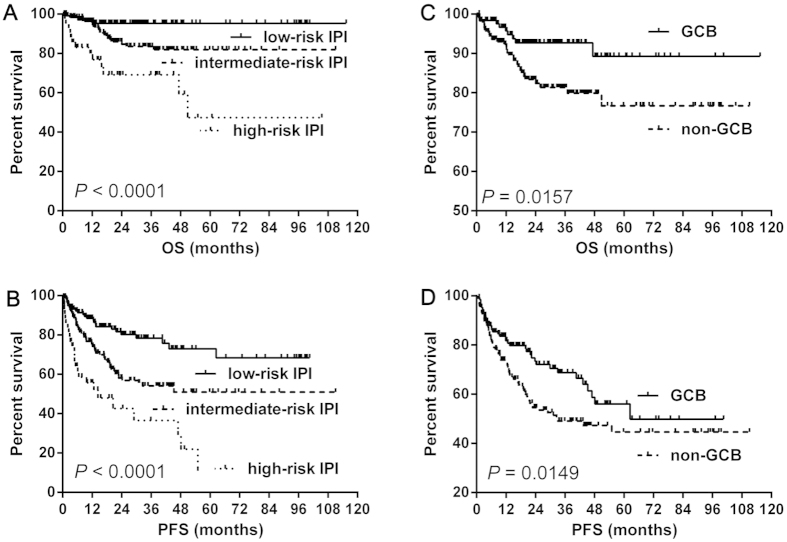
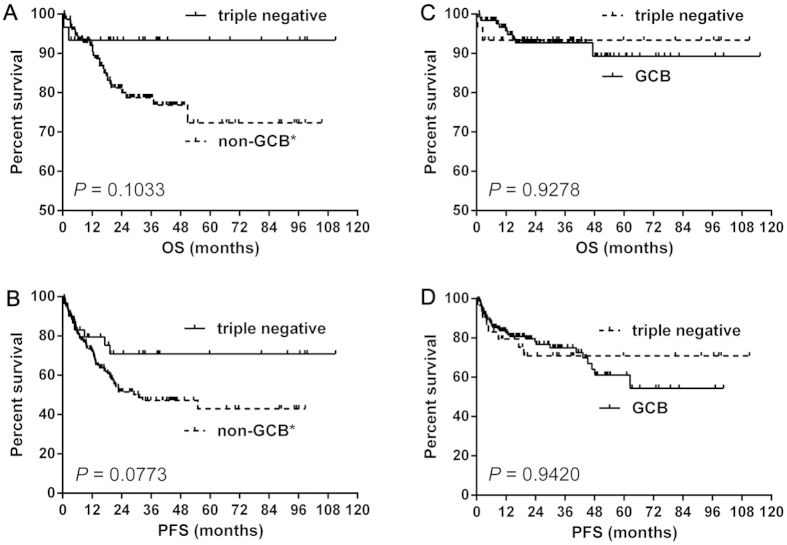
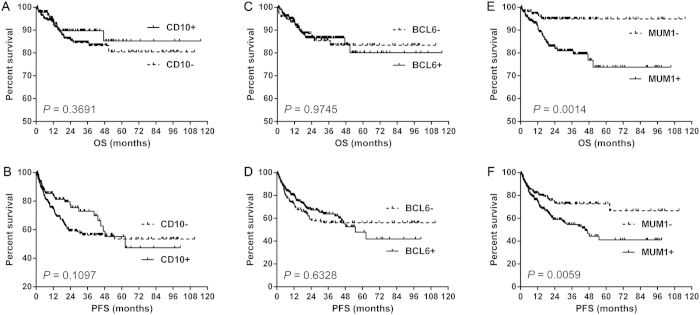
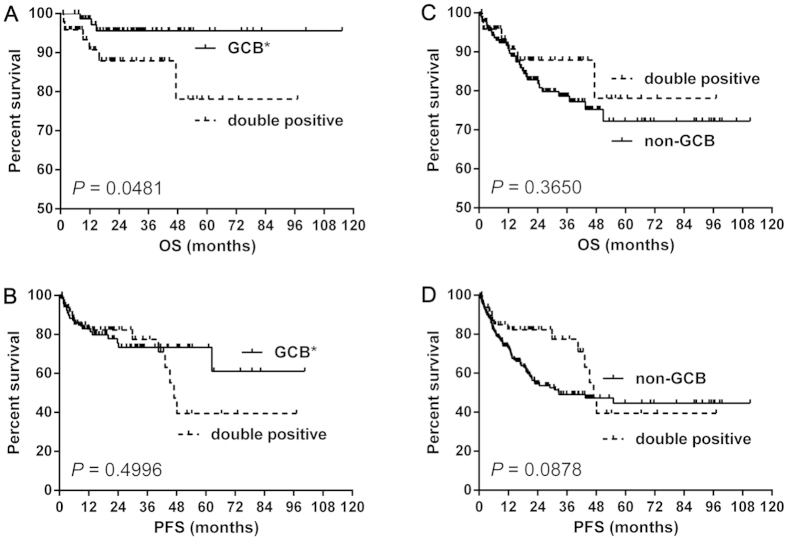
Using an immunohistochemistry (IHC) based method, diffuse large B-cell lymphoma (DLBCL) can be classified into germinal center B-cell (GCB) and non-GCB subtypes. However, the prognostic value of Hans algorithm was contradictory in the literature. Using IHC and fluorescence in situ hybridization, we analyzed the antibodies applied in Hans algorithm and other genetic factors in 601 DLBCL patients and prognostic value of Hans algorithm in 306 cases who were treated with chemoimmunotherapy. The results showed that patients with GCB subtype have better overall survival (OS) and progression-free survival (PFS) than non-GCB cases. However, to some extent, double positive (CD10(+)MUM1(+), DP) and triple negative (CD10(-)Bcl6(-)MUM(-), TN) showed different clinical characteristics and prognosis to others that were assigned to the same cell-of-origin group. The DP group showed similar OS (median OS: both not reached, P = 0.3650) and PFS (median PFS: 47.0 vs. 32.7 months, P = 0.0878) with the non-GCB group while the TN group showed similar OS (median OS: both not reached, P = 0.9278) and PFS (median PFS: both not reached, P = 0.9420) with the GCB group. In conclusion, Recognition of specific entities in Hans algorithm could help us to accurately predict outcome of the patients and choose the best clinical management for them.
采用基于免疫组织化学(IHC)的方法,弥漫性大B细胞淋巴瘤(DLBCL)可分为生发中心B细胞(GCB)和非GCB亚型。然而,汉斯算法的预后价值在文献中存在矛盾。我们运用免疫组织化学和荧光原位杂交技术,分析了601例DLBCL患者中应用于汉斯算法的抗体及其他遗传因素,以及306例接受化疗免疫治疗患者中汉斯算法的预后价值。结果显示,GCB亚型患者的总生存期(OS)和无进展生存期(PFS)优于非GCB患者。然而,在一定程度上,双阳性(CD10(+)MUM1(+),DP)和三阴性(CD10(-)Bcl6(-)MUM(-),TN)与分配到同一起源细胞组的其他患者表现出不同的临床特征和预后。DP组与非GCB组的OS(中位OS:均未达到,P = 0.3650)和PFS(中位PFS:47.0 vs. 32.7个月,P = 0.0878)相似,而TN组与GCB组的OS(中位OS:均未达到,P = 0.9278)和PFS(中位PFS:均未达到,P = 0.9420)相似。总之,识别汉斯算法中的特定实体有助于我们准确预测患者的预后,并为他们选择最佳的临床管理方案。