Martínková Jana, Klimešová Jitka
Department of Functional Ecology, Institute of Botany, Czech Academy of Sciences Třeboň, Czech Republic.
Front Plant Sci. 2016 Jan 26;7:2. doi: 10.3389/fpls.2016.00002. eCollection 2016.
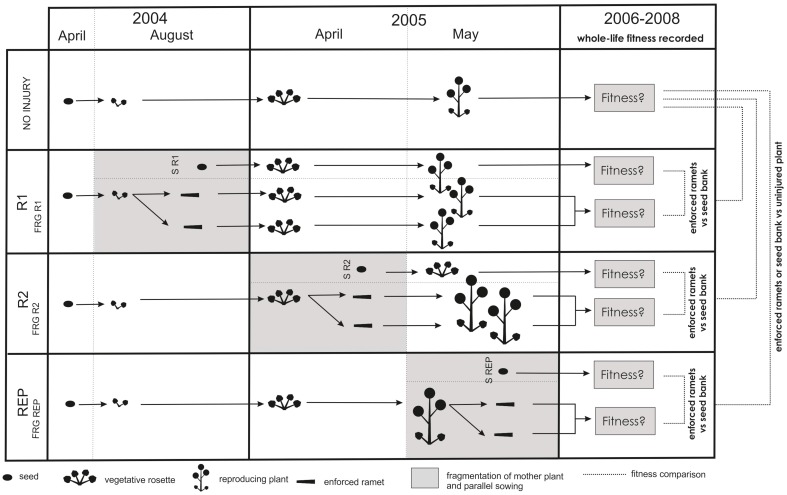
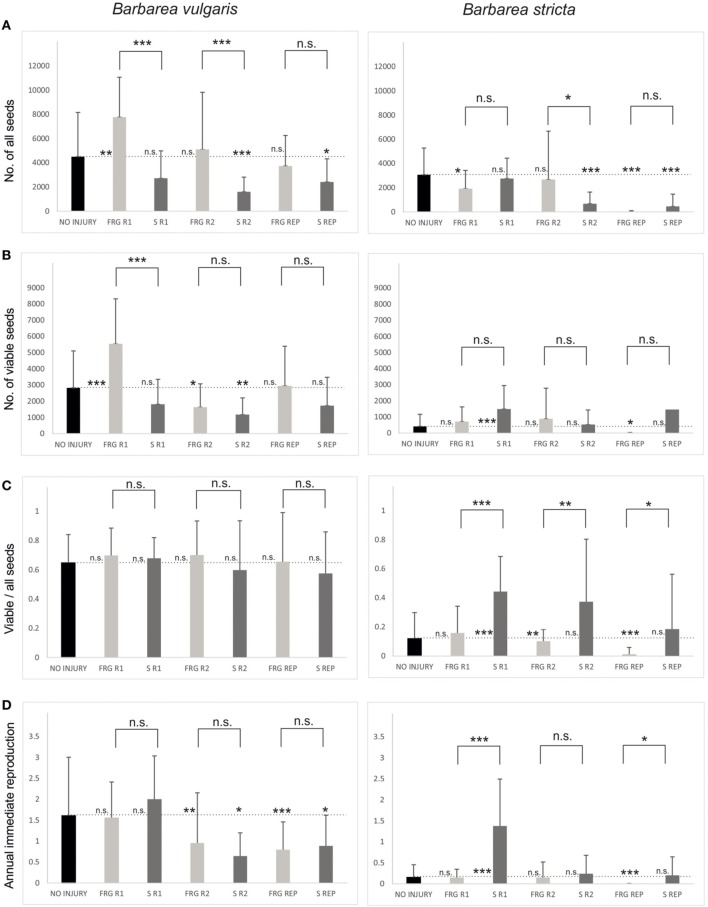
In largely clonal plants, splitting of a maternal plant into potentially independent plants (ramets) is usually spontaneous; however, such fragmentation also occurs in otherwise non-clonal species due to application of external force. This process might play an important yet largely overlooked role for otherwise non-clonal plants by providing a mechanism to regenerate after disturbance. Here, in a 5-year garden experiment on two short-lived, otherwise non-clonal species, Barbarea vulgaris and Barbarea stricta, we compared the fitness of plants fragmented by simulated disturbance ("enforced ramets") both with plants that contemporaneously originate in seed and with individuals unscathed by the disturbance event. Because the ability to regrow from fragments is related to plant age and stored reserves, we compared the effects of disturbance applied during three different ontogenetic stages of the plants. In B. vulgaris, enforced ramet fitness was higher than the measured fitness values of both uninjured plants and plants established from seed after the disturbance. This advantage decreased with increasing plant age at the time of fragmentation. In B. stricta, enforced ramet fitness was lower than or similar to fitness of uninjured plants and plants grown from seed. Our results likely reflect the habitat preferences of the study species, as B. vulgaris occurs in anthropogenic, disturbed habitats where body fragmentation is more probable and enforced clonality thus more advantageous than in the more natural habitats preferred by B. stricta. Generalizing from our results, we see that increased fitness yielded by enforced clonality would confer an evolutionary advantage in the face of disturbance, especially in habitats where a seed bank has not been formed, e.g., during invasion or colonization. Our results thus imply that enforced clonality should be taken into account when studying population dynamics and life strategies of otherwise non-clonal species in disturbed habitats.
在主要为克隆生长的植物中,母株分裂为潜在独立的植株(分株)通常是自发的;然而,由于外力作用,这种碎片化现象也会出现在非克隆物种中。这一过程可能通过提供一种在干扰后再生的机制,对非克隆植物起到重要但大多被忽视的作用。在此,我们在一个为期5年的花园实验中,对两种寿命较短的非克隆物种——普通山芥和窄叶山芥进行了研究,比较了经模拟干扰而碎片化的植株(“强制分株”)与同期由种子萌发的植株以及未受干扰影响的个体的适合度。由于从碎片再生的能力与植株年龄和储存的储备有关,我们比较了在植株三个不同个体发育阶段施加干扰的影响。在普通山芥中,强制分株的适合度高于干扰后未受伤植株和由种子长成植株的实测适合度值。这种优势随着碎片化时植株年龄的增加而降低。在窄叶山芥中,强制分株的适合度低于或类似于未受伤植株和由种子长成植株的适合度。我们的结果可能反映了研究物种的栖息地偏好,因为普通山芥生长在人为干扰的栖息地,在那里身体碎片化更有可能发生,因此强制克隆性比窄叶山芥更喜欢的更自然的栖息地更具优势。从我们的结果进行推广,我们发现强制克隆性带来的适合度增加在面对干扰时会赋予进化优势,特别是在尚未形成种子库的栖息地,例如在入侵或定殖期间。因此,我们的结果意味着在研究受干扰栖息地中非克隆物种的种群动态和生活策略时,应考虑强制克隆性。