Koga Kazumi, Maeda Jun, Tokunaga Masaki, Hanyu Masayuki, Kawamura Kazunori, Ohmichi Mari, Nakamura Toshio, Nagai Yuji, Seki Chie, Kimura Yasuyuki, Minamimoto Takafumi, Zhang Ming-Rong, Fukumura Toshimitsu, Suhara Tetsuya, Higuchi Makoto
Molecular Imaging Center, National Institute of Radiological Sciences, 4-9-1 Anagawa, Inage-ku, Chiba, Chiba, 263-8555, Japan.
Taisho Pharmaceutical Co., Ltd., 1-403 Yoshino-cho, Kita-ku, Saitama, 331-9530, Japan.
EJNMMI Res. 2016 Dec;6(1):11. doi: 10.1186/s13550-016-0170-2. Epub 2016 Feb 9.
Histamine H3 receptor (H3R) is a potential therapeutic target of sleep- and cognition-related disorders. The purpose of the present study is to develop a novel positron emission tomography (PET) ligand for H3Rs from dihydroquinolinone derivatives, which we previously found to have high affinity with these receptors.
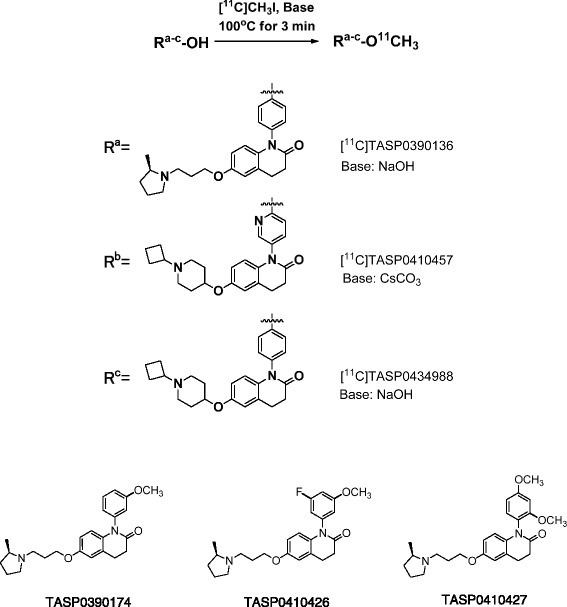
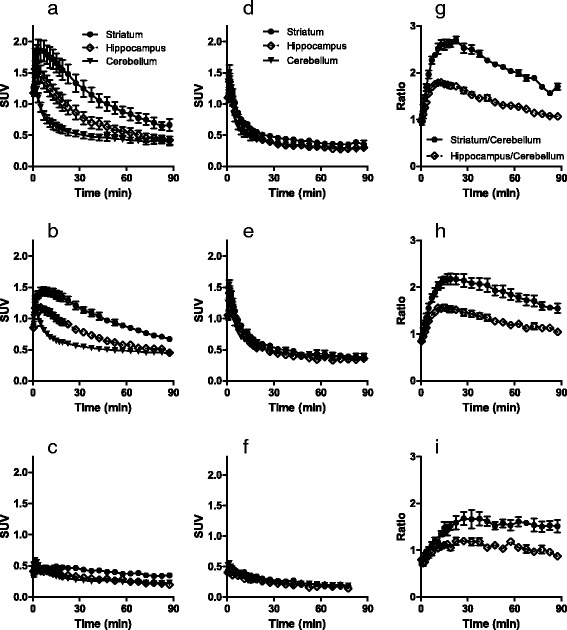
Six compounds were selected from a dihydroquinolinone compound library based on structural capability for (11)C labeling and binding affinity for H3Rs. Their in vivo kinetics in the rat brain were examined in a comparative manner by liquid chromatography and tandem mass spectrometry (LC-MS/MS). Chemicals with appropriate kinetic properties were then labeled with (11)C and evaluated in rats and monkeys using PET.
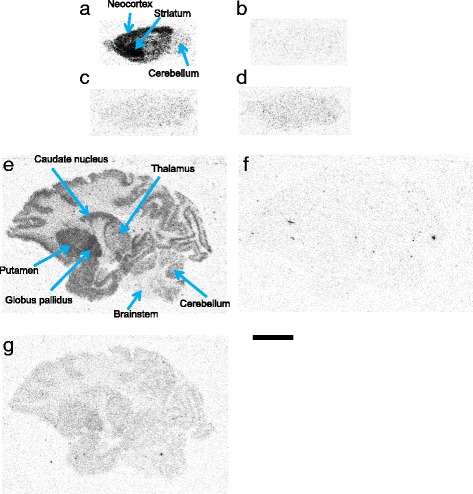
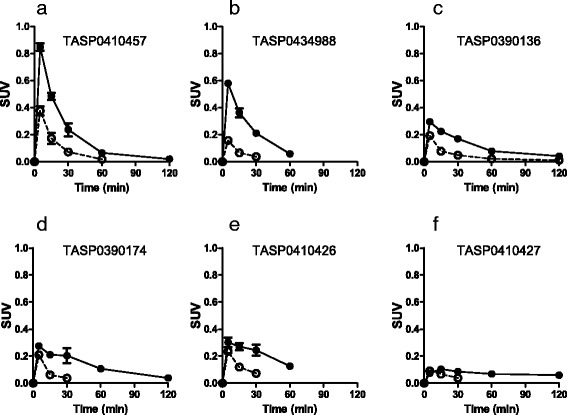
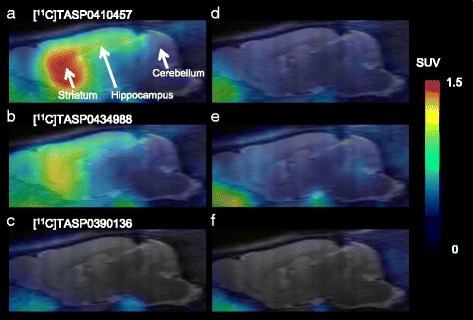
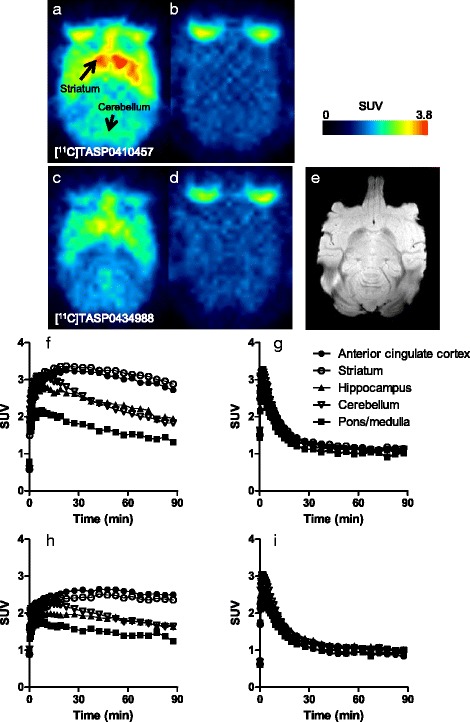
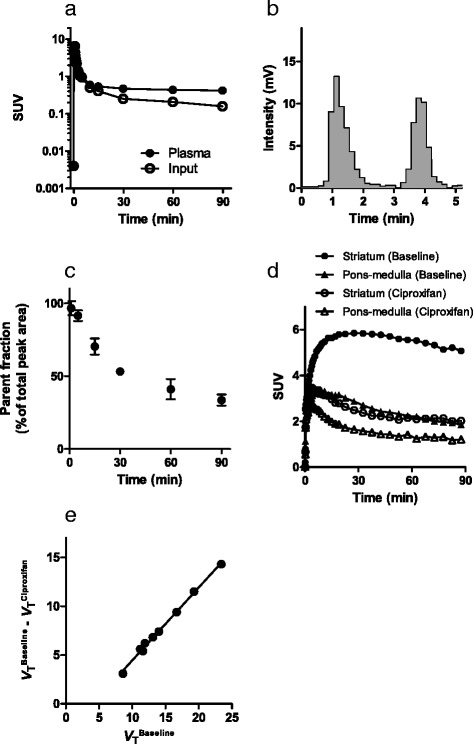
Of the six compounds, TASP0410457 (also diminutively called TASP457) and TASP0434988 exhibited fast kinetics and relatively high brain uptakes in ex vivo LC-MS/MS and were selected as candidate PET imaging agents. PET data in rat brains were mostly consistent with LC-MS/MS findings, and rat and monkey PET scans demonstrated that [(11)C]TASP0410457 was superior to [(11)C]TASP0434988 for high-contrast H3R PET imaging. In the monkey brain PET, distribution volume for [(11)C]TASP0410457 could be quantified, and receptor occupancy by a nonradioactive compound was measurable using this radioligand. The specific binding of [(11)C]TASP0410457 to H3Rs was confirmed by autoradiography using rat and monkey brain sections.
We developed [(11)C]TASP0410457 as a radioligand enabling a robust quantification of H3Rs in all brain regions and demonstrated the utility of ex vivo LC-MS/MS and in vivo PET assays for selecting appropriate imaging tracers. [(11)C]TASP0410457 will help to examine the implication of H3Rs in neuropsychiatric disorders and to characterize emerging therapeutic agents targeting H3Rs.
组胺H3受体(H3R)是睡眠和认知相关障碍的潜在治疗靶点。本研究的目的是从二氢喹啉酮衍生物开发一种新型的用于H3R的正电子发射断层扫描(PET)配体,我们之前发现这些衍生物与这些受体具有高亲和力。
基于(11)C标记的结构能力和对H3R的结合亲和力,从二氢喹啉酮化合物库中选择了六种化合物。通过液相色谱和串联质谱(LC-MS/MS)以比较的方式研究了它们在大鼠脑中的体内动力学。然后用(11)C标记具有适当动力学性质的化合物,并使用PET在大鼠和猴子中进行评估。
在这六种化合物中,TASP0410457(也简称为TASP457)和TASP0434988在体外LC-MS/MS中表现出快速动力学和相对较高的脑摄取,并被选为PET成像候选剂。大鼠脑内的PET数据大多与LC-MS/MS结果一致,大鼠和猴子的PET扫描表明,[(11)C]TASP0410457在高对比度H3R PET成像方面优于[(11)C]TASP�0434988。在猴子脑PET中,可以对[(11)C]TASP0410457的分布体积进行定量,并且使用这种放射性配体可以测量非放射性化合物的受体占有率。通过使用大鼠和猴子脑切片的放射自显影证实了[(11)C]TASP0410457与H3R的特异性结合。
我们开发了[(11)C]TASP0410457作为一种放射性配体,能够对所有脑区的H3R进行可靠定量,并证明了体外LC-MS/MS和体内PET测定在选择合适的成像示踪剂方面的实用性。[(11)C]TASP0410457将有助于研究H3R在神经精神疾病中的作用,并表征针对H3R的新型治疗药物。