Suchdev Parminder S, Addo O Yaw, Martorell Reynaldo, Grant Frederick Ke, Ruth Laird J, Patel Minal K, Juliao Patricia C, Quick Rob, Flores-Ayala Rafael
Nutrition Branch and Hubert Department of Global Health, Emory University, Atlanta, GA
Hubert Department of Global Health, Emory University, Atlanta, GA.
Am J Clin Nutr. 2016 Mar;103(3):934-41. doi: 10.3945/ajcn.115.118000. Epub 2016 Feb 10.
Although the use of micronutrient powders (MNPs) is considered the preferred approach for childhood anemia control, concerns about iron-related morbidity from clinical trials have challenged programmatic scale-up.
We aimed to measure the effects of community-based sales of MNPs on diarrhea-, fever-, cough-, and malaria-morbidity episodes in children 6-35 mo of age.
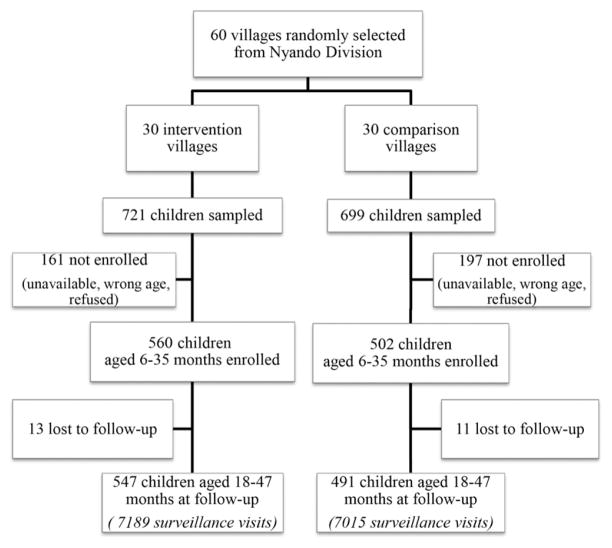
We conducted a cluster-randomized trial in rural Western Kenya where 60 villages were randomly assigned to either intervention or control groups. MNPs (containing iron, vitamin A, zinc, and 11 other micronutrients) and other health products (e.g., insecticide-treated bednets, soap, and water disinfectant) were marketed in 30 intervention villages from June 2007 to March 2008. Household visits every 2 wk were used to monitor self-reported MNP use and morbidity (illness episodes in the previous 24 h and hospitalizations in the previous 2 wk) in both groups. Iron, vitamin A, anemia, malaria, and anthropometric measures were assessed at baseline and at 12 mo of follow-up. Data were analyzed by intent-to-treat analyses.
Of 1062 children enrolled in the study, 1038 children (97.7%) were followed (a total of 14,204 surveillance visits). Mean MNP intake in intervention villages was 0.9 sachets/wk. Children in intervention villages, compared with children in control villages, had ~60% fewer hospitalizations for diarrhea (0.9% compared with 2.4%, respectively; P = 0.03) and 70% fewer hospitalizations for fever (1.8% compared with 5.3%, respectively; P = 0.003) but no significant differences in hospitalizations for respiratory illness (1.1% compared with 2.2%, respectively; P = 0.11) or malaria (3.1% compared with 2.9%, respectively; P = 0.82). There were no differences between groups in the numbers of episodes of diarrhea, cough, or fever.
MNP use in Western Kenya through market-based community sales was not associated with increased infectious morbidity in young children and was associated with decreased hospitalizations for diarrhea and fever. An integrated distribution of MNPs with other health interventions should be explored further in settings with a high child malnutrition and infection burden. This trial was registered at clinicaltrials.gov as NCT01088958.
尽管使用微量营养素粉(MNPs)被认为是控制儿童贫血的首选方法,但临床试验中对铁相关发病率的担忧对项目的扩大推广提出了挑战。
我们旨在衡量基于社区销售微量营养素粉对6至35月龄儿童腹泻、发热、咳嗽和疟疾发病次数的影响。
我们在肯尼亚西部农村地区进行了一项整群随机试验,将60个村庄随机分为干预组或对照组。2007年6月至2008年3月期间,在30个干预村庄销售微量营养素粉(含铁、维生素A、锌和其他11种微量营养素)及其他保健产品(如经杀虫剂处理的蚊帐、肥皂和水消毒剂)。每两周进行一次家庭访视,以监测两组中自我报告的微量营养素粉使用情况和发病率(过去24小时内的疾病发作和过去两周内的住院情况)。在基线和随访12个月时评估铁、维生素A、贫血、疟疾和人体测量指标。采用意向性分析方法对数据进行分析。
在纳入研究的1062名儿童中,有1038名儿童(97.7%)接受了随访(共进行了14204次监测访视)。干预村庄的微量营养素粉平均摄入量为0.9包/周。与对照村庄的儿童相比,干预村庄的儿童因腹泻住院的人数减少了约60%(分别为0.9%和2.4%;P = 0.03),因发热住院的人数减少了70%(分别为1.8%和5.3%;P = 0.003),但呼吸道疾病住院人数(分别为1.1%和2.2%;P = 0.11)或疟疾住院人数(分别为3.1%和2.9%;P = 0.82)无显著差异。两组在腹泻、咳嗽或发热发作次数上没有差异。
在肯尼亚西部通过基于市场的社区销售使用微量营养素粉与幼儿感染性发病率增加无关,且与腹泻和发热住院人数减少有关。在儿童营养不良和感染负担较高的地区,应进一步探索将微量营养素粉与其他健康干预措施整合分发的方式。该试验已在clinicaltrials.gov注册,注册号为NCT01088958。