Luo Qing, Huang Zikun, Ye Jianqing, Deng Yating, Fang Le, Li Xue, Guo Yang, Jiang Hong, Ju Beihua, Huang Qingshui, Li Junming
Department of Clinical Laboratory, First Affiliated Hospital of Nanchang University, Nanchang, Jiangxi, 330006, China.
Department of medical college, Nanchang University, Nanchang, Jiangxi, 330006, China.
Arthritis Res Ther. 2016 Feb 11;18:47. doi: 10.1186/s13075-016-0942-0.
It is well-known that increased frequency of neutrophils was found in patients with systemic lupus erythematosus (SLE). However, the immunomodulatory roles and mechanisms of neutrophils in SLE are poorly understood.
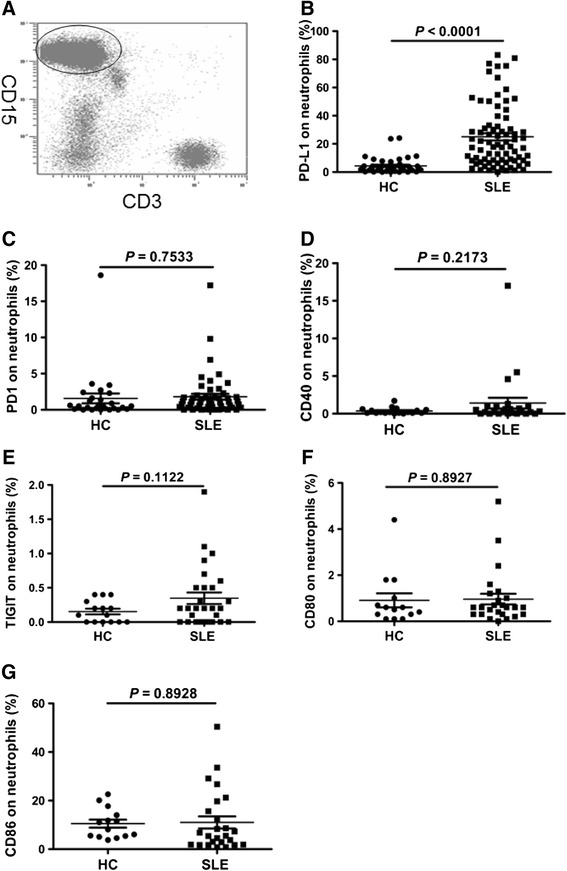
Patients with SLE were recruited from the First Affiliated Hospital of Nanchang University. The medical history, clinical manifestations, physical examination, laboratory measurements, therapeutic regimen and treatment response were recorded. The expression of costimulatory molecules including programmed death 1 (PD-1), programmed death ligand 1 (PD-L1), T-cell immunoglobulin and mucin domain-containing protein 3 (Tim-3), CD40, T cell immunoreceptor with Ig and immunoreceptor tyrosine-based inhibitory domains (TIGIT), CD80 and CD86 on neutrophils were determined by flow cytometry. The frequencies of PD-L1-expressing neutrophils in patients with SLE were further analyzed for their correlation with markers of autoimmune response, inflammation, disease activity and severity of SLE.
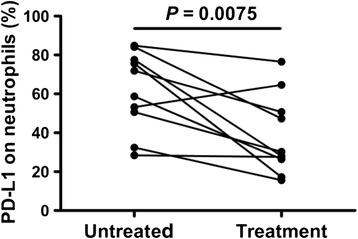
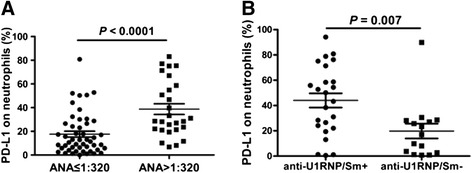
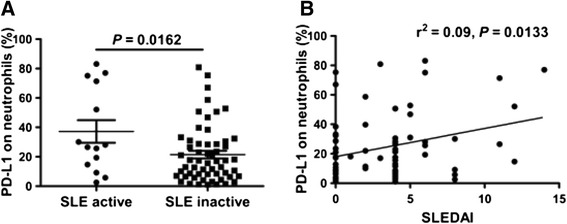
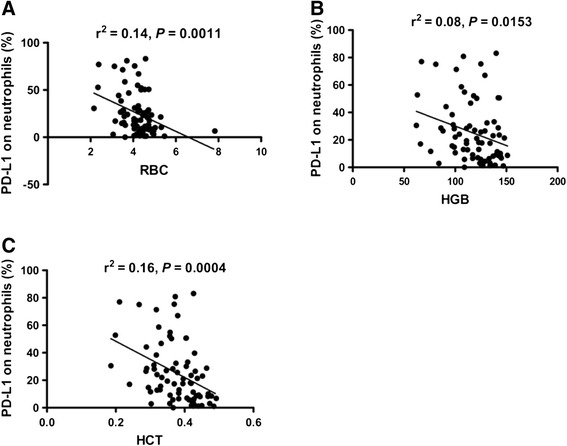
The frequency of PD-L1-expressing neutrophils was significantly elevated in SLE patients compared to the healthy controls (P < 0.0001). The frequency of PD-L1-expressing neutrophils in patients with SLE was increased significantly in subjects with high ANA titre, high anti-nRNP/Sm, high levels of inflammatory markers and high SLE Disease Activity Index (SLEDAI) score. Furthermore, the percentages of PD-L1-expressing neutrophils were significantly decreased in SLE patients that received a 15-day regular treatment with corticosteroids and immunosuppressive drugs (P = 0.0075).
The frequency of PD-L1-expressing neutrophils is elevates in patients with SLE, correlates with the disease activity and severity of SLE, and may serves as a negative feedback mechanism preventing potential tissue damage caused by excessive autoimmune responses in patients with SLE.
众所周知,系统性红斑狼疮(SLE)患者中性粒细胞频率增加。然而,中性粒细胞在SLE中的免疫调节作用和机制尚不清楚。
从南昌大学第一附属医院招募SLE患者。记录病史、临床表现、体格检查、实验室检查、治疗方案及治疗反应。采用流式细胞术检测中性粒细胞上共刺激分子程序性死亡蛋白1(PD-1)、程序性死亡配体1(PD-L1)、含T细胞免疫球蛋白和粘蛋白结构域蛋白3(Tim-3)、CD40、具有Ig和基于免疫受体酪氨酸抑制结构域的T细胞免疫受体(TIGIT)、CD80和CD86的表达。进一步分析SLE患者中表达PD-L1的中性粒细胞频率与自身免疫反应、炎症、疾病活动度及SLE严重程度标志物的相关性。
与健康对照相比,SLE患者中表达PD-L1的中性粒细胞频率显著升高(P<0.0001)。ANA滴度高、抗nRNP/Sm高、炎症标志物水平高及SLE疾病活动指数(SLEDAI)评分高的SLE患者中,表达PD-L1的中性粒细胞频率显著增加。此外,接受15天糖皮质激素和免疫抑制药物常规治疗的SLE患者中,表达PD-L1的中性粒细胞百分比显著降低(P=0.0075)。
SLE患者中表达PD-L1的中性粒细胞频率升高,与SLE的疾病活动度和严重程度相关,可能作为一种负反馈机制,防止SLE患者过度自身免疫反应导致潜在的组织损伤。