Garau Martina, Shah Koonal Kirit, Sharma Priya, Towse Adrian
Office of Health
Office of Health Economics.
Int J Technol Assess Health Care. 2015;31(6):449-56. doi: 10.1017/S0266462315000616. Epub 2016 Feb 12.
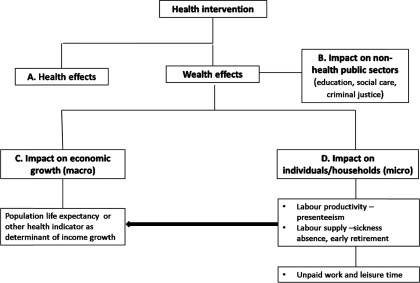
The aim of this study was to explore whether wealth effects of health interventions, including productivity gains and savings in other sectors, are considered in resource allocations by health technology assessment (HTA) agencies and government departments. To analyze reasons for including, or not including, wealth effects.
Semi-structured interviews with decision makers and academic experts in eight countries (Australia, France, Germany, Italy, Poland, South Korea, Sweden, and the United Kingdom).
There is evidence suggesting that health interventions can produce economic gains for patients and national economies. However, we found that the link between health and wealth does not influence decision making in any country with the exception of Sweden. This is due to a combination of factors, including system fragmentation, methodological issues, and the economic recession forcing national governments to focus on short-term measures.
In countries with established HTA processes and methods allowing, in principle, the inclusion of wider effects in exceptional cases or secondary analyses, it might be possible to overcome the methodological and practical barriers and see a more systematic consideration of wealth effect in decision making. This would be consistent with principles of efficient priority setting. Barriers for the consideration of wealth effects in government decision making are more fundamental, due to an enduring separation of budgets within the public sector and current financial pressures. However, governments should consider all relevant effects from public investments, including healthcare, even when benefits can only be captured in the medium- and long-term. This will ensure that resources are allocated where they bring the best returns.
本研究旨在探讨卫生技术评估(HTA)机构和政府部门在资源分配中是否考虑了健康干预措施的财富效应,包括生产力提高和其他部门的节约。分析纳入或不纳入财富效应的原因。
对八个国家(澳大利亚、法国、德国、意大利、波兰、韩国、瑞典和英国)的决策者和学术专家进行半结构化访谈。
有证据表明,健康干预措施可为患者和国民经济带来经济收益。然而,我们发现,除瑞典外,健康与财富之间的联系并未影响任何国家的决策。这是多种因素共同作用的结果,包括系统碎片化、方法学问题以及经济衰退迫使各国政府专注于短期措施。
在那些已建立HTA流程和方法、原则上允许在特殊情况或二次分析中纳入更广泛效应的国家,有可能克服方法学和实际障碍,在决策中更系统地考虑财富效应。这将符合有效确定优先事项的原则。由于公共部门预算的长期分离和当前的财政压力,政府决策中考虑财富效应的障碍更为根本。然而,政府应考虑公共投资(包括医疗保健)的所有相关效应,即使收益只能在中长期实现。这将确保资源分配到能带来最佳回报的地方。