Palacio Claudia, Fernández De Ortega Lourdes, Bustos Francisco R, Chávez Eduardo, Oregon-Miranda Aldo A, Mercado-Sesma Arieh R
Anterior Segment Department, Fundación Hospital Nuestra Señora de la Luz, México City, México.
Anterior Segment Department, Asociación Para Evitar la Ceguera en México, Hospital Dr Luis Sánchez Bulnes, México.
Clin Ophthalmol. 2016 Jan 27;10:233-7. doi: 10.2147/OPTH.S93530. eCollection 2016.
The purpose of this study was to evaluate the aqueous humor bioavailability and clinical efficacy of bromfenac 0.09% vs nepafenac on the presence of cystoid macular edema (CME) after phacoemulsification.
A Phase II, double-blind, masked, active-controlled, multicenter, clinical trial of 139 subjects, randomized to either a bromfenac 0.09% ophthalmic solution (n=69) or nepafenac 0.1% (n=70). Subjects instilled a drop three times a day for a period of 30 days. Follow-up visits were on days 2, 7, 15, 30, and 60. Biomicroscopy, clinical ocular signs, and assessment of posterior segment were performed. The primary efficacy endpoints included the presence of CME evaluated by optical coherence tomography. Safety evaluation included intraocular pressure, transaminase enzymes, lissamine green, and fluorescein stain.
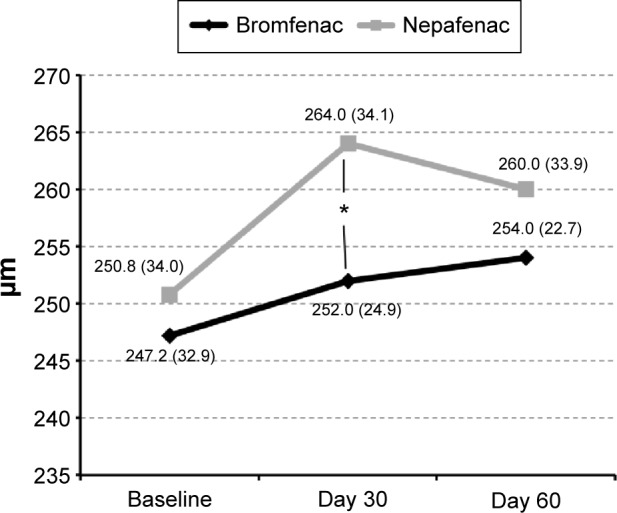
The demographic and efficacy variables were similar between groups at baseline. The presence of pain, photophobia, conjunctival hyperemia, chemosis, cellularity, and corneal edema disappeared by day 30 in both groups. The central retinal thickness did not show significant changes after treatment when compared to baseline as follows: in the bromfenac group (247.2±32.9 vs 252.0±24.9 μm; P=0.958) and in nepafenac group (250.8±34 vs 264.0±34.1 μm; P=0.137), respectively. A statistically significant difference was observed between bromfenac and nepafenac group: (252.0±24.9 vs 264.0±34.1 μm; P=0.022), at day 30, respectively; even though there was no clinical relevance in the presentation of CME. There were no significant alterations in intraocular pressure, either lissamine green or fluorescein stains. The adverse events were not related to the interventions.
Bromfenac 0.09% ophthalmic solution showed similar clinical efficacy to reduce the presentation of CME after phacoemulsification compared to nepafenac 0.01%.
本研究旨在评估0.09%溴芬酸与奈帕芬酸对白内障超声乳化术后囊样黄斑水肿(CME)的房水生物利用度及临床疗效。
一项II期、双盲、遮蔽、活性对照、多中心临床试验,139名受试者被随机分为0.09%溴芬酸眼用溶液组(n = 69)或0.1%奈帕芬酸组(n = 70)。受试者每天滴眼3次,持续30天。随访时间为第2、7、15、30和60天。进行生物显微镜检查、临床眼部体征检查及眼后段评估。主要疗效终点包括通过光学相干断层扫描评估CME的存在情况。安全性评估包括眼压、转氨酶、丽丝胺绿和荧光素染色。
两组在基线时人口统计学和疗效变量相似。两组在第30天时疼痛、畏光、结膜充血、球结膜水肿、细胞增多和角膜水肿均消失。与基线相比,治疗后视网膜中央厚度无显著变化,溴芬酸组分别为(247.2±32.9 vs 252.0±24.9μm;P = 0.958),奈帕芬酸组分别为(250.8±34 vs 264.0±34.1μm;P = 0.137)。在第30天时,溴芬酸组和奈帕芬酸组之间观察到统计学显著差异:分别为(252.0±24.9 vs 264.0±34.1μm;P = 0.022);尽管在CME表现方面无临床相关性。眼压、丽丝胺绿或荧光素染色均无显著变化。不良事件与干预措施无关。
与0.01%奈帕芬酸相比,0.09%溴芬酸眼用溶液在降低白内障超声乳化术后CME发生率方面显示出相似的临床疗效。