Smith Susan H, Peredo Carlos E, Takeda Yukimasa, Bui Thi, Neil Jessica, Rickard David, Millerman Elizabeth, Therrien Jean-Philippe, Nicodeme Edwige, Brusq Jean-Marie, Birault Veronique, Viviani Fabrice, Hofland Hans, Jetten Anton M, Cote-Sierra Javier
Discovery and Preclinical Development, Stiefel, a GSK company, Research Triangle Park, North Carolina, United States of America.
Immunity, Inflammation and Disease Laboratory, National Institute of Environmental Health Sciences, National Institutes of Health, Research Triangle Park, North Carolina, United States of America.
PLoS One. 2016 Feb 12;11(2):e0147979. doi: 10.1371/journal.pone.0147979. eCollection 2016.
Psoriasis is a chronic inflammatory skin disorder involving marked immunological changes. IL-17-targeting biologics have been successful in reducing the disease burden of psoriasis patients with moderate-to-severe disease. Unfortunately, the stratum corneum prevents penetration of large molecule weight proteins, including monoclonal antibodies. Thus, for the majority of psoriasis patients ineligible for systemic treatments, a small molecule targeting RORγt, the master regulator of IL-17 family cytokines, may represent an alternative topical medicine with biologic-like efficacy.
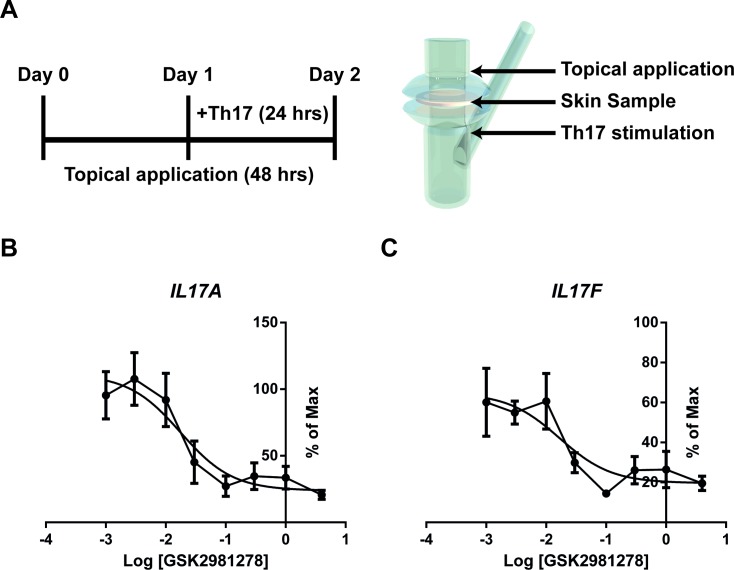
The preclinical studies described in this manuscript bridge the gap from bench to bedside to provide the scientific foundation for a compound entering clinical trials for patients with mild to moderate psoriasis. In addition to several ex vivo reporter assays, primary T cell cultures, and the imiquimod mouse model, we demonstrate efficacy in a newly developed human ex vivo skin assay, where Th17-skewed cytokine expression is induced from skin-resident immune cells. Importantly, the skin barrier remains intact allowing for the demonstration of topical drug delivery. With the development of this novel assay, we demonstrate potent compound activity in the target tissue: human skin. Finally, target engagement by this small molecule was confirmed in ex vivo lesional psoriatic skin.
Our work describes a progressive series of assays to demonstrate the potential clinical value of a novel RORγ inverse agonist small molecule with high potency and selectivity, which will enter clinical trials in late 2015 for psoriasis patients.
银屑病是一种慢性炎症性皮肤病,涉及显著的免疫变化。靶向白细胞介素-17(IL-17)的生物制剂已成功减轻了中重度银屑病患者的疾病负担。不幸的是,角质层会阻碍包括单克隆抗体在内的大分子蛋白质的渗透。因此,对于大多数不符合全身治疗条件的银屑病患者而言,一种靶向RORγt(IL-17家族细胞因子的主要调节因子)的小分子药物可能代表一种具有类似生物制剂疗效的替代外用药物。
本手稿中描述的临床前研究弥合了从实验室到临床的差距,为一种进入轻度至中度银屑病患者临床试验的化合物提供了科学依据。除了几种体外报告基因检测、原代T细胞培养和咪喹莫特小鼠模型外,我们还在一种新开发的人体体外皮肤检测中证明了其疗效,在该检测中,皮肤驻留免疫细胞可诱导产生Th17偏向性细胞因子表达。重要的是,皮肤屏障保持完整,从而能够证明局部给药的效果。随着这种新型检测方法的开发,我们在目标组织——人体皮肤中证明了该化合物的强效活性。最后,在体外银屑病皮损皮肤中证实了该小分子与靶点的结合。
我们的工作描述了一系列循序渐进的检测方法,以证明一种新型RORγ反向激动剂小分子具有高效力和选择性的潜在临床价值,该小分子将于2015年末进入银屑病患者的临床试验。