Maeno Koutaro Ould, Ould Ely Sidi, Nakamura Satoshi, Abdellaoui Khemais, Cissé Sory, Jaavar Mohamed El Hacen, Ould Mohamed Sid'Ahmed, Atheimine Mohamed, Ould Babah Mohamed Abdallahi
The Mauritanian Desert Locust Centre, Centre National de Lutte Antiacridienne (CNLA), BP 665, Nouakchott, Mauritania ; Hakubi Center for Advanced Research and Laboratory of Insect Ecology, Graduate School of Agriculture Kyoto University, Kyoto, 606-8502 Japan.
The Mauritanian Desert Locust Centre, Centre National de Lutte Antiacridienne (CNLA), BP 665, Nouakchott, Mauritania.
Springerplus. 2016 Feb 1;5:107. doi: 10.1186/s40064-016-1741-4. eCollection 2016.
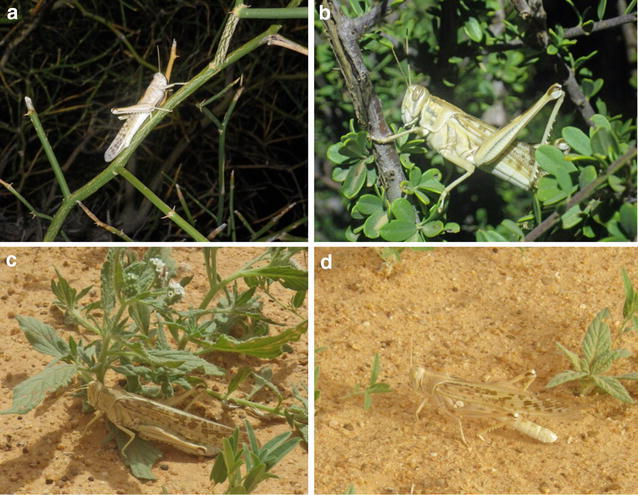
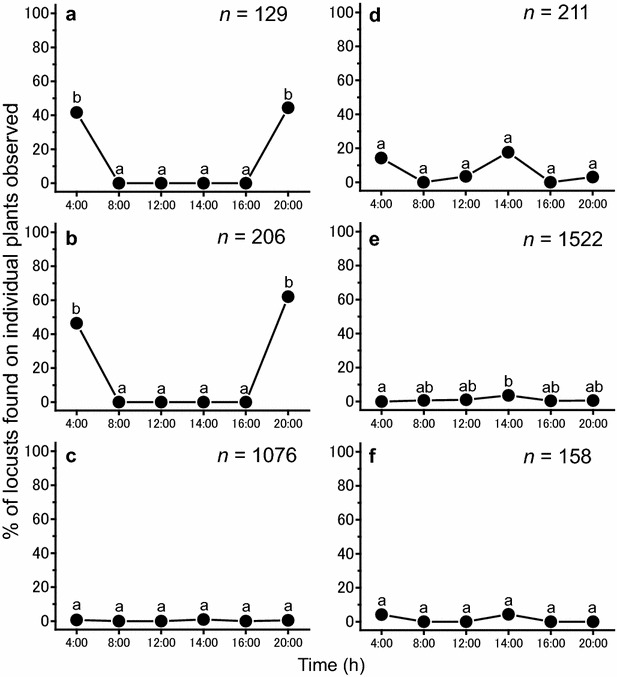
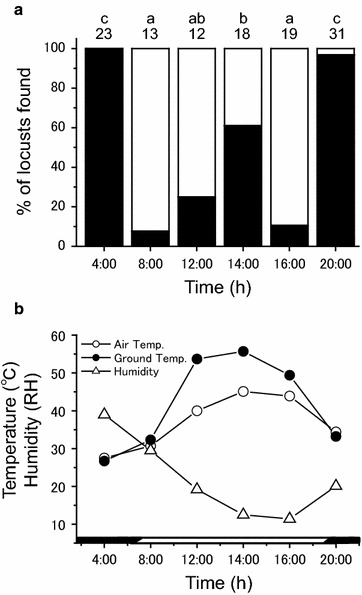
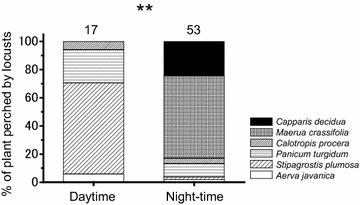
The Desert locust Schistocerca gregaria is a major world pest that causes substantial agricultural and economic damage. Effective pest control relies on effective monitoring, which requires knowledge of locust microhabitat selection. Yet little is known about microhabitat selection of solitarious adult locusts in the field. We conducted field surveys to investigate fine-scale diel temporal and spatial distributions of solitarious adults in the Sahara Desert in Mauritania, a major breeding and recession area. We found that solitarious adults moved among different, specific microhabitats throughout the 24-h period in a cyclical manner. At night, they roosted in trees, moved to the ground to feed shortly after dawn, sheltered in low vegetation during the hot midday, and returned to the ground in the late afternoon. Hence, they switched microhabitats and plant species throughout each day. These cyclical daily movements among diverse microhabitats and specific plant species were correlated with time of day, light intensity, temperature, humidity, and specific plant species, and may relate to anti-predator defence, thermoregulation, and feeding. The present study suggests that locust monitoring should be adjusted, based on time of day, locust age, phase state and relative abundance of specific plant species. For example, we recommend surveying ground after morning and trees at night, for solitarious adults, when at low density.
沙漠蝗虫(Schistocerca gregaria)是一种世界主要害虫,会造成重大的农业和经济损失。有效的害虫防治依赖于有效的监测,而这需要了解蝗虫的微生境选择情况。然而,对于独居成年蝗虫在野外的微生境选择却知之甚少。我们在毛里塔尼亚的撒哈拉沙漠(一个主要的繁殖和衰退区域)进行了实地调查,以研究独居成年蝗虫在精细尺度上的昼夜时间和空间分布。我们发现,独居成年蝗虫在24小时内以周期性方式在不同的特定微生境之间移动。夜间,它们栖息在树上;黎明后不久移到地面觅食;炎热的中午躲在低矮植被中;傍晚时分回到地面。因此,它们每天都会切换微生境和植物种类。这些在不同微生境和特定植物种类之间的周期性日常移动与一天中的时间、光照强度、温度、湿度以及特定植物种类有关,可能与反捕食防御、体温调节和觅食有关。本研究表明,蝗虫监测应根据一天中的时间、蝗虫年龄、阶段状态以及特定植物种类的相对丰度进行调整。例如,对于低密度的独居成年蝗虫,我们建议在早晨后调查地面,晚上调查树木