Zhang Zhiyong, Chao Maoni, Wang Sufang, Bu Jingjing, Tang Juxiang, Li Fei, Wang Qinglian, Zhang Baohong
Henan Collaborative Innovation Center of Modern Biological Breeding, School of Life Science and Technology, Henan Institute of Science and Technology, Xinxiang, 453003, China.
Department of Biology, East Carolina University, Greenville, NC 27858, US.
Sci Rep. 2016 Feb 16;6:21060. doi: 10.1038/srep21060.
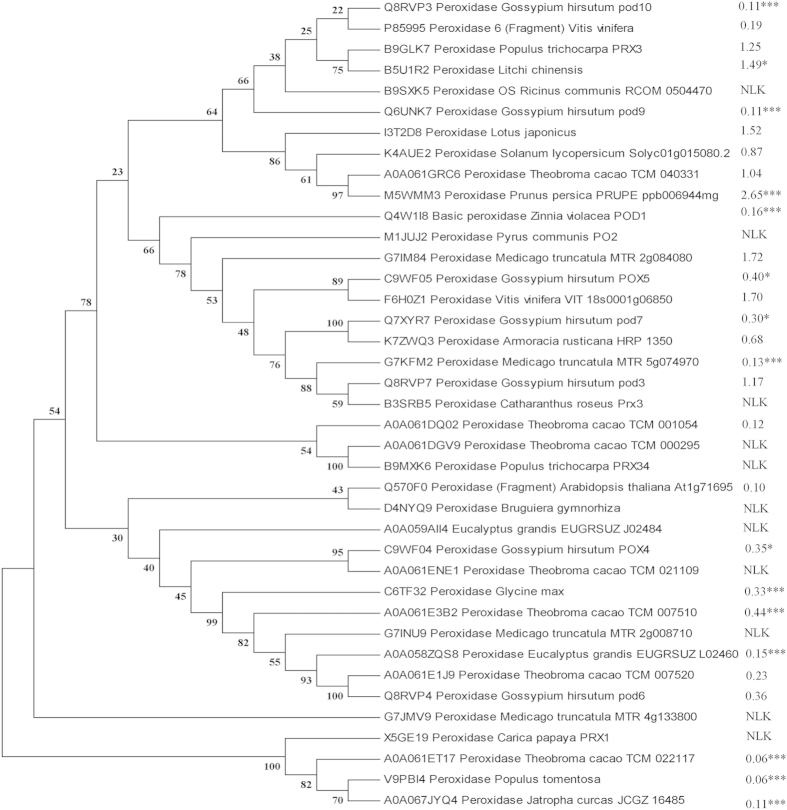
Proteomics was employed to investigate the molecular mechanisms of apoplastic response to potassium(K)-deficiency in cotton. Low K (LK) treatment significantly decreased the K and protein contents of xylem sap. Totally, 258 peptides were qualitatively identified in the xylem sap of cotton seedlings, of which, 90.31% were secreted proteins. Compared to the normal K (NK), LK significantly decreased the expression of most environmental-stress-related proteins and resulted in a lack of protein isoforms in the characterized proteins. For example, the contents of 21 Class Ш peroxidase isoforms under the LK were 6 to 44% of those under the NK and 11 its isoforms were lacking under the LK treatment; the contents of 3 chitinase isoforms under LK were 11-27% of those under the NK and 2 its isoforms were absent under LK. In addition, stress signaling and recognizing proteins were significantly down-regulated or disappeared under the LK. In contrast, the LK resulted in at least 2-fold increases of only one peroxidase, one protease inhibitor, one non-specific lipid-transfer protein and histone H4 and in the appearance of H2A. Therefore, K deficiency decreased plant tolerance to environmental stresses, probably due to the significant and pronounced decrease or disappearance of a myriad of stress-related proteins.
蛋白质组学被用于研究棉花对钾(K)缺乏的质外体反应的分子机制。低钾(LK)处理显著降低了木质部汁液中的钾和蛋白质含量。总共在棉花幼苗的木质部汁液中定性鉴定出258种肽,其中90.31%是分泌蛋白。与正常钾(NK)相比,LK显著降低了大多数环境胁迫相关蛋白的表达,并导致所鉴定蛋白中缺乏蛋白质异构体。例如,LK处理下21种Ⅲ类过氧化物酶异构体的含量是NK处理下的6%至44%,且LK处理下有11种异构体缺失;LK处理下3种几丁质酶异构体的含量是NK处理下的11%至27%,且LK处理下有2种异构体缺失。此外,胁迫信号传导和识别蛋白在LK处理下显著下调或消失。相反,LK处理仅导致一种过氧化物酶、一种蛋白酶抑制剂、一种非特异性脂质转移蛋白和组蛋白H4至少增加2倍,并出现了H2A。因此,钾缺乏降低了植物对环境胁迫的耐受性,这可能是由于大量胁迫相关蛋白显著减少或消失所致。