
AMPK与PKA在葡萄糖饥饿诱导的肝癌细胞生存调控中的相互作用
AMPK and PKA interaction in the regulation of survival of liver cancer cells subjected to glucose starvation.
作者信息
Ferretti Anabela C, Tonucci Facundo M, Hidalgo Florencia, Almada Evangelina, Larocca Maria C, Favre Cristián
机构信息
Institute of Experimental Physiology, CONICET, School of Biochemical Sciences, University of Rosario, Rosario, Argentina.
出版信息
Oncotarget. 2016 Apr 5;7(14):17815-28. doi: 10.18632/oncotarget.7404.
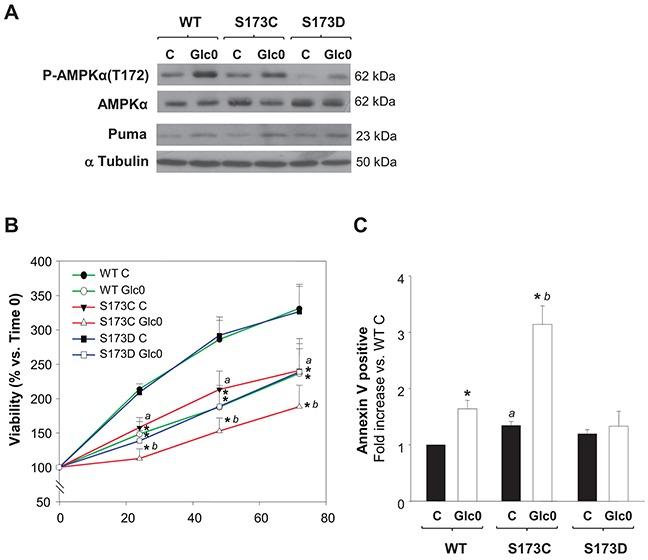
The signaling pathways that govern survival response in hepatic cancer cells subjected to nutritional restriction have not been clarified yet. In this study we showed that liver cancer cells undergoing glucose deprivation both arrested in G0/G1 and died mainly by apoptosis. Treatment with the AMPK activator AICAR phenocopied the effect of glucose deprivation on cell survival, whereas AMPK silencing in HepG2/C3A, HuH-7 or SK-Hep-1 cells blocked the cell cycle arrest and the increase in apoptotic death induced by glucose starvation. Both AMPK and PKA were promptly activated after glucose withdrawal. PKA signaling had a dual role during glucose starvation: whereas it elicited an early decreased in cell viability, it later improved this parameter. We detected AMPK phosphorylation (AMPKα(Ser173)) by PKA, which was increased in glucose starved cells and was associated with diminution of AMPK activation. To better explore this inhibitory effect, we constructed a hepatocarcinoma derived cell line which stably expressed an AMPK mutant lacking that PKA phosphorylation site: AMPKα1(S173C). Expression of this mutant significantly decreased viability in cells undergoing glucose starvation. Furthermore, after 36 h of glucose deprivation, the index of AMPKα1(S173C) apoptotic cells doubled the apoptotic index observed in control cells. Two main remarks arise: 1. AMPK is the central signaling kinase in the scenario of cell cycle arrest and death induced by glucose starvation in hepatic cancer cells; 2. PKA phosphorylation of Ser173 comes out as a strong control point that limits the antitumor effects of AMPK in this situation.
在遭受营养限制的肝癌细胞中,调控生存反应的信号通路尚未明确。在本研究中,我们发现经历葡萄糖剥夺的肝癌细胞停滞于G0/G1期,并且主要通过凋亡死亡。用AMPK激活剂AICAR处理可模拟葡萄糖剥夺对细胞存活的影响,而在HepG2/C3A、HuH-7或SK-Hep-1细胞中沉默AMPK则可阻断细胞周期停滞以及由葡萄糖饥饿诱导的凋亡死亡增加。葡萄糖撤除后,AMPK和PKA均迅速被激活。PKA信号在葡萄糖饥饿期间具有双重作用:虽然它在早期导致细胞活力下降,但随后又改善了这一参数。我们检测到PKA介导的AMPK磷酸化(AMPKα(Ser173)),其在葡萄糖饥饿细胞中增加,并且与AMPK激活的减弱相关。为了更好地探究这种抑制作用,我们构建了一个稳定表达缺乏该PKA磷酸化位点的AMPK突变体的肝癌衍生细胞系:AMPKα1(S173C)。该突变体的表达显著降低了经历葡萄糖饥饿的细胞的活力。此外,在葡萄糖剥夺36小时后,AMPKα1(S173C)凋亡细胞指数是对照细胞中观察到的凋亡指数的两倍。由此得出两点主要结论:1. 在肝癌细胞中,AMPK是由葡萄糖饥饿诱导的细胞周期停滞和死亡过程中的核心信号激酶;2. Ser173的PKA磷酸化成为在这种情况下限制AMPK抗肿瘤作用的一个强有力的控制点。


 Zotero 插件