Maeng Chi Hoon, Ahn Sung Woo, Ryu Seong-Yoon, Han Sungjun, Ko Young Hyeh, Ji Jun Ho, Kim Won Seog, Kim Seok Jin
Division of Hematology and Oncology, Department of Internal Medicine, Kyung Hee University Medical Center, Seoul, Korea.
Division of Hematology and Oncology, Department of Medicine, Samsung Medical Center, Sungkyunkwan University School of Medicine, Seoul, Korea.
Korean J Intern Med. 2016 May;31(3):560-9. doi: 10.3904/kjim.2014.222. Epub 2016 Feb 22.
BACKGROUND/AIMS: The Follicular Lymphoma International Prognostic Index (FLIPI) and FLIPI2 are well-known prognostic models for patients with follicular lymphoma (FL). However, their prognostic relevance has not been examined before in Korean patients with FL.
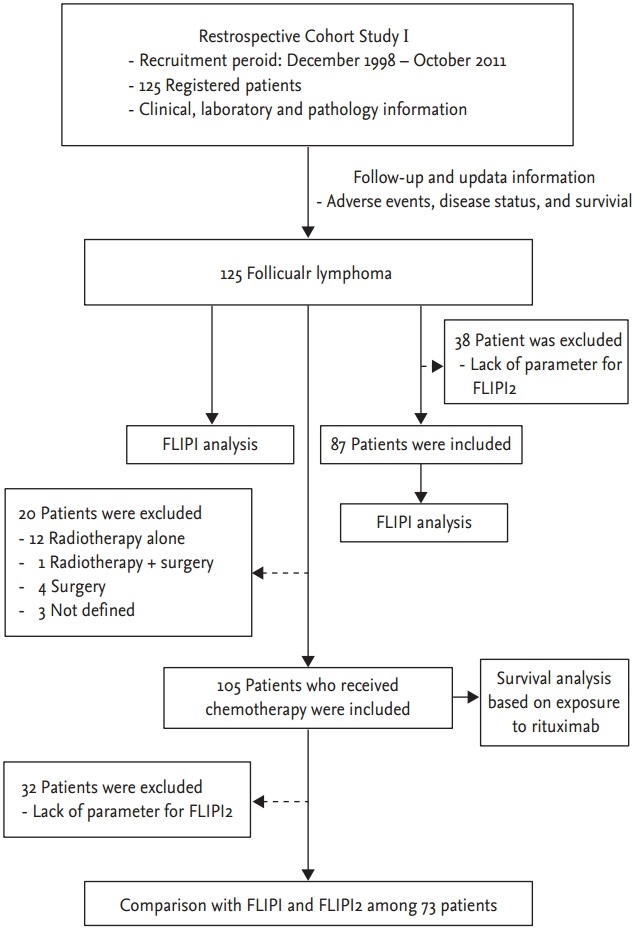
We reviewed clinical and laboratory information from our database of patients between 1995 and 2012. In total, 125 patients were stratified in three categories according to FLIPI or FLIPI2 scores: low-, intermediate-, and high-risk groups. We compared FLIPI and FLIPI2 in terms of progression-free survival (PFS) and overall survival (OS).
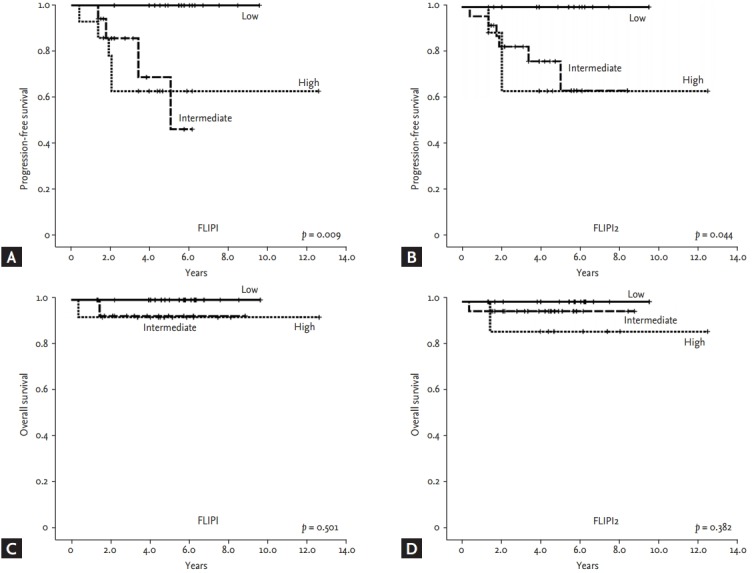
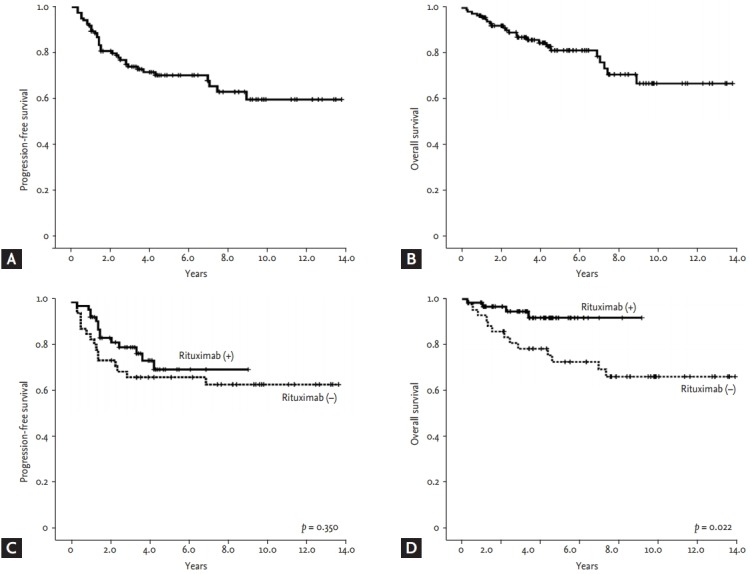
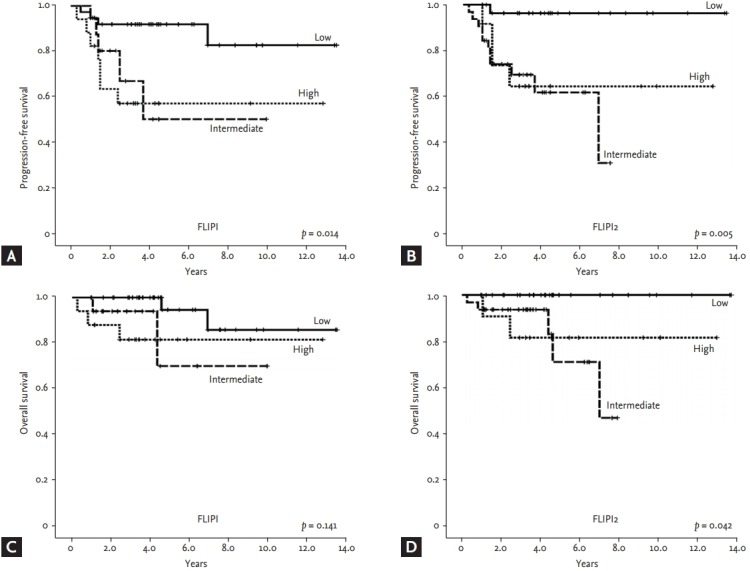
Among the 125 patients, the prognostic value of FLIPI and FLIPI2 was evaluated in 73 patients who fulfilled the criteria of both prognostic models. Risk stratification by FLIPI and FLIPI2 showed significant differences in unfavorable parameters among each risk group, particularly between low- and intermediate-risk groups. The high-risk group b was significantly associated with poor PFS on both FLIPI and FLIPI2 (p < 0.05). However, the OS was significantly different only in the risk groups determined by FLIPI2 (p = 0.042). In a subgroup analysis of patients who received rituximab-containing chemotherapy, the risk stratification of both prognostic models showed a significant impact on PFS, especially in the low-risk group.
FLIPI and FLIPI2 are appropriate prognostic models in Korean FL patients, especially for discriminating low-risk patients from intermediate- and high-risk groups.
背景/目的:滤泡性淋巴瘤国际预后指数(FLIPI)和FLIPI2是滤泡性淋巴瘤(FL)患者中广为人知的预后模型。然而,此前尚未在韩国FL患者中检验它们的预后相关性。
我们回顾了1995年至2012年间患者数据库中的临床和实验室信息。总共125例患者根据FLIPI或FLIPI2评分分为三类:低风险、中风险和高风险组。我们比较了FLIPI和FLIPI2在无进展生存期(PFS)和总生存期(OS)方面的情况。
在这125例患者中,对符合两种预后模型标准的73例患者评估了FLIPI和FLIPI2的预后价值。FLIPI和FLIPI2的风险分层显示各风险组之间在不良参数上存在显著差异,尤其是低风险组和中风险组之间。高风险组b在FLIPI和FLIPI2上均与较差的PFS显著相关(p < 0.05)。然而,仅在由FLIPI2确定的风险组中OS存在显著差异(p = 0.042)。在接受含利妥昔单抗化疗患者的亚组分析中,两种预后模型的风险分层对PFS均有显著影响,尤其是在低风险组。
FLIPI和FLIPI2是韩国FL患者合适的预后模型,特别是用于区分低风险患者与中、高风险组。