Paillusson Sebastien, Stoica Radu, Gomez-Suaga Patricia, Lau Dawn H W, Mueller Sarah, Miller Tanya, Miller Christopher C J
Department of Basic and Clinical Neuroscience, Institute of Psychiatry, Psychology and Neuroscience, King's College London, London, SE5 9NU, UK.
Churchill Hospital, Old Road, Headington, Oxford, OX3 7LE, UK.
Trends Neurosci. 2016 Mar;39(3):146-157. doi: 10.1016/j.tins.2016.01.008. Epub 2016 Feb 15.
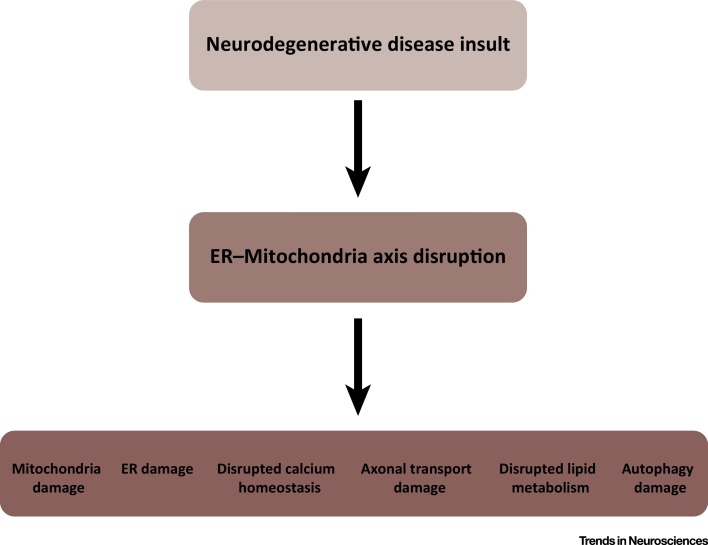
Alzheimer's disease (AD), Parkinson's disease (PD), and amyotrophic lateral sclerosis with associated frontotemporal dementia (ALS/FTD) are major neurodegenerative diseases for which there are no cures. All are characterised by damage to several seemingly disparate cellular processes. The broad nature of this damage makes understanding pathogenic mechanisms and devising new treatments difficult. Can the different damaged functions be linked together in a common disease pathway and which damaged function should be targeted for therapy? Many functions damaged in neurodegenerative diseases are regulated by communications that mitochondria make with a specialised region of the endoplasmic reticulum (ER; mitochondria-associated ER membranes or 'MAM'). Moreover, several recent studies have shown that disturbances to ER-mitochondria contacts occur in neurodegenerative diseases. Here, we review these findings.
阿尔茨海默病(AD)、帕金森病(PD)以及伴有额颞叶痴呆的肌萎缩侧索硬化症(ALS/FTD)是目前无法治愈的主要神经退行性疾病。所有这些疾病的特征都是对几个看似不同的细胞过程造成损害。这种损害的广泛性使得理解致病机制和设计新的治疗方法变得困难。不同的受损功能能否在一个共同的疾病途径中联系起来,以及哪种受损功能应该作为治疗靶点?神经退行性疾病中许多受损功能是由线粒体与内质网(ER;线粒体相关内质网膜或“MAM”)的一个特殊区域之间的通讯所调节的。此外,最近的几项研究表明,内质网与线粒体的接触紊乱在神经退行性疾病中会出现。在此,我们对这些研究结果进行综述。