
糖尿病大鼠肺泡细胞中的钠-葡萄糖协同转运蛋白1(SGLT1)活性调节气道表面液体葡萄糖浓度和细菌增殖。
SGLT1 activity in lung alveolar cells of diabetic rats modulates airway surface liquid glucose concentration and bacterial proliferation.
作者信息
Oliveira Tales Lyra, Candeia-Medeiros Návylla, Cavalcante-Araújo Polliane M, Melo Igor Santana, Fávaro-Pípi Elaine, Fátima Luciana Alves, Rocha Antônio Augusto, Goulart Luiz Ricardo, Machado Ubiratan Fabres, Campos Ruy R, Sabino-Silva Robinson
机构信息
Institute of Biological Sciences and Health, Federal University of Alagoas, Alagoas, Brazil.
Department of Physiology, Federal University of São Paulo, São Paulo, Brazil.
出版信息
Sci Rep. 2016 Feb 23;6:21752. doi: 10.1038/srep21752.
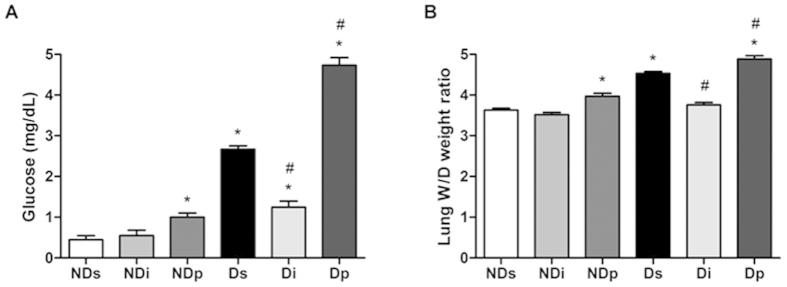
High glucose concentration in the airway surface liquid (ASL) is an important feature of diabetes that predisposes to respiratory infections. We investigated the role of alveolar epithelial SGLT1 activity on ASL glucose concentration and bacterial proliferation. Non-diabetic and diabetic rats were intranasally treated with saline, isoproterenol (to increase SGLT1 activity) or phlorizin (to decrease SGLT1 activity); 2 hours later, glucose concentration and bacterial proliferation (methicillin-resistant Sthaphylococcus aureus, MRSA and Pseudomonas aeruginosa, P. aeruginosa) were analyzed in bronchoalveolar lavage (BAL); and alveolar SGLT1 was analyzed by immunohistochemistry. BAL glucose concentration and bacterial proliferation increased in diabetic animals: isoproterenol stimulated SGLT1 migration to luminal membrane, and reduced (50%) the BAL glucose concentration; whereas phlorizin increased the BAL glucose concentration (100%). These regulations were accompanied by parallel changes of in vitro MRSA and P. aeruginosa proliferation in BAL (r = 0.9651 and r = 0.9613, respectively, Pearson correlation). The same regulations were observed in in vivo P. aeruginosa proliferation. In summary, the results indicate a relationship among SGLT1 activity, ASL glucose concentration and pulmonary bacterial proliferation. Besides, the study highlights that, in situations of pulmonary infection risk, such as in diabetic subjects, increased SGLT1 activity may prevent bacterial proliferation whereas decreased SGLT1 activity can exacerbate it.
气道表面液体(ASL)中的高葡萄糖浓度是糖尿病的一个重要特征,易引发呼吸道感染。我们研究了肺泡上皮钠-葡萄糖协同转运蛋白1(SGLT1)活性对ASL葡萄糖浓度和细菌增殖的作用。对非糖尿病和糖尿病大鼠进行鼻腔内给药,分别给予生理盐水、异丙肾上腺素(以增加SGLT1活性)或根皮素(以降低SGLT1活性);2小时后,分析支气管肺泡灌洗(BAL)中的葡萄糖浓度和细菌增殖情况(耐甲氧西林金黄色葡萄球菌、MRSA和铜绿假单胞菌、铜绿假单胞菌);并通过免疫组织化学分析肺泡SGLT1。糖尿病动物的BAL葡萄糖浓度和细菌增殖增加:异丙肾上腺素刺激SGLT1向管腔膜迁移,并降低(50%)BAL葡萄糖浓度;而根皮素则使BAL葡萄糖浓度增加(100%)。这些调节伴随着BAL中体外MRSA和铜绿假单胞菌增殖的平行变化(分别为r = 0.9651和r = 0.9613,Pearson相关性)。在体内铜绿假单胞菌增殖中也观察到相同的调节作用。总之,结果表明SGLT1活性、ASL葡萄糖浓度和肺部细菌增殖之间存在关联。此外,该研究强调,在肺部感染风险情况下,如糖尿病患者,SGLT1活性增加可能预防细菌增殖,而SGLT1活性降低则会加剧细菌增殖。




 Zotero 插件