Kano Shunsuke, Komada Haruna, Yonekura Lina, Sato Akihiko, Nishiwaki Hisashi, Tamura Hirotoshi
The United Graduate School of Agricultural Sciences, Ehime University, 3-5-7 Tarumi, Matsuyama 790-8566, Japan.
The Graduate School of Agriculture, Kagawa University, 2393 Ikenobe, Miki-cho, Kagawa 761-0795, Japan.
J Nutr Metab. 2016;2016:9104208. doi: 10.1155/2016/9104208. Epub 2016 Jan 19.
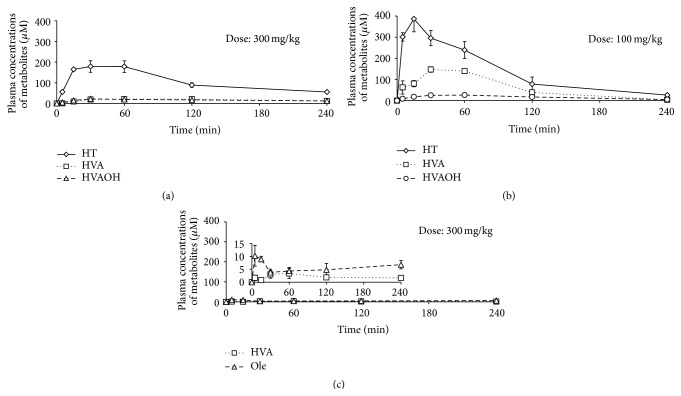
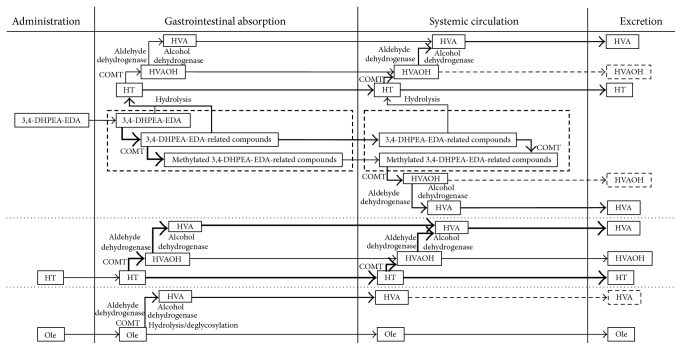
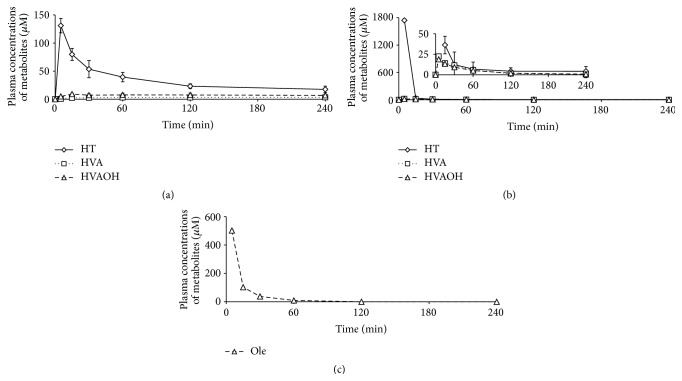
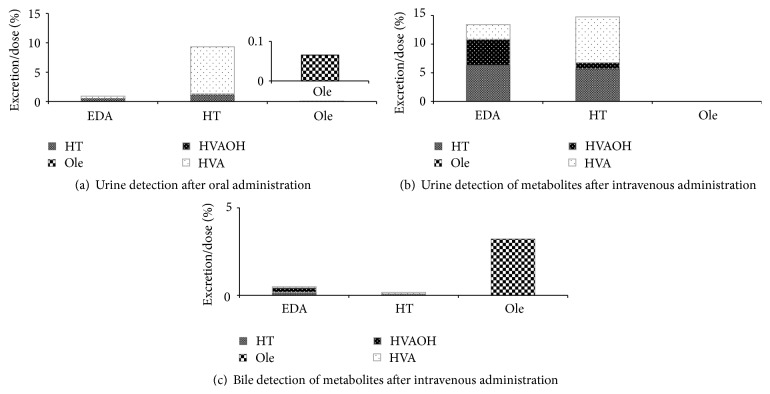
Absorption, metabolism, and excretion of 3,4-DHPEA-EDA, oleuropein, and hydroxytyrosol isolated from olive fruits were newly evaluated after oral and intravenous administration in freely moving rats cannulated in the portal vein, jugular vein, and bile duct. Orally administered 3,4-DHPEA-EDA, an important bioactive compound in olive pomace, was readily absorbed and metabolized to hydroxytyrosol, homovanillic acid, and homovanillyl alcohol, as shown by dose-normalized 4 h area under the curve (AUC0→4 h/Dose) values of 27.7, 4.5, and 4.2 μM·min·kg/μmol, respectively, in portal plasma after oral administration. The parent compound 3,4-DHPEA-EDA was not observed in the portal plasma, urine, and bile after oral and intravenous administration. Additionally, hydroxytyrosol, homovanillic acid, and homovanillyl alcohol in the portal plasma after oral administration of hydroxytyrosol showed 51.1, 22.8, and 7.1 μM·min·kg/μmol AUC0→4 h/Dose, respectively. When oleuropein, a polar glucoside, was injected orally, oleuropein in the portal plasma showed 0.9 μM·min·kg/μmol AUC0→4 h/Dose. However, homovanillic acid was detected from oleuropein in only a small amount in the portal plasma. Moreover, the bioavailability of hydroxytyrosol and oleuropein for 4 hours was 13.1% and 0.5%, respectively. Because the amount of 3,4-DHPEA-EDA in olive fruits is about 2-3 times greater than that of hydroxytyrosol, the metabolites of 3,4-DHPEA-EDA will influence biological activities.
在对门静脉、颈静脉和胆管插管的自由活动大鼠进行口服和静脉给药后,新评估了从橄榄果实中分离出的3,4-二羟基苯乙胺-乙二胺(3,4-DHPEA-EDA)、橄榄苦苷和羟基酪醇的吸收、代谢及排泄情况。口服的3,4-DHPEA-EDA是橄榄果渣中的一种重要生物活性化合物,很容易被吸收并代谢为羟基酪醇、高香草酸和高香草醇,口服给药后门静脉血浆中剂量标准化的4小时曲线下面积(AUC0→4 h/剂量)值分别为27.7、4.5和4.2 μM·min·kg/μmol,表明了这一点。口服和静脉给药后,在门静脉血浆、尿液和胆汁中均未观察到母体化合物3,4-DHPEA-EDA。此外,口服羟基酪醇后门静脉血浆中的羟基酪醇、高香草酸和高香草醇的AUC0→4 h/剂量分别为51.1、22.8和7.1 μM·min·kg/μmol。当口服注射极性糖苷橄榄苦苷时,门静脉血浆中的橄榄苦苷的AUC0→4 h/剂量为0.9 μM·min·kg/μmol。然而,仅在门静脉血浆中从橄榄苦苷中检测到少量的高香草酸。此外,羟基酪醇和橄榄苦苷4小时的生物利用度分别为13.1%和0.5%。由于橄榄果实中3,4-DHPEA-EDA的含量约为羟基酪醇的2-3倍,3,4-DHPEA-EDA的代谢产物将影响生物活性。