Zhang Qian, Gou Wenyu, Wang Xiaotong, Zhang Yawen, Ma Jun, Zhang Hongliang, Zhang Ying, Zhang Hao
National Engineering Laboratory for Animal Breeding, China Agricultural University, Beijing, People's Republic of China.
School of Agriculture, Ludong University, Yantai, China.
Genome Biol Evol. 2016 Feb 23;8(3):765-76. doi: 10.1093/gbe/evw032.
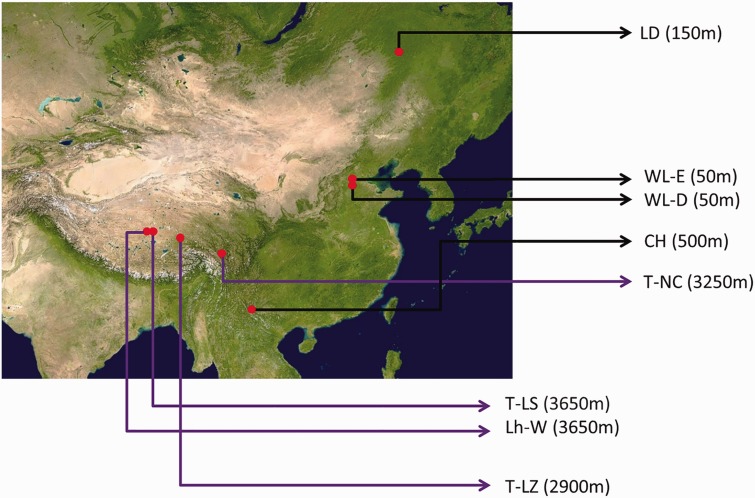
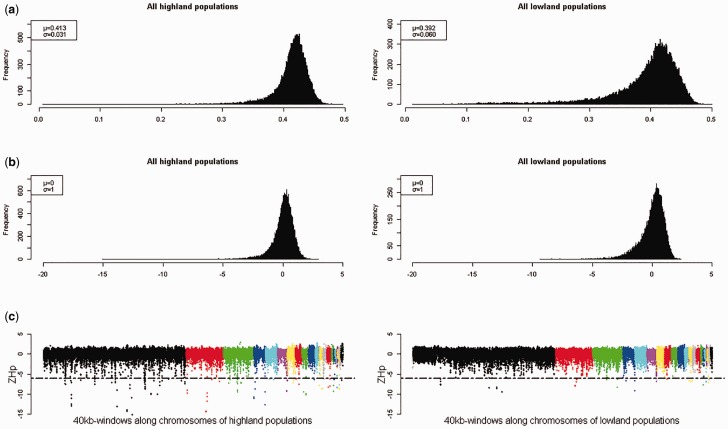
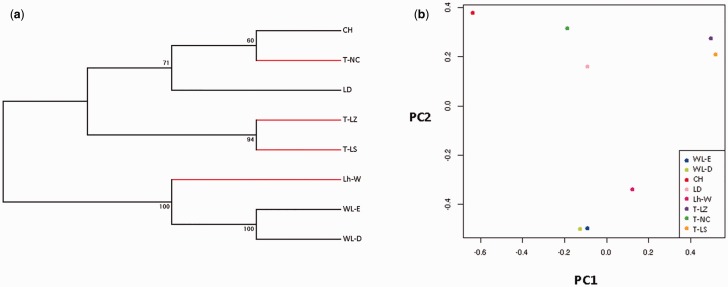
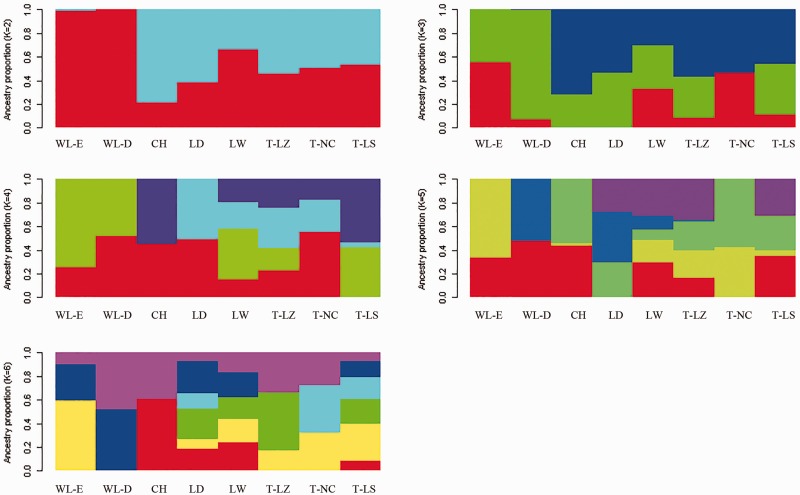
Tibetan chicken, unlike their lowland counterparts, exhibit specific adaptations to high-altitude conditions. The genetic mechanisms of such adaptations in highland chickens were determined by resequencing the genomes of four highland (Tibetan and Lhasa White) and four lowland (White Leghorn, Lindian, and Chahua) chicken populations. Our results showed an evident genetic admixture in Tibetan chickens, suggesting a history of introgression from lowland gene pools. Genes showing positive selection in highland populations were related to cardiovascular and respiratory system development, DNA repair, response to radiation, inflammation, and immune responses, indicating a strong adaptation to oxygen scarcity and high-intensity solar radiation. The distribution of allele frequencies of nonsynonymous single nucleotide polymorphisms between highland and lowland populations was analyzed using chi-square test, which showed that several differentially distributed genes with missense mutations were enriched in several functional categories, especially in blood vessel development and adaptations to hypoxia and intense radiation. RNA sequencing revealed that several differentially expressed genes were enriched in gene ontology terms related to blood vessel and respiratory system development. Several candidate genes involved in the development of cardiorespiratory system (FGFR1, CTGF, ADAM9, JPH2, SATB1, BMP4, LOX, LPR, ANGPTL4, and HYAL1), inflammation and immune responses (AIRE, MYO1F, ZAP70, DDX60, CCL19, CD47, JSC, and FAS), DNA repair, and responses to radiation (VCP, ASH2L, and FANCG) were identified to play key roles in the adaptation to high-altitude conditions. Our data provide new insights into the unique adaptations of highland animals to extreme environments.
与低地鸡不同,藏鸡表现出对高海拔环境的特定适应性。通过对四个高地鸡(藏鸡和拉萨白鸡)和四个低地鸡(白来航鸡、林甸鸡和茶花鸡)群体的基因组进行重测序,确定了高地鸡这种适应性的遗传机制。我们的结果显示藏鸡存在明显的基因混合现象,这表明其有来自低地基因库的基因渗入历史。在高地鸡群体中显示出正选择的基因与心血管和呼吸系统发育、DNA修复、对辐射的反应、炎症和免疫反应有关,这表明它们对缺氧和高强度太阳辐射有很强的适应性。使用卡方检验分析了高地和低地群体之间非同义单核苷酸多态性的等位基因频率分布,结果表明几个具有错义突变的差异分布基因在几个功能类别中富集,特别是在血管发育以及对缺氧和强辐射的适应方面。RNA测序显示,几个差异表达基因在与血管和呼吸系统发育相关的基因本体术语中富集。确定了几个参与心肺系统发育(FGFR1、CTGF、ADAM9、JPH2、SATB1、BMP4、LOX、LPR、ANGPTL4和HYAL1)、炎症和免疫反应(AIRE、MYO1F、ZAP70、DDX60、CCL19、CD47、JSC和FAS)、DNA修复以及对辐射的反应(VCP、ASH2L和FANCG)的候选基因在适应高海拔环境中起关键作用。我们的数据为高地动物对极端环境的独特适应性提供了新的见解。