García-Jiménez Custodia, Gutiérrez-Salmerón María, Chocarro-Calvo Ana, García-Martinez Jose Manuel, Castaño Angel, De la Vieja Antonio
Department of Basic Health Sciences, Faculty of Health Science, University Rey Juan Carlos, 28922 Alcorcon, Madrid, Spain.
Ludwig Institute for Cancer Research, Nuffield Department of Clinical Medicine, University of Oxford, Headington, Oxford, UK.
Br J Cancer. 2016 Mar 29;114(7):716-22. doi: 10.1038/bjc.2016.37. Epub 2016 Feb 23.
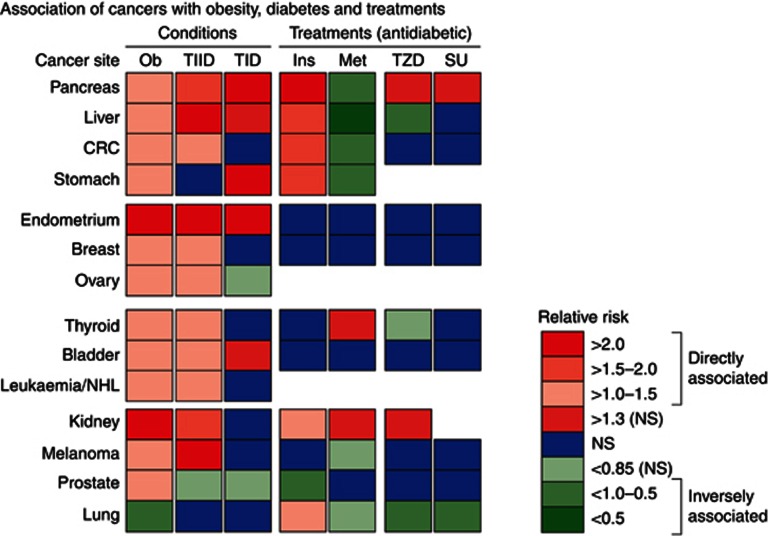
Increasing evidence suggests a complex relationship between obesity, diabetes and cancer. Here we review the evidence for the association between obesity and diabetes and a wide range of cancer types. In many cases the evidence for a positive association is strong, but for other cancer types a more complex picture emerges with some site-specific cancers associated with obesity but not to diabetes, and some associated with type I but not type II diabetes. The evidence therefore suggests the existence of cumulative common and differential mechanisms influencing the relationship between these diseases. Importantly, we highlight the influence of antidiabetics on cancer and antineoplastic agents on diabetes and in particular that antineoplastic targeting of insulin/IGF-1 signalling induces hyperglycaemia that often evolves to overt diabetes. Overall, a coincidence of diabetes and cancer worsens outcome and increases mortality. Future epidemiology should consider dose and time of exposure to both disease and treatment, and should classify cancers by their molecular signatures. Well-controlled studies on the development of diabetes upon cancer treatment are necessary and should identify the underlying mechanisms responsible for these reciprocal interactions. Given the global epidemic of diabetes, preventing both cancer occurrence in diabetics and the onset of diabetes in cancer patients will translate into a substantial socioeconomic benefit.
越来越多的证据表明肥胖、糖尿病和癌症之间存在复杂的关系。在此,我们综述肥胖与糖尿病以及多种癌症类型之间关联的证据。在许多情况下,两者呈正相关的证据确凿,但对于其他癌症类型,情况更为复杂,一些特定部位的癌症与肥胖相关但与糖尿病无关,还有一些与I型糖尿病相关而非II型糖尿病。因此,证据表明存在影响这些疾病关系的累积性共同机制和差异机制。重要的是,我们强调了抗糖尿病药物对癌症的影响以及抗肿瘤药物对糖尿病的影响,特别是抗肿瘤药物对胰岛素/IGF-1信号通路的靶向作用会引发高血糖,进而常常发展为显性糖尿病。总体而言,糖尿病和癌症并存会使预后恶化并增加死亡率。未来的流行病学研究应考虑疾病和治疗的暴露剂量及时间,并应根据癌症的分子特征进行分类。有必要对癌症治疗过程中糖尿病的发生进行严格对照研究,并确定导致这些相互作用的潜在机制。鉴于糖尿病在全球范围内的流行,预防糖尿病患者患癌以及癌症患者患糖尿病将带来巨大的社会经济效益。