Cheshin Arik, Heerdink Marc W, Kossakowski Jolanda J, Van Kleef Gerben A
Human Services, University of HaifaHaifa, Israel; Psychology, University of AmsterdamAmsterdam, Netherlands.
Psychology, University of Amsterdam Amsterdam, Netherlands.
Front Psychol. 2016 Feb 16;7:178. doi: 10.3389/fpsyg.2016.00178. eCollection 2016.
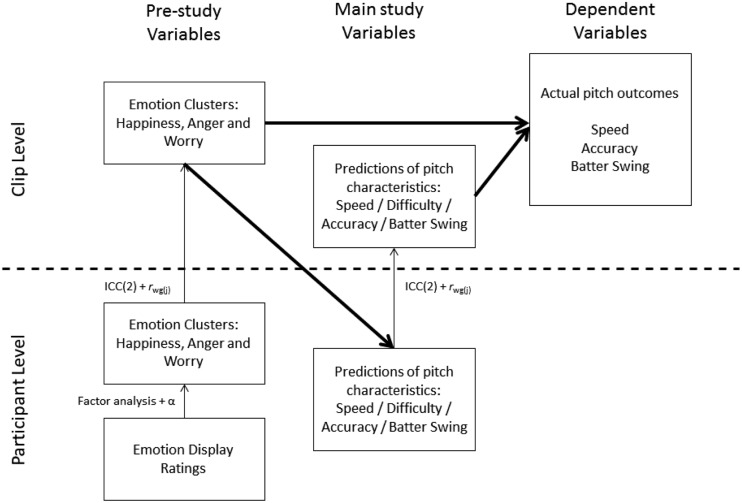
Sports games are inherently emotional situations, but surprisingly little is known about the social consequences of these emotions. We examined the interpersonal effects of emotional expressions in professional baseball. Specifically, we investigated whether pitchers' facial displays influence how pitches are assessed and responded to. Using footage from the Major League Baseball World Series finals, we isolated incidents where the pitcher's face was visible before a pitch. A pre-study indicated that participants consistently perceived anger, happiness, and worry in pitchers' facial displays. An independent sample then predicted pitch characteristics and batter responses based on the same perceived emotional displays. Participants expected pitchers perceived as happy to throw more accurate balls, pitchers perceived as angry to throw faster and more difficult balls, and pitchers perceived as worried to throw slower and less accurate balls. Batters were expected to approach (swing) when faced with a pitcher perceived as happy and to avoid (no swing) when faced with a pitcher perceived as worried. Whereas previous research focused on using emotional expressions as information regarding past and current situations, our work suggests that people also use perceived emotional expressions to predict future behavior. Our results attest to the impact perceived emotional expressions can have on professional sports.
体育比赛本质上是充满情感的场景,但令人惊讶的是,对于这些情感的社会后果却知之甚少。我们研究了职业棒球运动中情感表达的人际影响。具体而言,我们调查了投手的面部表情是否会影响对投球的评估和反应。我们使用美国职业棒球大联盟世界大赛决赛的录像,分离出投球前投手面部可见的事件。一项预研究表明,参与者在投手的面部表情中一致察觉到愤怒、快乐和担忧。然后,一个独立样本根据相同的感知情感表达预测投球特征和击球手的反应。参与者预计,被视为快乐的投手会投出更准确的球,被视为愤怒的投手会投出更快、更难接的球,被视为担忧的投手会投出更慢、更不准确的球。预计击球手面对被视为快乐的投手时会接近(挥棒),面对被视为担忧的投手时会避开(不挥棒)。以往的研究主要关注将情感表达用作关于过去和当前情况的信息,而我们的研究表明,人们也会利用感知到的情感表达来预测未来行为。我们的结果证明了感知到的情感表达对职业体育可能产生的影响。