Smolina Irina, Kollias Spyros, Jueterbock Alexander, Coyer James A, Hoarau Galice
Faculty of Biosciences and Aquaculture , University of Nordland , Bodø 8049, Norway.
Shoals Marine Laboratory , Cornell University , 400 Little Harbor Road, Portsmouth, NH 03801, USA.
R Soc Open Sci. 2016 Jan 13;3(1):150429. doi: 10.1098/rsos.150429. eCollection 2016 Jan.
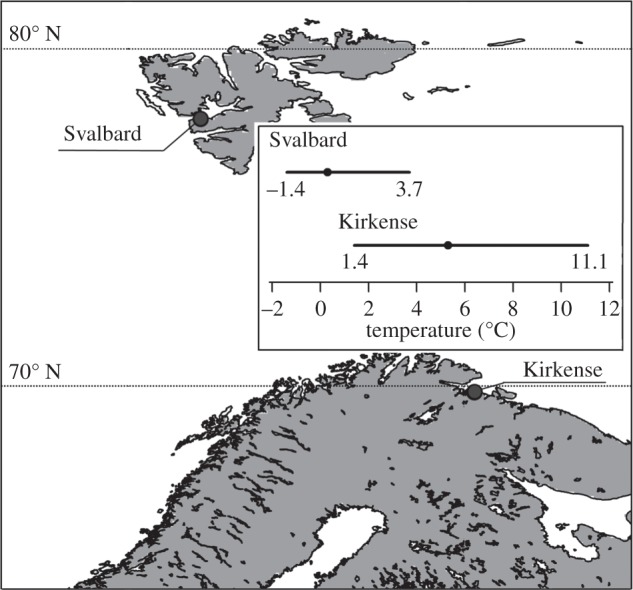
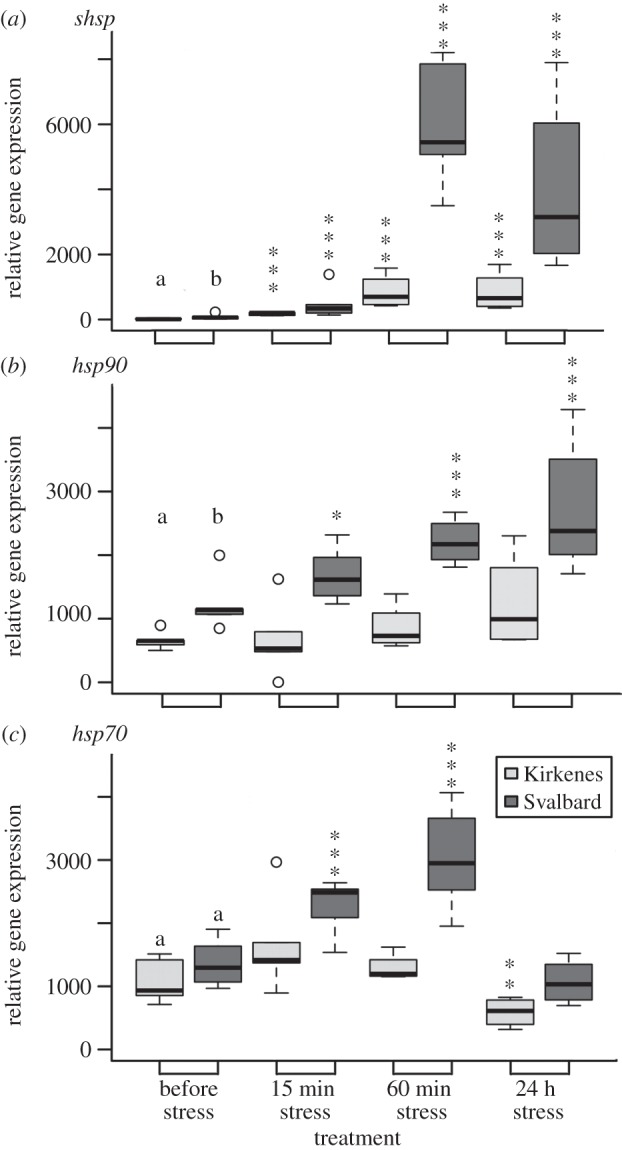
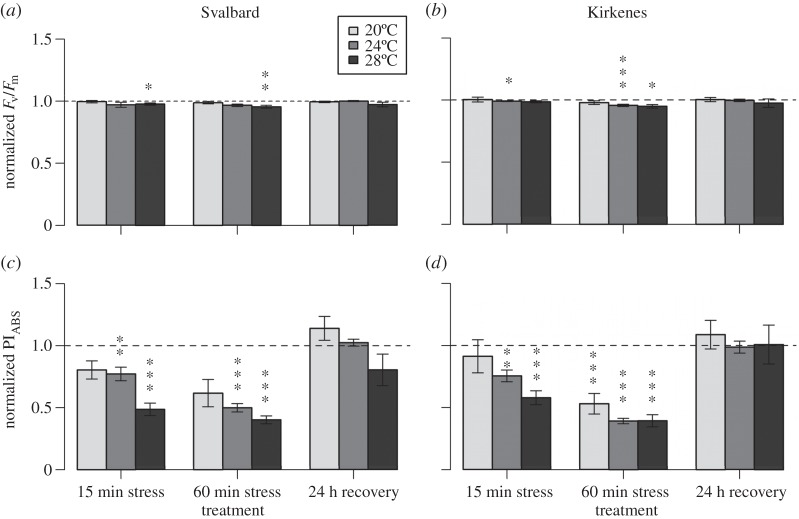
It is unclear whether intertidal organisms are 'preadapted' to cope with the increase of temperature and temperature variability or if they are currently at their thermal tolerance limits. To address the dichotomy, we focused on an important ecosystem engineer of the Arctic intertidal rocky shores, the seaweed Fucus distichus and investigated thermal stress responses of two populations from different temperature regimes (Svalbard and Kirkenes, Norway). Thermal stress responses at 20°C, 24°C and 28°C were assessed by measuring photosynthetic performance and expression of heat shock protein (HSP) genes (shsp, hsp90 and hsp70). We detected population-specific responses between the two populations of F. distichus, as the Svalbard population revealed a smaller decrease in photosynthesis performance but a greater activation of molecular defence mechanisms (indicated by a wider repertoire of HSP genes and their stronger upregulation) compared with the Kirkenes population. Although the temperatures used in our study exceed temperatures encountered by F. distichus at the study sites, we believe response to these temperatures may serve as a proxy for the species' potential to respond to climate-related stresses.
目前尚不清楚潮间带生物是否“预先适应”了温度升高和温度变异性的增加,或者它们目前是否处于热耐受极限。为了解决这一分歧,我们重点研究了北极潮间带岩石海岸的一种重要生态系统工程师——海藻(Fucus distichus),并调查了来自不同温度区域(挪威斯瓦尔巴群岛和希尔克内斯)的两个种群的热应激反应。通过测量光合性能和热休克蛋白(HSP)基因(shsp、hsp90和hsp70)的表达,评估了在20°C、24°C和28°C下的热应激反应。我们在两种F. distichus种群之间检测到了种群特异性反应,因为与希尔克内斯种群相比,斯瓦尔巴群岛种群的光合作用性能下降较小,但分子防御机制的激活程度更高(表现为HSP基因种类更多且上调更强)。尽管我们研究中使用的温度超过了F. distichus在研究地点所遇到的温度,但我们认为对这些温度的反应可能代表了该物种对气候相关压力的潜在反应能力。