Hutton Brian, Addison Christina, Mazzarello Sasha, Joy Anil A, Bouganim Nathaniel, Fergusson Dean, Clemons Mark
Ottawa Hospital Research Institute, University of Ottawa, Ottawa, Canada; Department of Epidemiology and Community Medicine, University of Ottawa, Ottawa, Canada.
Ottawa Hospital Research Institute, University of Ottawa, Ottawa, Canada; Department of Biochemistry, Microbiology and Immunology, University of Ottawa, Ottawa, Canada; Department of Medicine, University of Ottawa, Ottawa, Canada.
J Bone Oncol. 2013 Apr 15;2(2):77-83. doi: 10.1016/j.jbo.2013.03.001. eCollection 2013 Jun.
Questions remain regarding the optimal use of bone-targeted agents in patients with metastatic bone disease. The purpose of this study was to assess current clinical practice regarding the use and administration of bone-targeted agents by Canadian oncologists in patients with metastatic breast and prostate cancer.
A survey was designed to explore; bone-targeted agent use in metastatic bone disease, variability in the choice and the frequency of administration of these agents. Opinions were sought on potential outcomes for future trials.
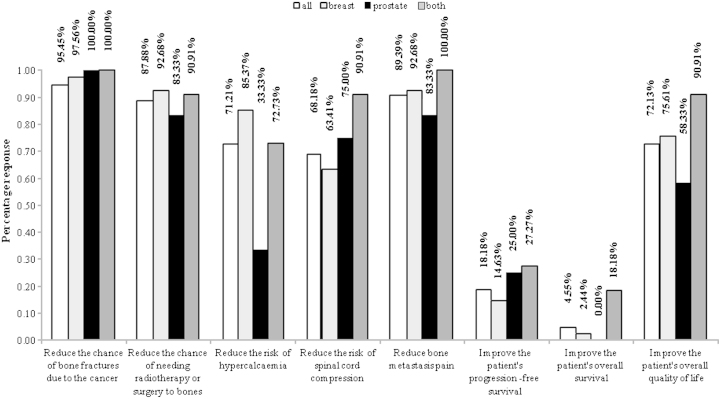
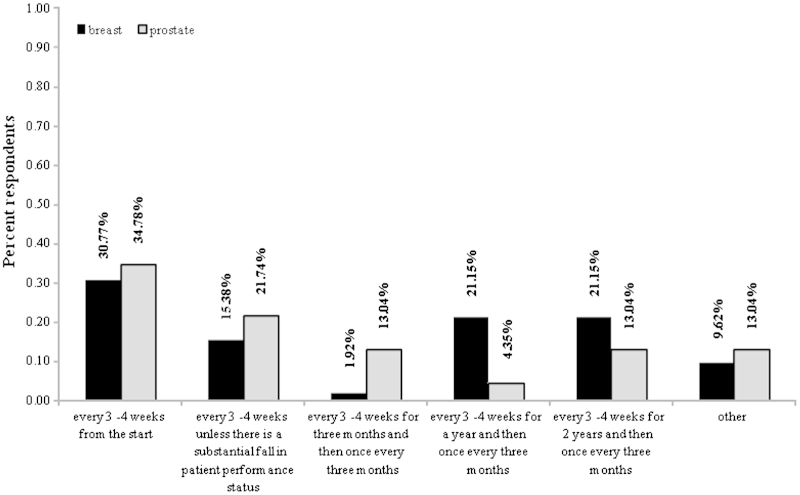
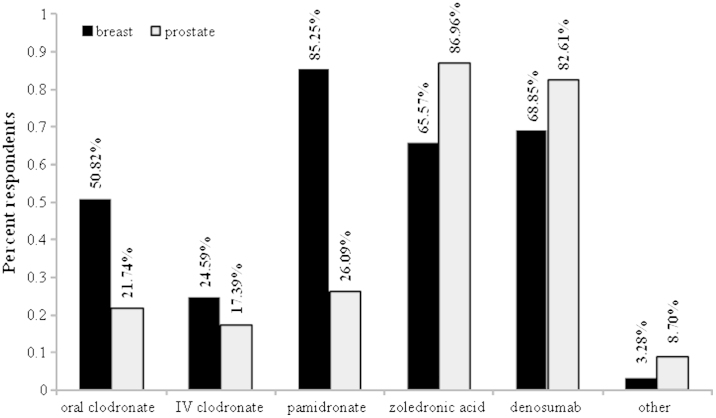
A total of 193 clinicians were contacted and 90 completed our survey (response rate 49% after adjustment for inactivity). Survey respondents were medical oncologists (71.1%), radiation oncologists (21.1%) and urologists (7.8%). The findings suggest that once bone-targeted agents are started they are rarely discontinued. More agents are used in breast cancer than in prostate cancer. There was considerable interest in performing studies of de-escalated therapy in both breast and prostate cancer. Physicians requested (86%) that the primary study endpoint be the occurrence of skeletal related events and not biomarker driven.
Despite clinical practice guidelines and widespread use, significant areas of clinical equipoise with respect to use of bone-targeted agents exist. Findings from this survey suggest that physicians are interested in de-escalated therapy for both breast and prostate patients. However, the use of multiple agents in breast cancer and the desire for skeletal related events to be the primary endpoint means that very large randomized studies will be required.
对于转移性骨病患者骨靶向药物的最佳使用仍存在疑问。本研究的目的是评估加拿大肿瘤学家在转移性乳腺癌和前列腺癌患者中使用和给予骨靶向药物的当前临床实践。
设计了一项调查以探讨:转移性骨病中骨靶向药物的使用、这些药物选择和给药频率的变异性。征求了对未来试验潜在结果的意见。
共联系了193名临床医生,90名完成了我们的调查(调整无活动情况后回复率为49%)。调查对象为医学肿瘤学家(71.1%)、放射肿瘤学家(21.1%)和泌尿科医生(7.8%)。研究结果表明,一旦开始使用骨靶向药物,很少会停药。乳腺癌中使用的药物比前列腺癌更多。对在乳腺癌和前列腺癌中进行降阶梯治疗的研究有相当大的兴趣。医生们要求(86%)主要研究终点是骨相关事件的发生,而不是由生物标志物驱动。
尽管有临床实践指南且广泛使用,但在骨靶向药物使用方面仍存在重大临床平衡领域。本次调查结果表明,医生们对乳腺癌和前列腺癌患者的降阶梯治疗感兴趣。然而,乳腺癌中多种药物的使用以及将骨相关事件作为主要终点的愿望意味着需要非常大型的随机研究。