Jia Yanfei, Sun Haiji, Wu Hongqiao, Zhang Huilin, Zhang Xiuping, Xiao Dongjie, Ma Xiaoli, Wang Yunshan
Central Laboratory, Jinan Central Hospital Affiliated to Shandong University, Jinan, China.
College of Life Science, Shandong Normal University, Jinan, China.
PLoS One. 2016 Feb 24;11(2):e0149120. doi: 10.1371/journal.pone.0149120. eCollection 2016.
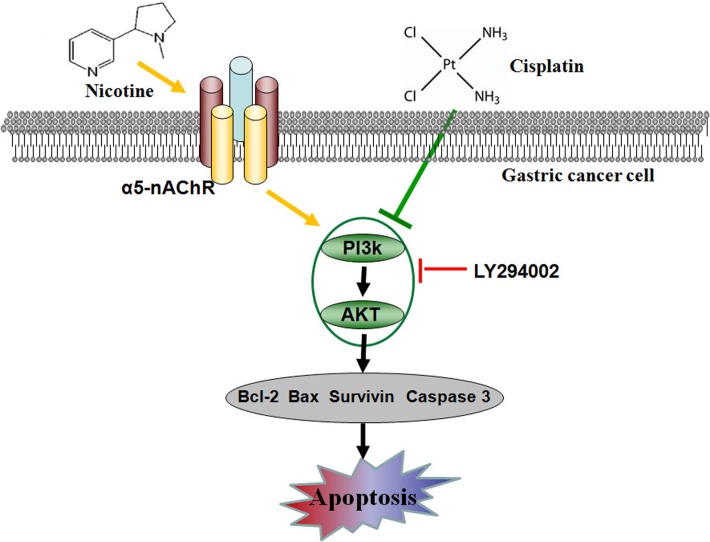
Gastric cancer incidence demonstrates a strong etiologic association with smoking. Nicotine, the major component in tobacco, is a survival agonist that inhibits apoptosis induced by certain chemotherapeutic agents, but the precise mechanisms involved remain largely unknown. Recently studies have indicated that α5-nicotinic acetylcholine receptor (α5-nAChR) is highly associated with lung cancer risk and nicotine dependence. Nevertheless, no information has been available about whether nicotine also affects proliferation of human gastric cancer cells through regulation of α5-nAChR. To evaluate the hypothesis that α5-nAChR may play a role in gastric cancer, we investigated its expression in gastric cancer tissues and cell lines. The expression of α5-nAChR increased in gastric cancer tissue compared with para-carcinoma tissues. In view of the results, we proceeded to investigate whether nicotine inhibits cisplatin-induced apoptosis via regulating α5-nAChR in gastric cancer cell. The results showed that nicotine significantly promoted cell proliferation in a dose and time-dependent manner through α5-nAChR activation in human gastric cells. Furthermore, nicotine inhibited apoptosis induced by cisplatin. Silence of α5-nAChR ablated the protective effects of nicotine. However, when co-administrating LY294002, an inhibitor of PI3K/AKT pathway, an increased apoptosis was observed. This effect correlated with the induction of Bcl-2, Bax, Survivin and Caspase-3 by nicotine in gastric cell lines. These results suggest that exposure to nicotine might negatively impact the apoptotic potential of chemotherapeutic drugs and that α5-nAChR/AKT signaling plays a key role in the anti-apoptotic activity of nicotine induced by cisplatin.
胃癌发病率与吸烟之间存在很强的病因学关联。尼古丁是烟草中的主要成分,是一种存活激动剂,可抑制某些化疗药物诱导的细胞凋亡,但其中的确切机制仍 largely 未知。最近的研究表明,α5-烟碱型乙酰胆碱受体(α5-nAChR)与肺癌风险和尼古丁依赖性高度相关。然而,关于尼古丁是否也通过调节α5-nAChR影响人胃癌细胞的增殖,尚无相关信息。为了评估α5-nAChR可能在胃癌中起作用的假设,我们研究了其在胃癌组织和细胞系中的表达。与癌旁组织相比,α5-nAChR在胃癌组织中的表达增加。鉴于这些结果,我们继续研究尼古丁是否通过调节胃癌细胞中的α5-nAChR抑制顺铂诱导的细胞凋亡。结果表明,尼古丁通过激活人胃细胞中的α5-nAChR以剂量和时间依赖性方式显著促进细胞增殖。此外,尼古丁抑制顺铂诱导的细胞凋亡。α5-nAChR的沉默消除了尼古丁的保护作用。然而,当共同施用PI3K/AKT途径的抑制剂LY294002时,观察到细胞凋亡增加。这种效应与尼古丁在胃细胞系中诱导的Bcl-2、Bax、Survivin和Caspase-3相关。这些结果表明,接触尼古丁可能对化疗药物的凋亡潜力产生负面影响,并且α5-nAChR/AKT信号通路在顺铂诱导的尼古丁抗凋亡活性中起关键作用。