Dorward Hilary S, Du Alice, Bruhn Maressa A, Wrin Joseph, Pei Jinxin V, Evdokiou Andreas, Price Timothy J, Yool Andrea J, Hardingham Jennifer E
Molecular Oncology, Basil Hetzel Institute, The Queen Elizabeth Hospital, Woodville, SA, Australia.
Discipline of Physiology, School of Medicine, University of Adelaide, Adelaide, SA, Australia.
J Exp Clin Cancer Res. 2016 Feb 24;35:36. doi: 10.1186/s13046-016-0310-6.
Aquaporins (AQP) are water channel proteins that enable fluid fluxes across cell membranes, important for homeostasis of the tissue environment and for cell migration. AQP1 knockout mouse models of human cancers showed marked inhibition of tumor-induced angiogenesis, and in pre-clinical studies of colon adenocarcinomas, forced over-expression of AQP1 was shown to increase angiogenesis, invasion and metastasis. We have synthesized small molecule antagonists of AQP1. Our hypothesis is that inhibition of AQP1 will reduce migration and invasiveness of colon cancer cells, and the migration and tube-forming capacity of endothelial cells in vitro.
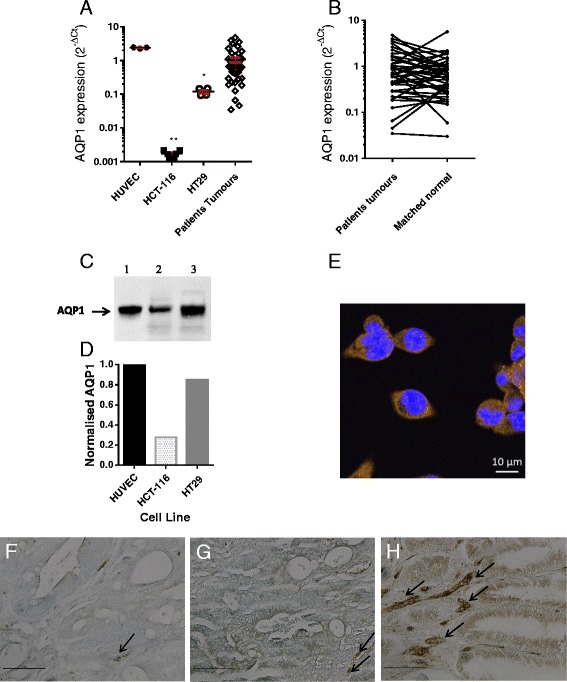
Expression of AQP1 in cell lines was assessed by quantitative (q) PCR, western blot and immunofluorescence, while expression of AQP1 in human colon tumour tissue was assessed by immunohistochemistry. The effect of varying concentrations of the AQP1 inhibitor AqB013 was tested on human colon cancer cell lines expressing high versus low levels of AQP1, using wound closure (migration) assays, matrigel invasion assays, and proliferation assays. The effect of AqB013 on angiogenesis was tested using an endothelial cell tube-formation assay.
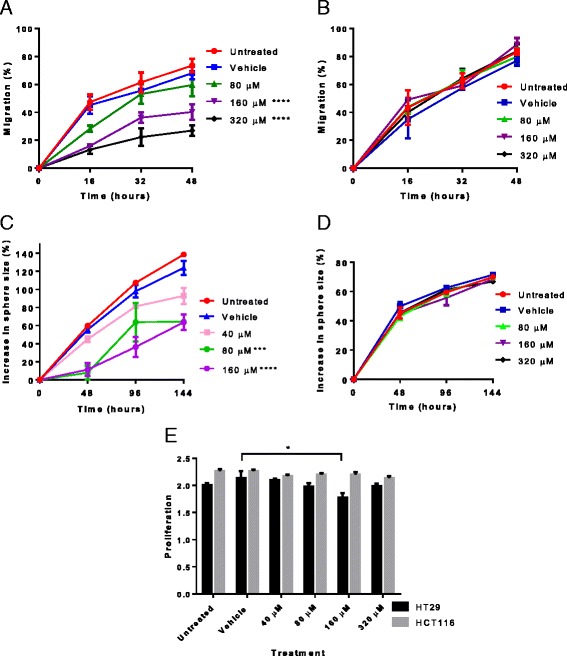
HT29 colon cancer cells with high AQP1 levels showed significant inhibition of migration compared to vehicle control of 27.9% ± 2.6% (p < 0.0001) and 41.2% ± 2.7 (p <0.0001) treated with 160 or 320 μM AqB013 respectively, whereas there was no effect on migration of HCT-116 cells with low AQP1 expression. In an invasion assay, HT29 cells treated with 160 μM of AqB013, showed a 60.3% ± 8.5% decrease in invasion at 144 hours (p < 0.0001) and significantly decreased rate of invasion compared with the vehicle control (F-test, p = 0.001). Almost complete inhibition of endothelial tube formation (angiogenesis assay) was achieved at 80 μM AqB013 compared to vehicle control (p < 0.0001).
These data provide good evidence for further testing of the inhibitor as a therapeutic agent in colon cancer.
水通道蛋白(AQP)是一类水通道蛋白,可使液体跨细胞膜流动,这对于组织环境的稳态和细胞迁移至关重要。人类癌症的AQP1基因敲除小鼠模型显示肿瘤诱导的血管生成受到显著抑制,并且在结肠腺癌的临床前研究中,AQP1的强制过表达被证明可增加血管生成、侵袭和转移。我们已经合成了AQP1的小分子拮抗剂。我们的假设是,抑制AQP1将降低结肠癌细胞的迁移和侵袭能力,以及体外内皮细胞的迁移和管形成能力。
通过定量(q)PCR、蛋白质印迹和免疫荧光评估细胞系中AQP1的表达,同时通过免疫组织化学评估人结肠肿瘤组织中AQP1的表达。使用伤口闭合(迁移)试验、基质胶侵袭试验和增殖试验,测试不同浓度的AQP1抑制剂AqB013对高表达和低表达AQP1的人结肠癌细胞系的影响。使用内皮细胞管形成试验测试AqB013对血管生成的影响。
与分别用160或320μM AqB013处理的溶媒对照相比,高AQP1水平的HT29结肠癌细胞的迁移受到显著抑制,分别为27.9%±2.6%(p<0.0001)和41.2%±2.7(p<0.0001),而对低AQP1表达的HCT-116细胞的迁移没有影响。在侵袭试验中,用160μM AqB013处理的HT29细胞在144小时时侵袭减少了60.3%±8.5%(p<0.0001),与溶媒对照相比侵袭率显著降低(F检验,p=0.001)。与溶媒对照相比,在80μM AqB013时几乎完全抑制了内皮管形成(血管生成试验)(p<0.0001)。
这些数据为进一步测试该抑制剂作为结肠癌治疗药物提供了有力证据。