Xu Min, Lv Jing, Fu Pengcheng, Mi Hualing
National Key Laboratory of Plant Molecular Genetics, Institute of Plant Physiology and Ecology, Shanghai Institutes for Biological Sciences, Chines Academy of Sciences Shanghai, China.
Renewable Energy Research Center, China University of Petroleum Beijing, China.
Front Plant Sci. 2016 Feb 15;7:108. doi: 10.3389/fpls.2016.00108. eCollection 2016.
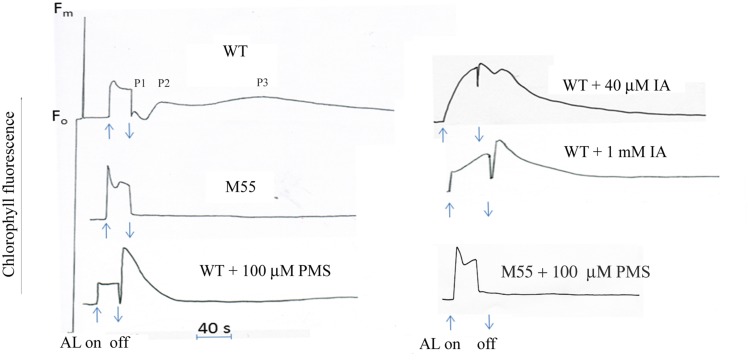
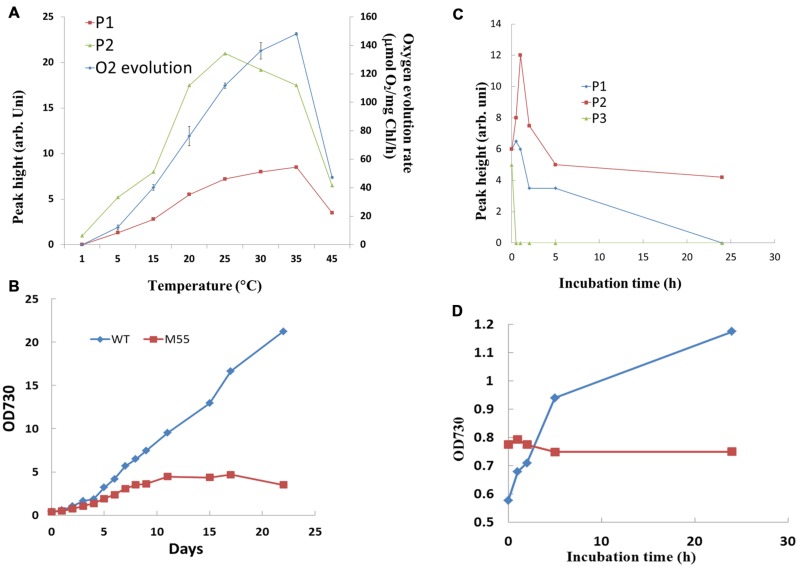
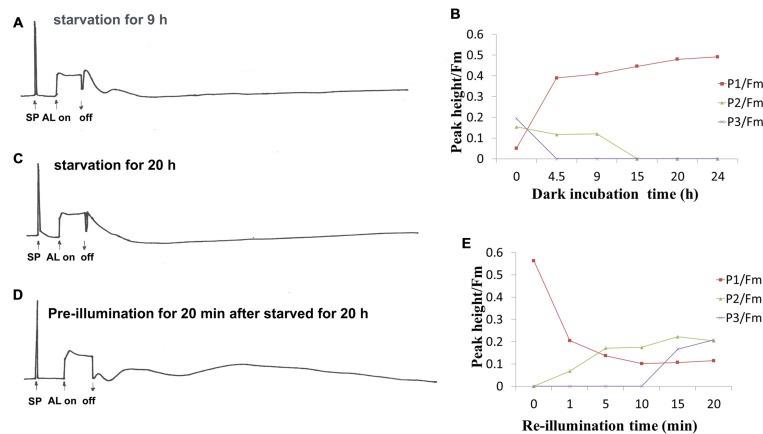
After termination of longer-illumination (more than 30 s), the wild type of Synechocystis PCC 6803 showed the oscillation kinetics of post-illumination increase in Chl fluorescence: a fast phase followed by one or two slow phases. Unlike the wild type, ndh-B defective mutant M55 did not show any post-illumination increase under the same conditions, indicating that not only the fast phase, but also the slow phases were related to the NDH-mediated cyclic electron flow around photosystem I (PS I) to plastoquinone (PQ). The fast phase was stimulated by dark incubation or in the presence of Calvin cycle inhibitor, iodoacetamide (IA) or cyclic photophosphorylation cofactor, phenazine methosulphate (PMS), implying the redox changes of PQ by electrons generated at PS I reduced side, probably NAD(P)H or ferredoxin (Fd). In contrast, the slow phases disappeared after dark starvation or in the presence of IA or PMS, and reappeared by longer re-illumination, suggesting that they are related to the redox changes of PQ by the electrons from the photoreductants produced in carbon assimilation process. Both the fast phase and slow phases were stimulated at high temperature and the slow phase was promoted by response to high concentration of NaCl. The mutant M55 without both phases could not survive under the stressed conditions.
在较长时间光照(超过30秒)终止后,集胞藻PCC 6803野生型呈现出光照后叶绿素荧光增加的振荡动力学:一个快速相接着一到两个慢速相。与野生型不同,ndh - B缺陷突变体M55在相同条件下未显示出任何光照后增加的现象,这表明不仅快速相,慢速相也与通过光合系统I(PS I)到质体醌(PQ)的NDH介导的循环电子流有关。快速相受到暗处理或在卡尔文循环抑制剂碘乙酰胺(IA)或循环光合磷酸化辅因子硫酸甲酯吩嗪(PMS)存在的情况下的刺激,这意味着PQ的氧化还原变化是由PS I还原侧产生的电子引起的,可能是NAD(P)H或铁氧还蛋白(Fd)。相反,慢速相在暗饥饿后或在IA或PMS存在的情况下消失,并通过更长时间的重新光照而重新出现,这表明它们与碳同化过程中产生的光还原剂的电子引起的PQ氧化还原变化有关。快速相和慢速相在高温下均受到刺激,慢速相在高浓度NaCl响应下得到促进。没有这两个相的突变体M55在胁迫条件下无法存活。