Gorth Deborah J, Martin John T, Dodge George R, Elliott Dawn M, Malhotra Neil R, Mauck Robert L, Smith Lachlan J
Department of Neurosurgery, Perelman School of Medicine, University of Pennsylvania, 424 Stemmler Hall, 3450 Hamilton Walk, Philadelphia, 19104, PA, USA.
Department of Orthopaedic Surgery, Perelman School of Medicine, University of Pennsylvania, 424 Stemmler Hall, 3450 Hamilton Walk, Philadelphia, 19104, PA, USA.
J Exp Orthop. 2014 Dec;1(1):15. doi: 10.1186/s40634-014-0015-8. Epub 2014 Nov 21.
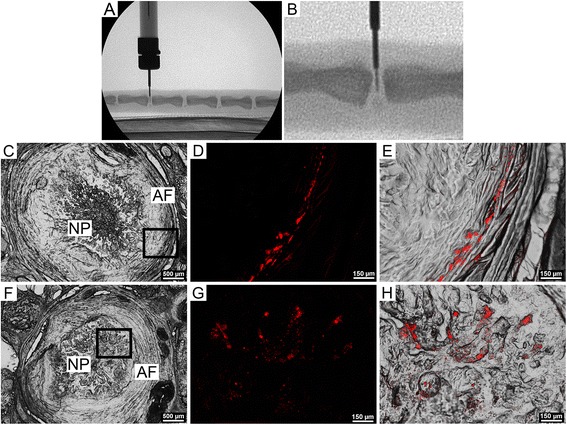
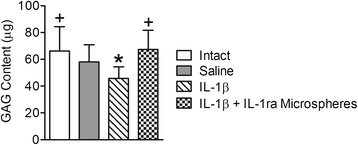
Inflammatory cytokines such as interleukin-1 beta (IL-1β) contribute to the progression of intervertebral disc degeneration. Previously we demonstrated, in vitro, that by delivering interleukin-1 receptor antagonist (IL-1ra) from poly(lactic co-glycolic acid) (PLGA) microspheres, we could attenuate the degradative effects of IL-1β on the nucleus pulposus (NP) for up to 20 days. The objective of this study was to undertake a preliminary investigation into whether microspheres could be successfully delivered to and retained in the disc in vivo, and whether IL-1ra released from those microspheres remained biologically active. For retention studies, fluorescently-labeled microspheres were delivered to the NPs of rat caudal discs. Rats were sacrificed at time points up to 56 days, and microspheres were localized using fluorescent microscopy. To investigate whether IL-1ra microspheres could effectively inhibit the effects of IL-1β in vivo, four disc levels were allocated to the following treatment groups: intact; saline; IL-1β; or IL-1β + IL-1ra microspheres. Rats were sacrificed after seven days and NP glycosaminoglycan content was measured.
Microspheres were visible in the disc at all time points up to 28 days, and localized to the NP, the annulus fibrosus (AF), or both. Glycosaminoglycan content for discs injected with IL-1β alone was significantly lower than for intact controls. For discs injected with IL-1β along with IL-1ra microspheres, glycosaminoglycan content was not significantly different from intact controls.
Microspheres can successfully be delivered to the disc in vivo and retained for a clinically relevant time frame. IL-1ra released from microspheres can effectively prevent IL-1β-induced NP glycosaminoglycan loss in vivo.
诸如白细胞介素-1β(IL-1β)等炎性细胞因子会促使椎间盘退变进展。此前我们在体外证明,通过聚乳酸-羟基乙酸共聚物(PLGA)微球递送白细胞介素-1受体拮抗剂(IL-1ra),我们能够在长达20天的时间里减弱IL-1β对髓核(NP)的降解作用。本研究的目的是初步调查微球是否能够在体内成功递送至椎间盘并留存其中,以及从这些微球释放的IL-1ra是否仍保持生物活性。对于留存研究,将荧光标记的微球递送至大鼠尾椎椎间盘的髓核。在长达56天的时间点处死大鼠,并使用荧光显微镜对微球进行定位。为了研究IL-1ra微球是否能够在体内有效抑制IL-1β的作用,将四个椎间盘节段分配至以下治疗组:完整;生理盐水;IL-1β;或IL-1β + IL-1ra微球。七天后处死大鼠并测量髓核糖胺聚糖含量。
在长达28天的所有时间点,微球在椎间盘中均可见,并定位于髓核、纤维环(AF)或两者。单独注射IL-1β的椎间盘的糖胺聚糖含量显著低于完整对照组。对于注射IL-1β以及IL-1ra微球的椎间盘,糖胺聚糖含量与完整对照组无显著差异。
微球能够在体内成功递送至椎间盘并在临床相关的时间范围内留存。从微球释放的IL-1ra能够在体内有效防止IL-1β诱导的髓核糖胺聚糖丢失。