Ogura Takahiro, Suzuki Miyako, Sakuma Yoshihiro, Yamauchi Kazuyo, Orita Sumihisa, Miyagi Masayuki, Ishikawa Tetsuhiro, Kamoda Hiroto, Oikawa Yasuhiro, Kanisawa Izumi, Takahashi Kenji, Sakai Hiroki, Nagamine Tomonori, Fukuda Hideaki, Takahashi Kazuhisa, Ohtori Seiji, Tsuchiya Akihiro
Funabashi Orthopaedic Hospital Sports Medicine Center, Funabashi, Chiba, Japan.
Department of Orthopaedic Surgery, Graduate School of Medicine, Chiba University, Chiba, Japan.
J Exp Orthop. 2016 Dec;3(1):7. doi: 10.1186/s40634-016-0041-9. Epub 2016 Feb 3.
Meniscal injuries are a risk factor for osteoarthritis (OA). While a mechanical pathway between meniscal injury and OA has been described, the biological effects of inflammation on this pathway have yet to be clarified. The aim of our study was to compare levels of specific inflammatory mediators, tumor necrosis factor-alpha (TNF-α), interleukin-6 (IL-6), and nerve growth factor (NGF), in injured and uninjured meniscal tissue and related knee joint synovium.
Tissue samples were obtained from 19 patients, 31.1 ± 13.6 years old, who underwent arthroscopic partial meniscectomy. For analysis, tissue samples were categorized into the following groups: injured meniscal site (IM), non-injured meniscal site (NIM), synovium 'nearest' the lesion (NS), and synovium from the opposite knee compartment, 'farthest' synovium (FS). Levels of inflammatory mediators were determined using enzyme-linked immunosorbent assay and between-group differences (IM and NIM; NS and FS) were evaluated using the Wilcoxon signed-rank test. The association between pre-operative pain score and the level of each inflammatory mediator was evaluated using Spearman's correlation.
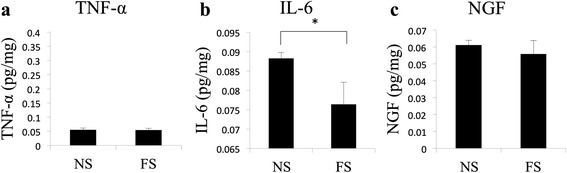
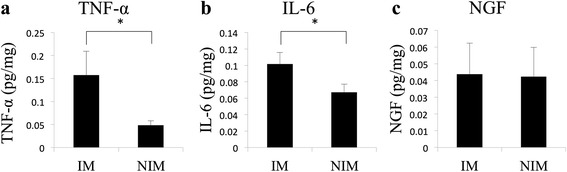
Higher levels of TNF-α and IL-6 were identified in the IM tissue, compared to NIM (p <0.05). IL-6 levels were also higher in the NS compared to the FS (p <0.05). There was no correlation between pre-operative pain score and level of each inflammatory mediator.
Our outcomes confirm a local increase in inflammatory mediator levels, in both meniscal and synovial tissue, which could contribute to development of OA. Management of these biological effects of meniscal injury might be warranted.
半月板损伤是骨关节炎(OA)的一个危险因素。虽然已经描述了半月板损伤与OA之间的机械通路,但炎症对该通路的生物学影响尚未阐明。我们研究的目的是比较受伤和未受伤的半月板组织以及相关膝关节滑膜中特定炎症介质肿瘤坏死因子-α(TNF-α)、白细胞介素-6(IL-6)和神经生长因子(NGF)的水平。
组织样本取自19例接受关节镜下部分半月板切除术的患者,年龄31.1±13.6岁。为了进行分析,组织样本被分为以下几组:受伤半月板部位(IM)、未受伤半月板部位(NIM)、病变“最接近”的滑膜(NS)以及对侧膝关节腔的滑膜,“最远”的滑膜(FS)。使用酶联免疫吸附测定法测定炎症介质水平,并使用Wilcoxon符号秩检验评估组间差异(IM和NIM;NS和FS)。使用Spearman相关性评估术前疼痛评分与每种炎症介质水平之间的关联。
与NIM相比,IM组织中TNF-α和IL-6水平更高(p<0.05)。与FS相比,NS中的IL-6水平也更高(p<0.05)。术前疼痛评分与每种炎症介质水平之间无相关性。
我们的结果证实半月板和滑膜组织中炎症介质水平均局部升高,这可能导致OA的发展。对半月板损伤的这些生物学效应进行管理可能是必要的。