Okuma Yusuke, Hosomi Yukio, Miyamoto Shingo, Shibuya Masahiko, Okamura Tatsuru, Hishima Tsunekazu
Department of Thoracic Oncology and Respiratory Medicine, Tokyo Metropolitan Cancer and Infectious diseases Center Komagome Hospital, 3-18-22 Honkomagome, Bunkyo, Tokyo, 113-8677, Japan.
Division of Oncology, Research Center for Medical Sciences, The Jikei University School of Medicine, Minato, Tokyo, Japan.
BMC Cancer. 2016 Feb 25;16:156. doi: 10.1186/s12885-016-2159-7.
Thymic carcinoma is a rare cancer with minimal evidence of a survival benefit following chemotherapy. An oral fluoropyrimidine of S-1, however, is the recommended active cytotoxic chemotherapy agent for refractory thymic carcinoma based on a case series, whereas sunitinib or everolimus are recommended as molecular-targeted agents based on Phase II trials. We retrospectively investigated the efficacy of S-1 for refractory thymic carcinoma and performed a biomarker analysis.
We assessed the clinicopathological variables of 14 consecutive patients who underwent S-1 for refractory thymic carcinoma and correlated the clinical outcomes with potential biomarkers using paraffin-embedded cancer tissues of eight patients in the cohort.
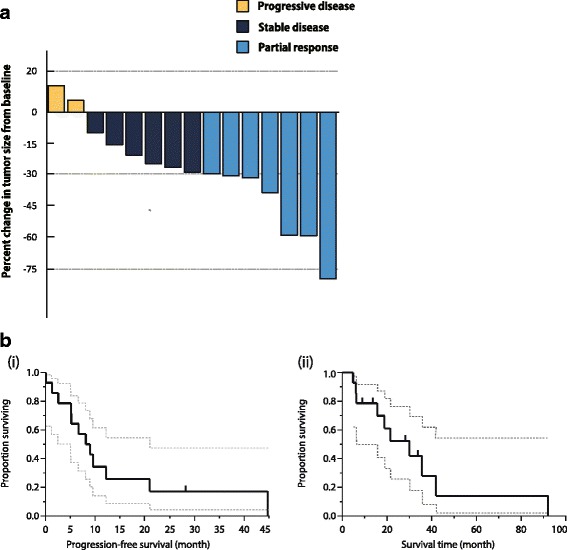
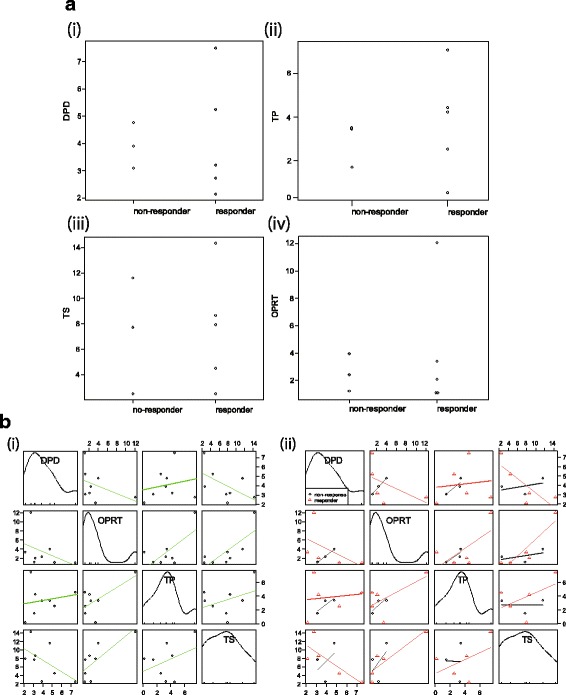
A total of 178 thymic malignancies were identified, of whom 14 patients included 12 cases of squamous cell carcinoma, one lymphoepithelioma-like carcinoma, and one undifferentiated carcinoma. Six patients exhibited a partial response (42.9 %: 95 % confidence interval [CI], 21.4-67.4) and the disease control rate was 85.7 % (60.0-96.0 %). After a median follow-up of 24.2 months, the median progression-free survival was 8.1 months (range, 2.6-12.2 months), and median overall survival was 30.0 months (range, 6.2-41.9 months). No significant correlation between biomarker expression and response was noted. However, thymidine synthase (TS)/dihydropyrimidine dehydrogenase and TS/orotate phosphoribosyltransferase were observed.
S-1 for refractory thymic carcinoma offered clinical activity and achieved an 85 % disease control rate. Although the biomarkers did not correlate with clinical outcome, the study results showed efficacy of S-1 as a cytotoxic chemotherapy for refractory thymic carcinoma, which warrants future investigation.
胸腺癌是一种罕见癌症,化疗后生存获益的证据极少。然而,基于一项病例系列研究,口服氟尿嘧啶类药物S-1是推荐用于难治性胸腺癌的活性细胞毒性化疗药物,而基于II期试验,舒尼替尼或依维莫司被推荐作为分子靶向药物。我们回顾性研究了S-1治疗难治性胸腺癌的疗效并进行了生物标志物分析。
我们评估了14例连续接受S-1治疗难治性胸腺癌患者的临床病理变量,并使用队列中8例患者的石蜡包埋癌组织将临床结局与潜在生物标志物进行关联分析。
共鉴定出178例胸腺恶性肿瘤,其中14例患者包括12例鳞状细胞癌、1例淋巴上皮瘤样癌和1例未分化癌。6例患者出现部分缓解(42.9%:95%置信区间[CI],21.4 - 67.4),疾病控制率为85.7%(60.0 - 96.0%)。中位随访24.2个月后,中位无进展生存期为8.1个月(范围,2.6 - 12.2个月),中位总生存期为30.0个月(范围,6.2 - 41.9个月)。未观察到生物标志物表达与反应之间存在显著相关性。然而,观察到胸苷合酶(TS)/二氢嘧啶脱氢酶和TS/乳清酸磷酸核糖基转移酶。
S-1治疗难治性胸腺癌具有临床活性,疾病控制率达85%。虽然生物标志物与临床结局无相关性,但研究结果显示S-1作为难治性胸腺癌的细胞毒性化疗药物具有疗效,值得未来进一步研究。