Adams Jeremy N, Raffield Laura M, Martelle Susan E, Freedman Barry I, Langefeld Carl D, Carr J Jeffrey, Cox Amanda J, Bowden Donald W
Program in Molecular Genetics and Genomics, Wake Forest School of Medicine, Winston-Salem, NC 27157, USA.
Integrative Physiology and Pharmacology, Wake Forest School of Medicine, Winston-Salem, NC 27157, USA.
Gene. 2016 Jun 15;584(2):173-9. doi: 10.1016/j.gene.2016.02.029. Epub 2016 Feb 23.
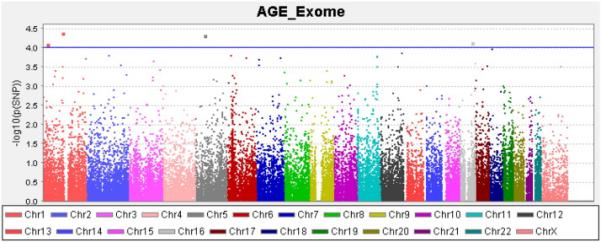
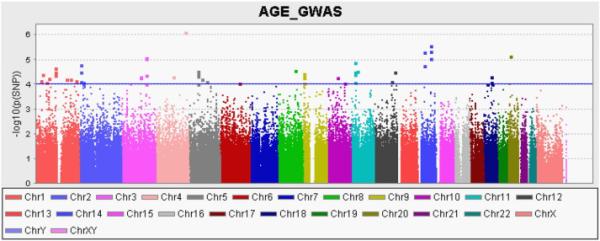
Advanced glycation end-products (AGEs) are a diverse group of molecules produced by the non-enzymatic addition of glucose to proteins, lipids, and nucleic acids. AGE levels have been associated with hyperglycemia and diabetic complications, especially in animal models, but less clearly in human studies. We measured total serum AGEs using an enzyme linked immunosorbant assay (ELISA) in 506 subjects from 246 families in the Diabetes Heart Study (DHS)/DHS MIND Study (n=399 type 2 diabetes (T2D)-affected). Single nucleotide polymorphisms (SNPs) in several candidate genes, including known AGE receptors, were tested for their influence on circulating AGE levels. The genetic analysis was expanded to include an exploratory genome-wide association study (GWAS) and exome chip analysis of AGEs (≈440,000 SNPs). AGEs were found to be highly heritable (h(2)=0.628, p=8.96 × 10(-10)). While no SNPs from candidate genes were significantly associated after Bonferroni correction, rs1035798 in the gene AGER was the most significantly associated (p=0.007). Additionally, rs7198427, in MT1A, showed a nominally significant p-value (p=0.0099). No SNPs from the GWAS or exome studies were identified after correction for multiple comparisons; however, rs17054480 in the PALLD2 gene on chromosome 4 showed the strongest association (p=7.77 × 10(-7)). Five SNPs at two loci (ISCA2/NPC2 and FBXO33) had p-values of less than 2.0 × 10(-5) and three additional SNPs (rs716326 in MACROD2, and rs6795197 and rs6765857 in ZBTB38) showed a nominal association with p-values of less than 1.0 × 10(-5).These findings provide a foundation for further investigation into the genetic component of circulating AGEs.
晚期糖基化终末产物(AGEs)是一类通过葡萄糖非酶促加成到蛋白质、脂质和核酸上而产生的多种分子。AGE水平与高血糖及糖尿病并发症相关,尤其在动物模型中,但在人体研究中相关性较弱。我们在糖尿病心脏研究(DHS)/DHS脑研究(n = 399例2型糖尿病(T2D)患者)的246个家庭的506名受试者中,使用酶联免疫吸附测定(ELISA)法测量了血清总AGEs。检测了包括已知AGE受体在内的几个候选基因中的单核苷酸多态性(SNP)对循环AGE水平的影响。遗传分析扩展至包括一项探索性全基因组关联研究(GWAS)以及对AGEs的外显子芯片分析(约440,000个SNP)。发现AGEs具有高度遗传性(h(2)=0.628,p = 8.96×10(-10))。虽然经Bonferroni校正后,候选基因中的SNP均无显著关联,但AGER基因中的rs1035798关联最为显著(p = 0.007)。此外,MT1A基因中的rs7198427显示出名义上显著的p值(p = 0.0099)。经多重比较校正后,GWAS或外显子研究中未鉴定出SNP;然而,4号染色体上PALLD2基因中的rs17054480关联最强(p = 7.77×10(-7))。两个位点(ISCA2/NPC2和FBXO33)的五个SNP的p值小于2.0×10(-5),另外三个SNP(MACROD2中的rs716326以及ZBTB38中的rs6795197和rs6765857)显示出名义上的关联,p值小于1.0×10(-5)。这些发现为进一步研究循环AGEs的遗传成分奠定了基础。