Cheng Ya-Wen, Lin Frank Cheau-Feng, Chen Chih-Yi, Hsu Nan-Yung
Graduate Institute of Cancer Biology and Drug Discovery, College of Medical Science and Technology, Taipei Medical University, Taipei, Taiwan.
Cancer Center, Taipei Medical University Hospital, Taipei Medical University, Taipei, Taiwan.
Oncotarget. 2016 Apr 12;7(15):19850-62. doi: 10.18632/oncotarget.7628.
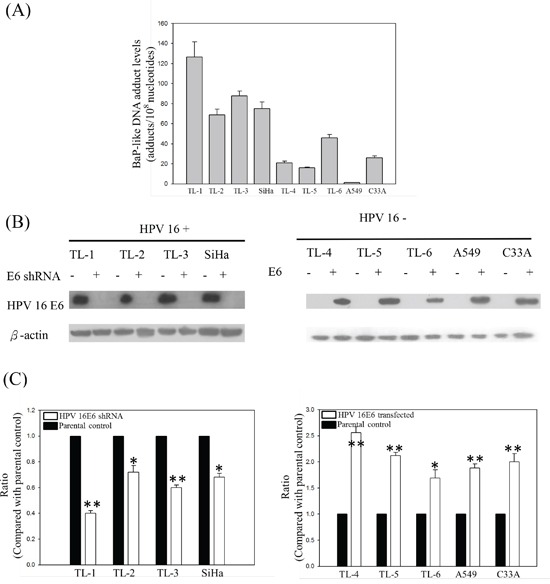
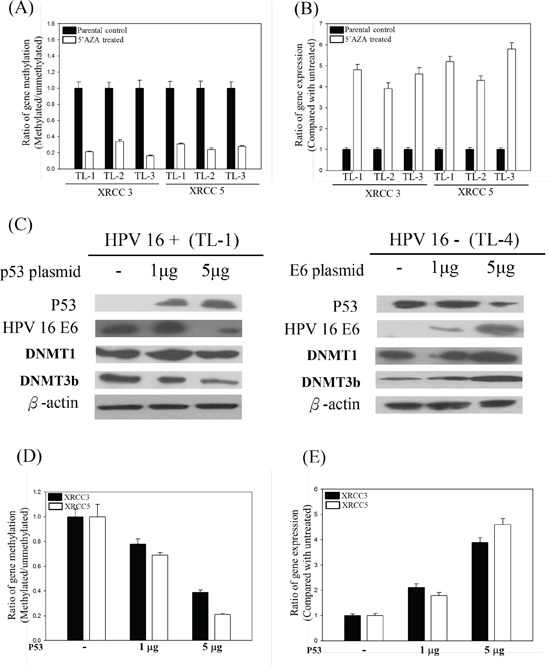
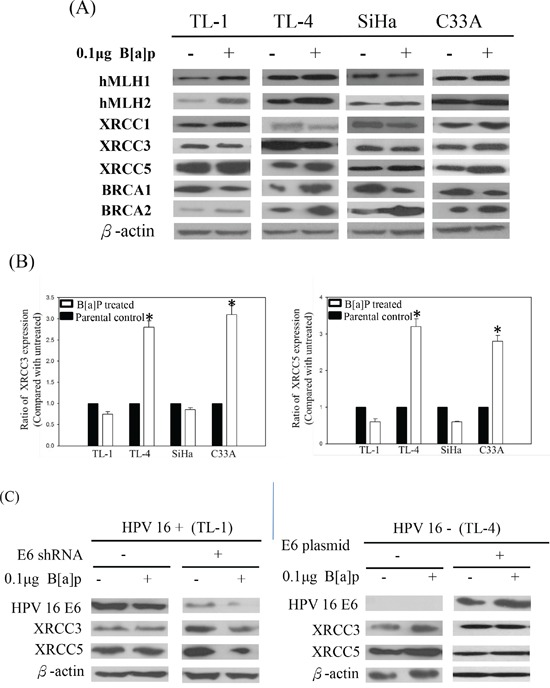
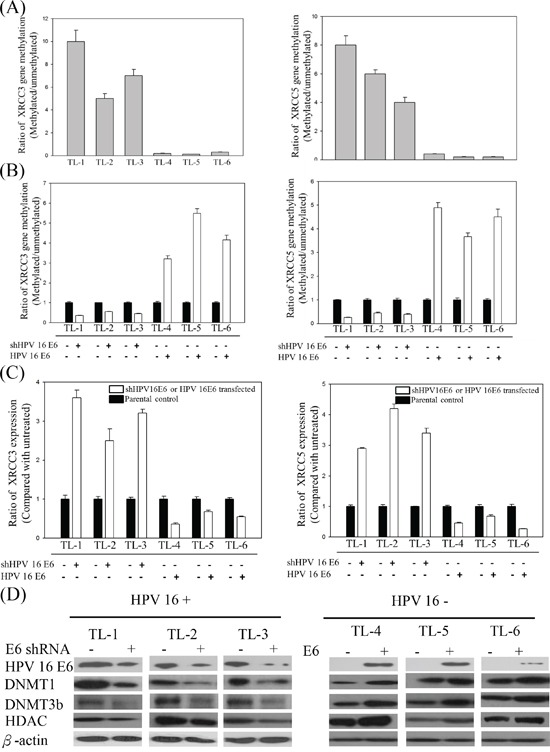
Most studies of lung tumorigenesis have focused on smokers rather than nonsmokers. In this study, we used human papillomavirus (HPV)-positive and HPV-negative lung cancer cells to test the hypothesis that HPV infection synergistically increases DNA damage induced by exposure to the carcinogen benzo[a]pyrene (B[a]P), and contributes to lung tumorigenesis in nonsmokers. DNA adduct levels induced by B[a]P in HPV-positive cells were significantly higher than in HPV-negative cells. The DNA adduct formation was dependent on HPV E6 oncoprotein expression. Gene and protein expression of two DNA repair genes, XRCC3 and XRCC5, were lower in B[a]P-treated E6-positive cells than in E6-negative lung cancer cells. The reduced expression was also detected immunohistochemically and was caused by increased promoter hypermethylation. Moreover, mutations of p53 and epidermal growth factor receptor (EGFR) genes in lung cancer patients were associated with XRCC5 inactivation. In sum, our study indicates that HPV E6-induced promoter hypermethylation of the XRCC3 and XRCC5 DNA repair genes and the resultant decrease in their expression increases B[a]P-induced DNA adducts and contributes to lung tumorigenesis in nonsmokers.
大多数肺癌发生的研究都集中在吸烟者而非不吸烟者身上。在本研究中,我们使用人乳头瘤病毒(HPV)阳性和阴性的肺癌细胞来验证以下假说:HPV感染协同增加暴露于致癌物苯并[a]芘(B[a]P)所诱导的DNA损伤,并促进不吸烟者的肺癌发生。B[a]P在HPV阳性细胞中诱导产生的DNA加合物水平显著高于HPV阴性细胞。DNA加合物的形成依赖于HPV E6癌蛋白的表达。在经B[a]P处理的E6阳性细胞中,两个DNA修复基因XRCC3和XRCC5的基因及蛋白表达低于E6阴性肺癌细胞。这种表达降低也通过免疫组化检测到,并且是由启动子高甲基化增加所致。此外,肺癌患者中p53和表皮生长因子受体(EGFR)基因的突变与XRCC5失活相关。总之,我们的研究表明,HPV E6诱导的XRCC3和XRCC5 DNA修复基因启动子高甲基化以及其表达的相应降低增加了B[a]P诱导的DNA加合物,并促进了不吸烟者的肺癌发生。