Shiozaki Takuhei, Ijichi Minoru, Isobe Kazuo, Hashihama Fuminori, Nakamura Ken-Ichi, Ehama Makoto, Hayashizaki Ken-Ichi, Takahashi Kazutaka, Hamasaki Koji, Furuya Ken
Department of Marine Ecosystem Dynamics, Atmosphere and Ocean Research Institute, The University of Tokyo, Chiba, Japan.
Department of Applied Biological Chemistry, Graduate School of Agricultural and Life Sciences, The University of Tokyo, Tokyo, Japan.
ISME J. 2016 Sep;10(9):2184-97. doi: 10.1038/ismej.2016.18. Epub 2016 Feb 26.
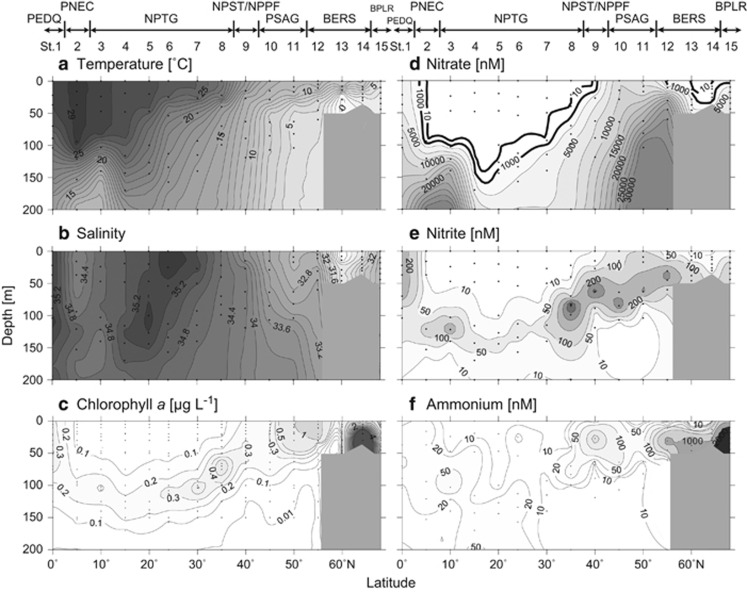
We examined nitrification in the euphotic zone, its impact on the nitrogen cycles, and the controlling factors along a 7500 km transect from the equatorial Pacific Ocean to the Arctic Ocean. Ammonia oxidation occurred in the euphotic zone at most of the stations. The gene and transcript abundances for ammonia oxidation indicated that the shallow clade archaea were the major ammonia oxidizers throughout the study regions. Ammonia oxidation accounted for up to 87.4% (average 55.6%) of the rate of nitrate assimilation in the subtropical oligotrophic region. However, in the shallow Bering and Chukchi sea shelves (bottom ⩽67 m), the percentage was small (0-4.74%) because ammonia oxidation and the abundance of ammonia oxidizers were low, the light environment being one possible explanation for the low activity. With the exception of the shallow bottom stations, depth-integrated ammonia oxidation was positively correlated with depth-integrated primary production. Ammonia oxidation was low in the high-nutrient low-chlorophyll subarctic region and high in the Bering Sea Green Belt, and primary production in both was influenced by micronutrient supply. An ammonium kinetics experiment demonstrated that ammonia oxidation did not increase significantly with the addition of 31-1560 nm ammonium at most stations except in the Bering Sea Green Belt. Thus, the relationship between ammonia oxidation and primary production does not simply indicate that ammonia oxidation increased with ammonium supply through decomposition of organic matter produced by primary production but that ammonia oxidation might also be controlled by micronutrient availability as with primary production.
我们沿着从赤道太平洋到北冰洋的7500公里断面,研究了真光层中的硝化作用、其对氮循环的影响以及控制因素。在大多数站点的真光层中都发生了氨氧化作用。氨氧化的基因和转录本丰度表明,浅分支古菌是整个研究区域的主要氨氧化菌。在亚热带贫营养区域,氨氧化占硝酸盐同化速率的比例高达87.4%(平均55.6%)。然而,在白令海和楚科奇海的浅海陆架(底部⩽67米),该比例较小(0 - 4.74%),因为氨氧化作用和氨氧化菌的丰度较低,光照环境可能是活性较低的一个原因。除了浅海底部站点外,深度积分氨氧化与深度积分初级生产呈正相关。在高营养低叶绿素的亚北极区域氨氧化作用较低,而在白令海绿带较高,两者的初级生产都受微量营养素供应的影响。一项铵动力学实验表明,除了白令海绿带外,在大多数站点添加31 - 1560纳米铵后氨氧化作用并未显著增加。因此,氨氧化与初级生产之间的关系并不简单地表明氨氧化作用随着初级生产产生的有机物分解所提供的铵供应而增加,而是氨氧化作用可能也像初级生产一样受微量营养素可用性的控制。