Welzenbach Julia, Neuhoff Christiane, Looft Christian, Schellander Karl, Tholen Ernst, Große-Brinkhaus Christine
Institute of Animal Science, University of Bonn, Endenicher Allee 15, 53115 Bonn, Germany.
PLoS One. 2016 Feb 26;11(2):e0149758. doi: 10.1371/journal.pone.0149758. eCollection 2016.
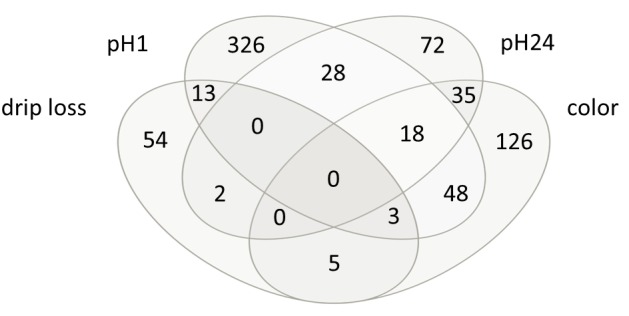
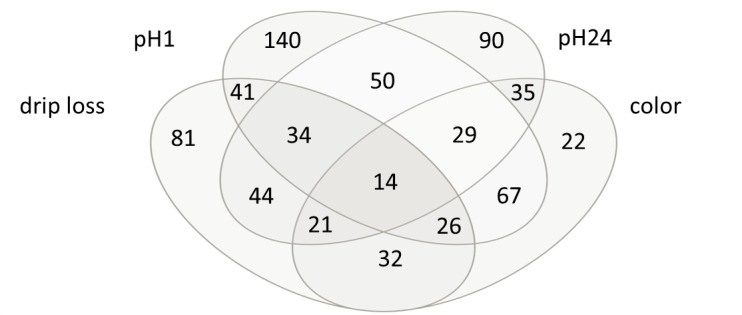
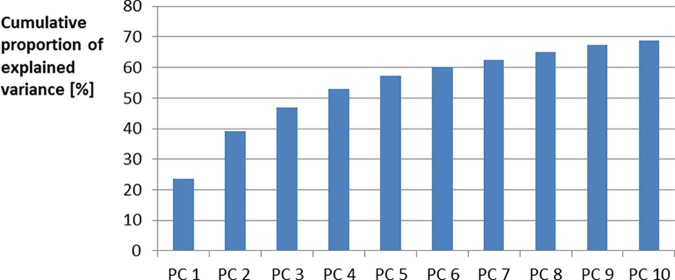
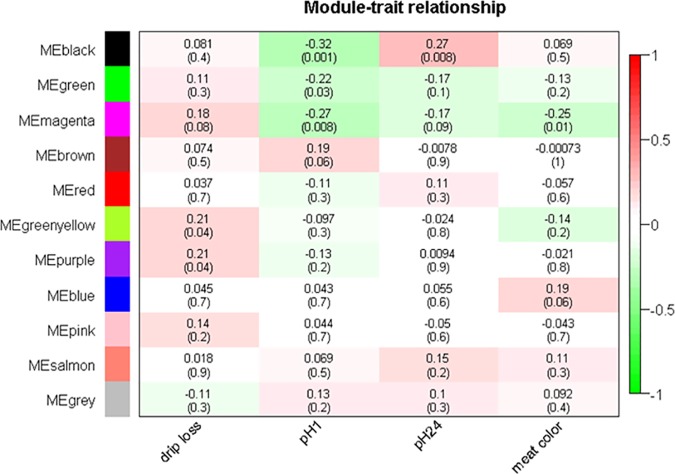
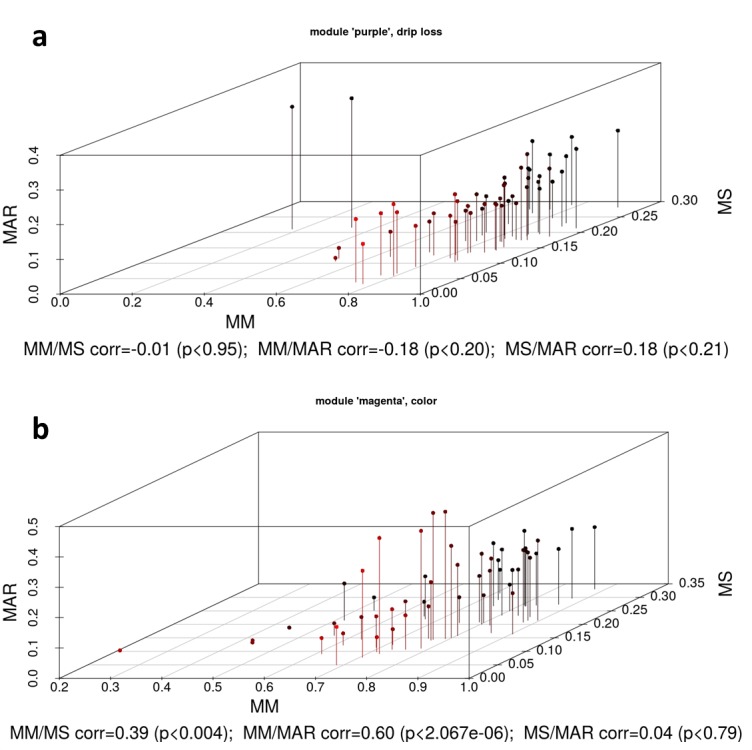
The aim of this study was to elucidate the underlying biochemical processes to identify potential key molecules of meat quality traits drip loss, pH of meat 1 h post-mortem (pH1), pH in meat 24 h post-mortem (pH24) and meat color. An untargeted metabolomics approach detected the profiles of 393 annotated and 1,600 unknown metabolites in 97 Duroc × Pietrain pigs. Despite obvious differences regarding the statistical approaches, the four applied methods, namely correlation analysis, principal component analysis, weighted network analysis (WNA) and random forest regression (RFR), revealed mainly concordant results. Our findings lead to the conclusion that meat quality traits pH1, pH24 and color are strongly influenced by processes of post-mortem energy metabolism like glycolysis and pentose phosphate pathway, whereas drip loss is significantly associated with metabolites of lipid metabolism. In case of drip loss, RFR was the most suitable method to identify reliable biomarkers and to predict the phenotype based on metabolites. On the other hand, WNA provides the best parameters to investigate the metabolite interactions and to clarify the complex molecular background of meat quality traits. In summary, it was possible to attain findings on the interaction of meat quality traits and their underlying biochemical processes. The detected key metabolites might be better indicators of meat quality especially of drip loss than the measured phenotype itself and potentially might be used as bio indicators.
本研究的目的是阐明潜在的生化过程,以确定肉质性状滴水损失、宰后1小时肉的pH值(pH1)、宰后24小时肉的pH值(pH24)和肉色的潜在关键分子。一种非靶向代谢组学方法在97头杜洛克×皮特兰猪中检测到了393种注释代谢物和1600种未知代谢物的谱图。尽管在统计方法上存在明显差异,但所应用的四种方法,即相关性分析、主成分分析、加权网络分析(WNA)和随机森林回归(RFR),主要得出了一致的结果。我们的研究结果得出结论,肉质性状pH1、pH24和颜色受宰后能量代谢过程(如糖酵解和磷酸戊糖途径)的强烈影响,而滴水损失与脂质代谢的代谢物显著相关。在滴水损失方面,RFR是识别可靠生物标志物并基于代谢物预测表型的最合适方法。另一方面,WNA提供了最佳参数来研究代谢物相互作用,并阐明肉质性状的复杂分子背景。总之,有可能获得关于肉质性状及其潜在生化过程相互作用的研究结果。检测到的关键代谢物可能比测量的表型本身更能作为肉质尤其是滴水损失的更好指标,并且有可能用作生物指标。