Department of Public Administration and Health Services Management, University of Ghana Business School, P. O. Box 78, Legon, Accra, Ghana.
Health Econ Rev. 2016 Dec;6(1):9. doi: 10.1186/s13561-016-0085-7. Epub 2016 Feb 27.
The study examines trends in the consumption of reproductive health services (use of modern contraceptives, health facility deliveries, assisted deliveries, first trimester antenatal visit and 4+ antenatal visits) and their determinants using four rounds of Ghana Demographic and Health Surveys (1993, 1998, 2003 and 2008) data.
The study uses cross-sectional and pooled probit and negative bionomial regressions models to estimate the determinants of use of the above listed reproductive health services for the period from 1993 to 2008.
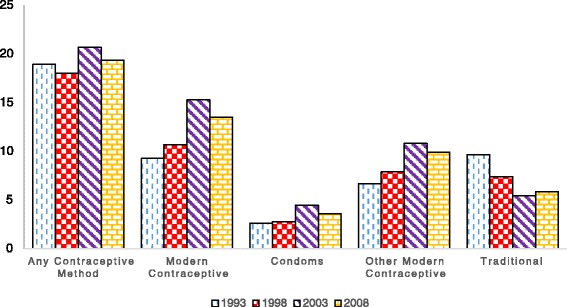
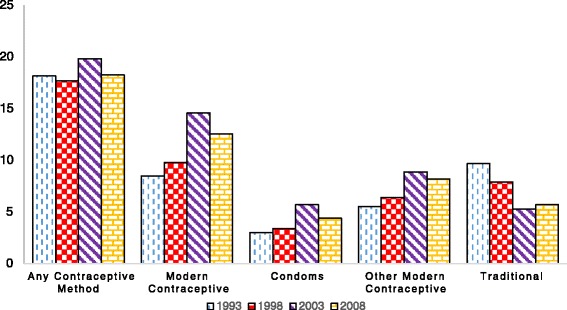
Summary statistics suggest that the above-listed reproductive health services have consistently improved from 1993 to 2008. However, use of traditional methods of contraception increased in urban centers between 2003 and 2008, although the reverse was the case in rural areas. Regression results suggest that place of residence, access to and availability of health services, religion, and birth order are significant correlates of use of reproductive health services. Additionally, the study suggests that the number of living children has the largest effect on use of modern contraception. The effect of a partner's education on use of modern contraception is higher than that of the woman, and a much stronger correlation exists between household wealth and use of reproductive health inputs than expected.
The study associates the increasing use of traditional contraceptives in urban centers and the much stronger effect of household wealth with urban poverty and the increasing indirect cost of health services, and argues for interventions to improve quality of service in public facilities and reduce inequities in the distribution of health facilities. Finally, the study advocates for family planning-related interventions that involve and target partners given the importance of partner education in the use of modern contraception.
本研究使用加纳四次人口和健康调查(1993 年、1998 年、2003 年和 2008 年)的数据,考察了生殖健康服务(现代避孕方法的使用、在医疗保健机构分娩、辅助分娩、孕早期产前检查和 4 次以上产前检查)的消费趋势及其决定因素。
本研究采用横截面和汇总概率单位和负二项回归模型,估计了 1993 年至 2008 年期间上述生殖健康服务的使用决定因素。
汇总统计数据表明,上述生殖健康服务自 1993 年以来持续改善。然而,2003 年至 2008 年期间,城市中心传统避孕方法的使用有所增加,而农村地区则相反。回归结果表明,居住地、获得和提供卫生服务的机会、宗教和出生顺序是生殖健康服务使用的重要相关因素。此外,研究表明,现有子女数量对现代避孕方法的使用影响最大。与女性相比,伴侣教育对现代避孕方法的使用具有更高的影响,而且家庭财富与生殖健康投入的使用之间的相关性比预期的要强得多。
本研究将城市中心传统避孕药具使用的增加以及家庭财富的更大影响与城市贫困和医疗服务间接成本的增加联系起来,并呼吁采取干预措施,提高公共设施的服务质量,减少卫生设施分配的不平等。最后,本研究主张进行计划生育相关的干预措施,让伴侣参与并成为目标人群,因为伴侣教育对现代避孕方法的使用非常重要。