Zhao Jiangtao, Cai Bing, Luo Zhenlin, Dong Yongqi, Zhang Yi, Xu Han, Hong Bin, Yang Yuanjun, Li Liangbin, Zhang Wenhua, Gao Chen
National Synchrotron Radiation Laboratory and CAS Key Laboratory of Materials for Energy Conversion, University of Science and Technology of China, Hefei, Anhui, 230026, China.
State Key Laboratory of Catalysis, Dalian Institute of Chemical Physics, Chinese Academy of Sciences, Dalian National Laboratory for Clean Energy, Dalian 116023, China.
Sci Rep. 2016 Feb 29;6:21976. doi: 10.1038/srep21976.
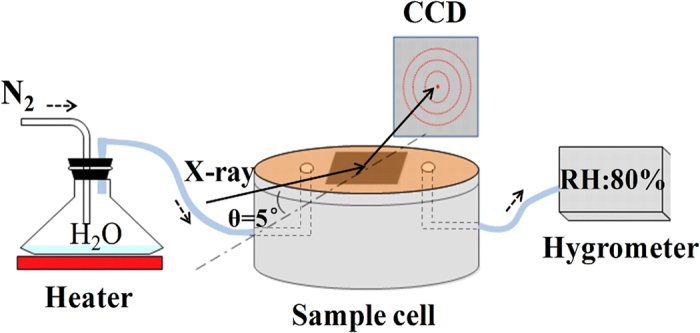
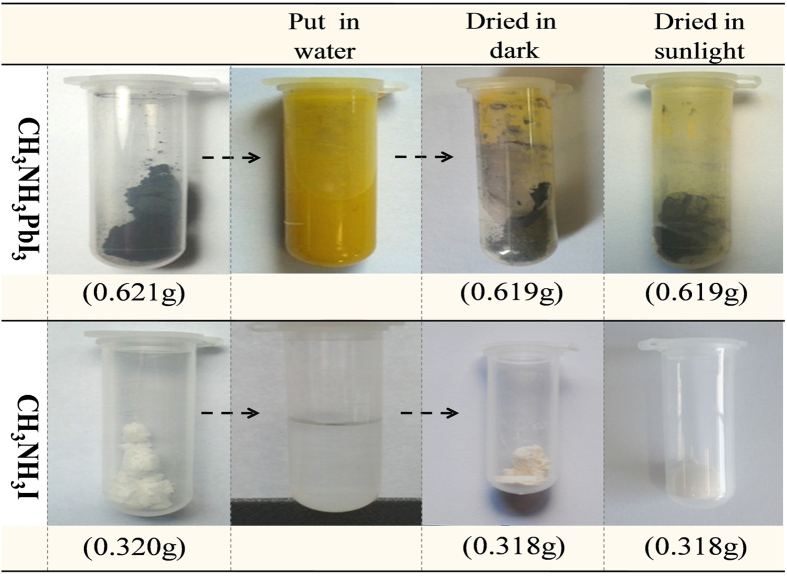
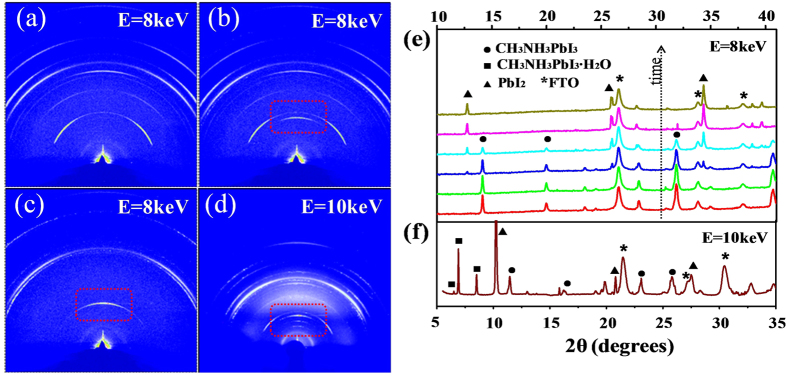
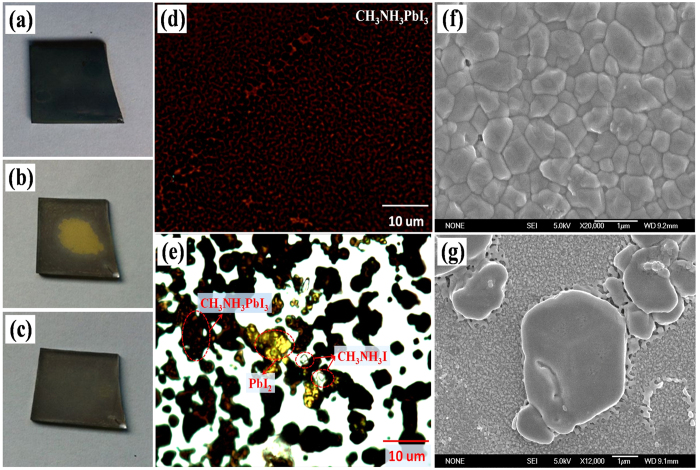
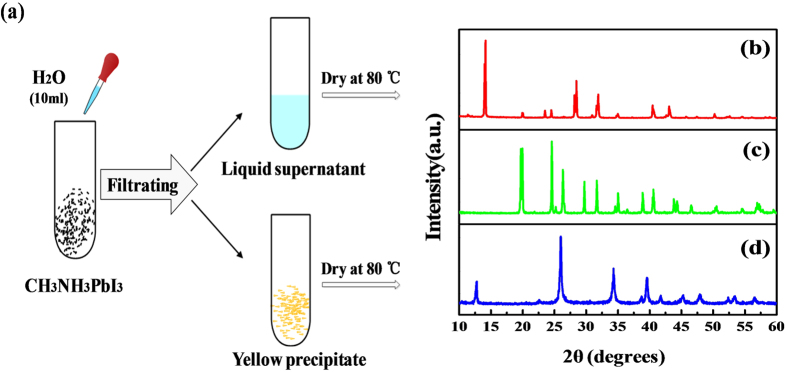
Instability of emerging perovskite organometallic halide in humidity environment is the biggest obstacle for its potential applications in solar energy harvest and electroluminescent display. Understanding the detailed decay mechanism of these materials in moisture is a critical step towards the final appropriate solutions. As a model study presented in this work, in situ synchrotron radiation x-ray diffraction was combined with microscopy and gravimetric analysis to study the degradation process of CH3NH3PbI3 in moisture, and the results reveal that: 1) intermediate monohydrated CH3NH3PbI3·H2O is detected in the degradation process of CH3NH3PbI3 and the final decomposition products are PbI2 and aqueous CH3NH3I; 2) the aqueous CH3NH3I could hardly further decompose into volatile CH3NH2, HI or I2; 3) the moisture disintegrate CH3NH3PbI3 and then alter the distribution of the decomposition products, which leads to an incompletely-reversible reaction of CH3NH3PbI3 hydrolysis and degrades the photoelectric properties. These findings further elucidate the picture of hydrolysis process of perovskite organometallic halide in humidity environment.
新兴的钙钛矿有机金属卤化物在潮湿环境中的不稳定性是其在太阳能收集和电致发光显示方面潜在应用的最大障碍。了解这些材料在潮湿环境中的详细衰减机制是找到最终合适解决方案的关键一步。作为本工作中提出的一项模型研究,原位同步辐射X射线衍射与显微镜和重量分析相结合,以研究CH3NH3PbI3在潮湿环境中的降解过程,结果表明:1)在CH3NH3PbI3的降解过程中检测到中间产物一水合CH3NH3PbI3·H2O,最终分解产物是PbI2和CH3NH3I水溶液;2)CH3NH3I水溶液几乎不能进一步分解为挥发性的CH3NH2、HI或I2;3)水分使CH3NH3PbI3分解,进而改变分解产物的分布,导致CH出3NH3PbI3水解反应不完全可逆,并降低其光电性能。这些发现进一步阐明了钙钛矿有机金属卤化物在潮湿环境中的水解过程。