Stephan Jules R, Nolan Elizabeth M
Department of Chemistry, Massachusetts Institute of Technology, Cambridge, MA 02139, USA.
Chem Sci. 2016 Mar 1;7(3):1962-1975. doi: 10.1039/C5SC03287C. Epub 2015 Nov 23.
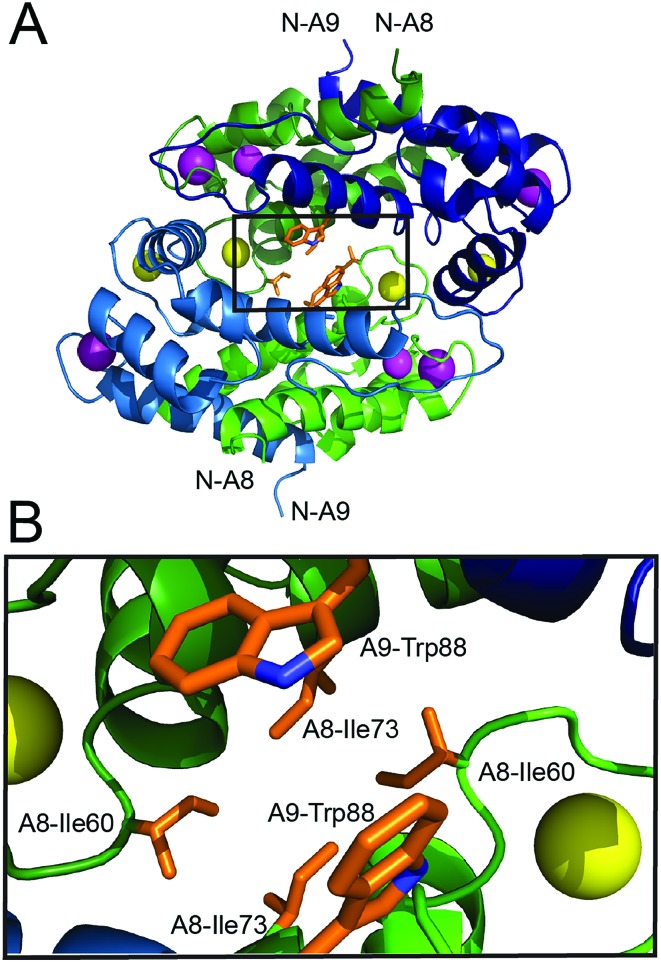
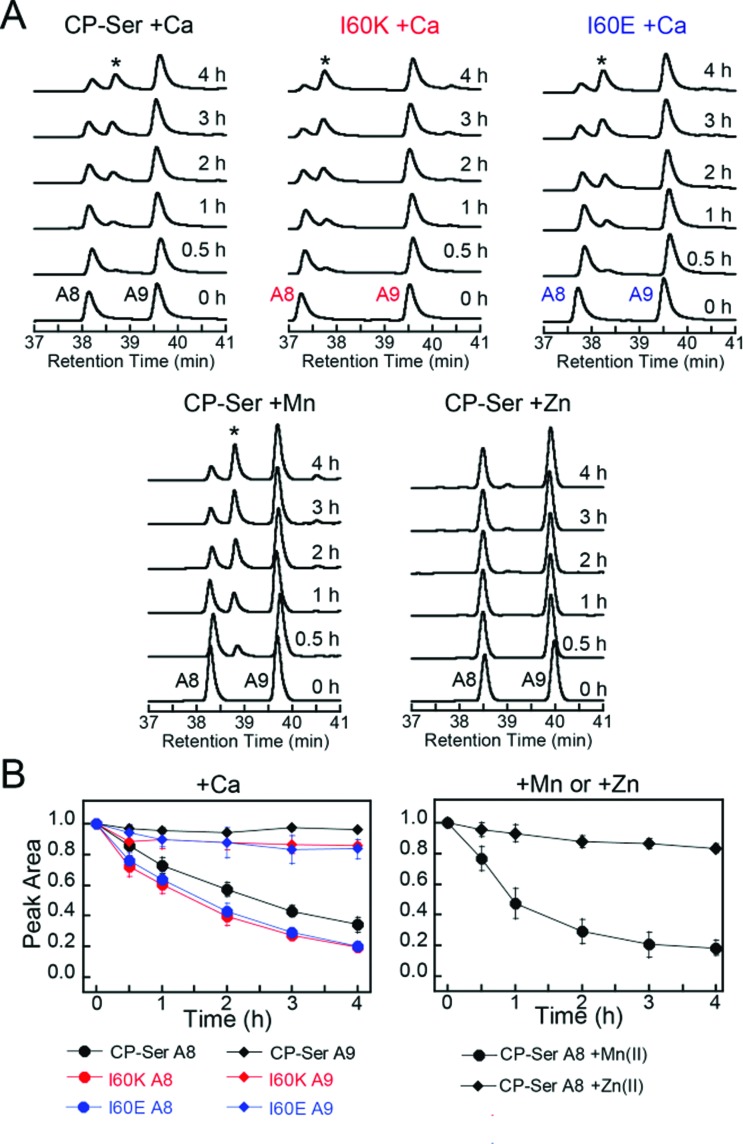
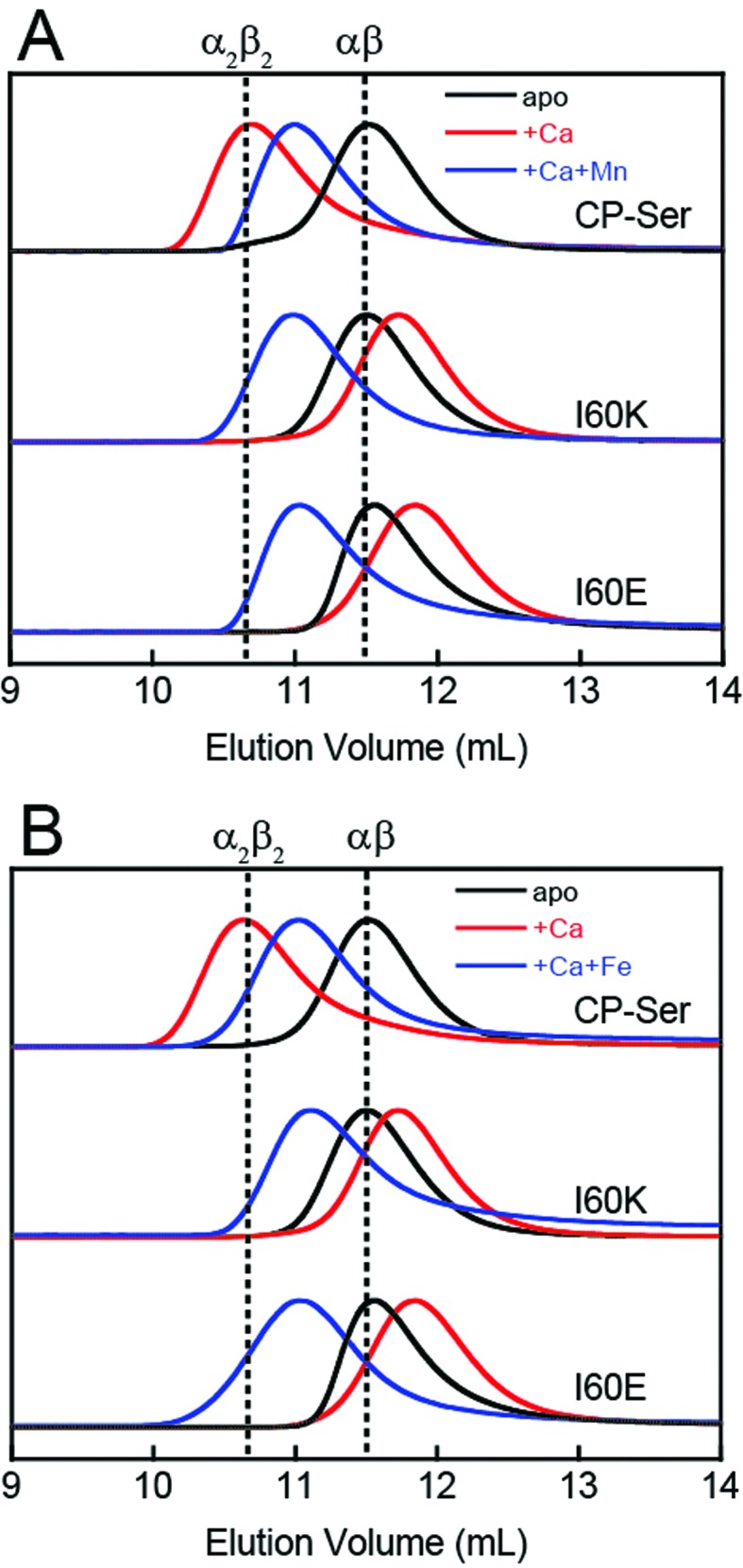
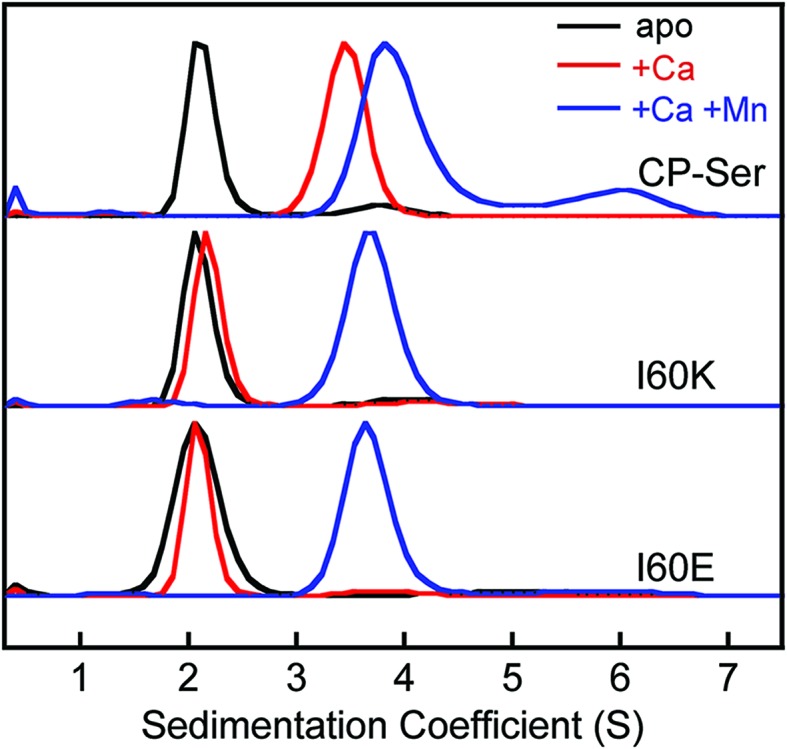
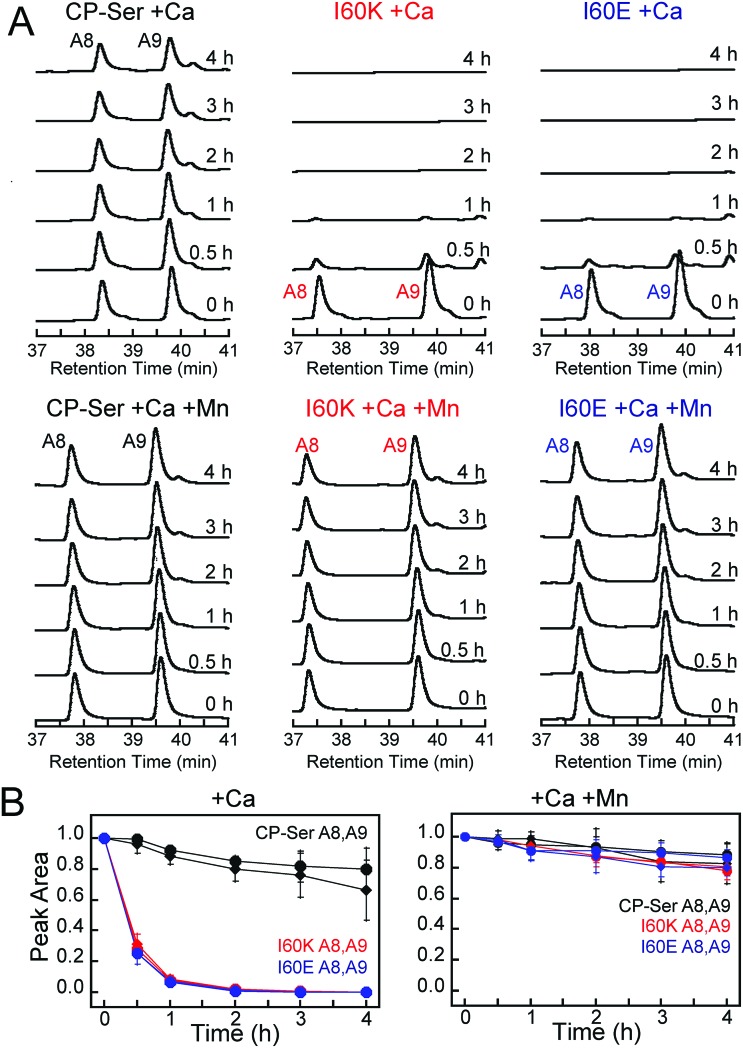
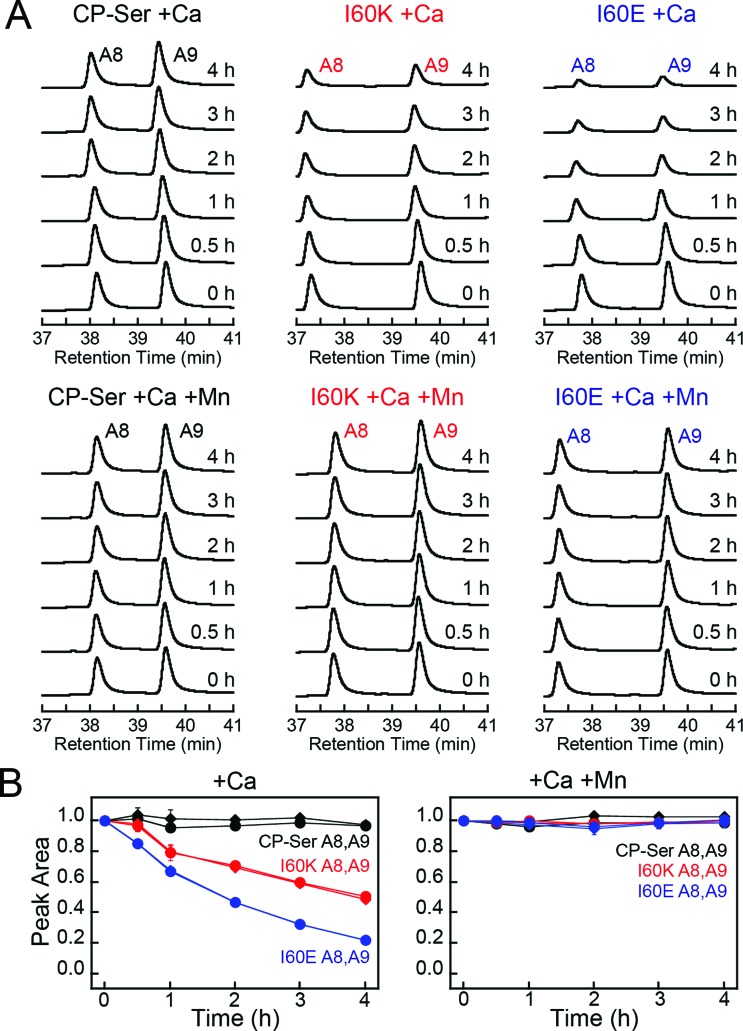
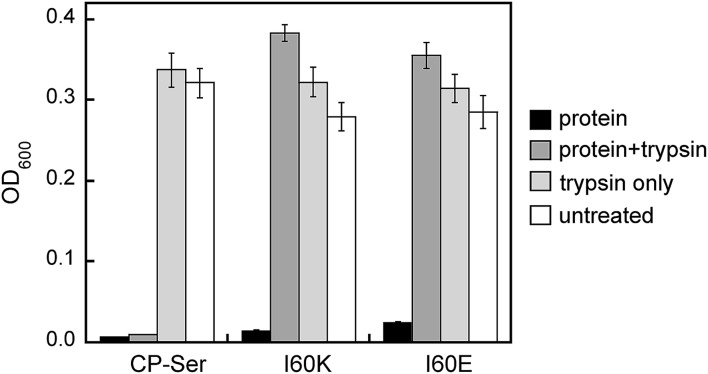
Calprotectin (CP, S100A8/S100A9 oligomer, MRP-8/14 oligomer, calgranulins A and B) is a protein component of the innate immune system that contributes to the metal-withholding response by sequestering bioavailable transition metal ions at sites of infection. Human CP employs Ca(II) ions to modulate its quaternary structure, transition metal binding properties, and antimicrobial activity. In this work, we report the discovery that Ca(II)-induced self-association of human CP to afford heterotetramers protects the protein scaffold from degradation by host serine proteases. We present the design and characterization of two new human CP-Ser variants, S100A8(C42S)(I60E)/S100A9(C3S) and S100A8(C42S)(I60K)/S100A9(C3S), that exhibit defective tetramerization properties. Analytical size exclusion chromatography and analytical ultracentrifugation reveal that both variants, hereafter I60E and I60K, persist as heterodimers in the presence of Ca(II) only, and form heterotetramers in the presence of Mn(II) only and both Ca(II) and Mn(II). Coordination to Fe(II) also causes I60E and I60K to form heterotetramers in both the absence and presence of Ca(II). The Ca(II)-bound I60E and I60K heterodimers are readily degraded by trypsin, chymotrypsin and human neutrophil elastase, whereas the Ca(II)-bound CP-Ser heterotetramers and the Ca(II)- and Mn(II)-bound I60E and I60K heterotetramers are resistant to degradation by these host proteases. The staphylococcal extracellular protease GluC cuts the S100A8 subunit of CP-Ser at the C-terminal end of residue 89 to afford a ΔSKHE variant. The GluC cleavage site is in close proximity to the HisAsp metal-binding site, which coordinates Zn(II) with high affinity, and Zn(II) chelation protects the S100A8 subunit from GluC cleavage. Taken together, these results provide new insight into how Ca(II) ions and transition metals modulate the chemistry and biology of CP, and indicate that coordination to divalent cations transforms human CP into a protease-resistant form and enables innate immune function in the hostile conditions of an infection site.
钙卫蛋白(CP,S100A8/S100A9寡聚体、MRP - 8/14寡聚体、钙粒蛋白A和B)是先天性免疫系统的一种蛋白质成分,通过在感染部位螯合生物可利用的过渡金属离子,参与金属扣留反应。人CP利用钙离子来调节其四级结构、过渡金属结合特性和抗菌活性。在这项工作中,我们报告了一项发现,即钙离子诱导人CP自组装形成异源四聚体,可保护蛋白质支架免受宿主丝氨酸蛋白酶的降解。我们展示了两种新的人CP - Ser变体S100A8(C42S)(I60E)/S100A9(C3S)和S100A8(C42S)(I60K)/S100A9(C3S)的设计与表征,它们表现出有缺陷的四聚化特性。分析型尺寸排阻色谱和分析型超速离心表明,这两种变体(以下简称I60E和I60K)仅在存在钙离子时以异源二聚体形式存在,仅在存在锰离子以及同时存在钙离子和锰离子时形成异源四聚体。与亚铁离子配位也会使I60E和I60K在有无钙离子的情况下都形成异源四聚体。结合钙离子的I60E和I60K异源二聚体很容易被胰蛋白酶、胰凝乳蛋白酶和人中性粒细胞弹性蛋白酶降解,而结合钙离子的CP - Ser异源四聚体以及结合钙离子和锰离子的I60E和I60K异源四聚体对这些宿主蛋白酶的降解具有抗性。葡萄球菌细胞外蛋白酶GluC在残基89的C末端切割CP - Ser的S100A8亚基,得到一个ΔSKHE变体。GluC的切割位点紧邻HisAsp金属结合位点,该位点以高亲和力配位锌离子,并且锌离子螯合可保护S100A8亚基免受GluC切割。综上所述,这些结果为钙离子和过渡金属如何调节CP的化学性质和生物学特性提供了新的见解,并表明与二价阳离子配位可将人CP转化为抗蛋白酶形式,并在感染部位的恶劣条件下实现先天性免疫功能。