Aceves M, Mathai B B, Hook M A
Department of Neuroscience and Experimental Therapeutics, Texas A&M Health Science Center, Bryan, TX, USA.
Spinal Cord. 2016 Oct;54(10):767-777. doi: 10.1038/sc.2016.28. Epub 2016 Mar 1.
The current study aimed to evaluate the contribution(s) of specific opioid receptor systems to the analgesic and detrimental effects of morphine, observed after spinal cord injury in prior studies.
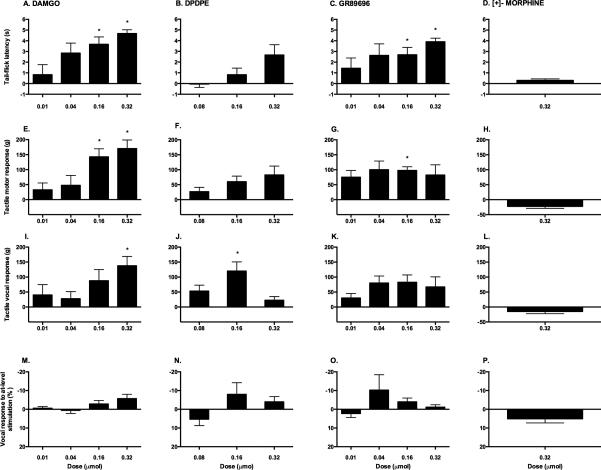
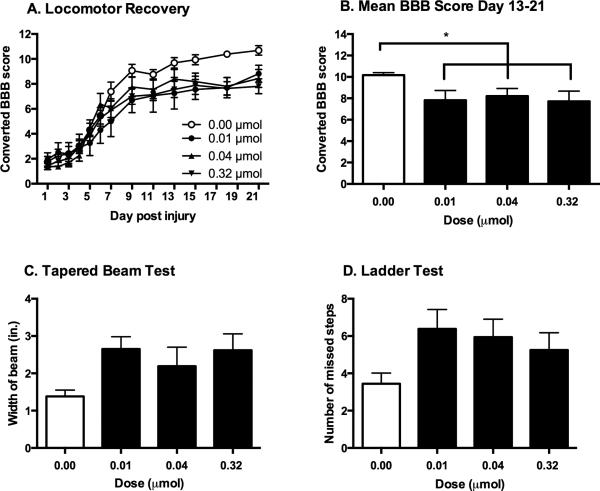
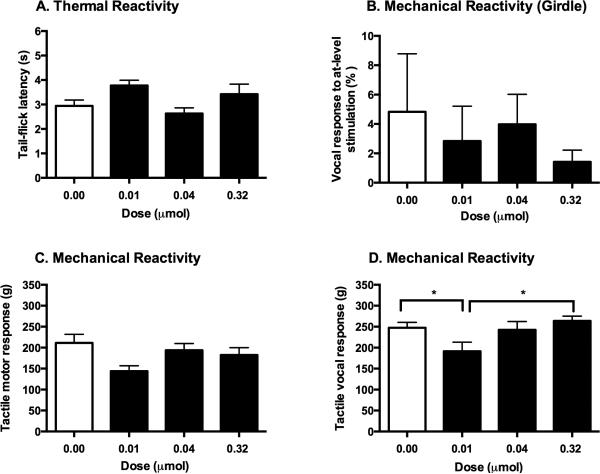
We used specific opioid receptor agonists to assess the effects of μ- (DAMGO), δ- (DPDPE) and κ- (GR89696) opioid receptor activation on locomotor (Basso, Beattie and Bresnahan scale, tapered beam and ladder tests) and sensory (girdle, tactile and tail-flick tests) recovery in a rodent contusion model (T12). We also tested the contribution of non-classic opioid binding using [+]- morphine.
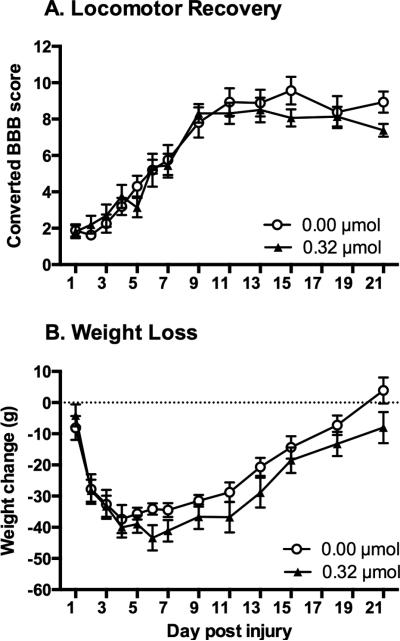
First, a dose-response curve for analgesic efficacy was generated for each opioid agonist. Baseline locomotor and sensory reactivity was assessed 24 h after injury. Subjects were then treated with an intrathecal dose of a specific agonist and re-tested after 30 min. To evaluate the effects on recovery, subjects were treated with a single dose of an agonist and both locomotor and sensory function were monitored for 21 days.
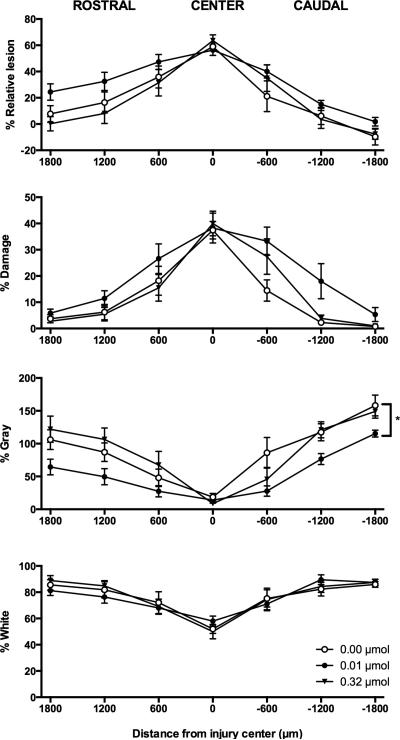
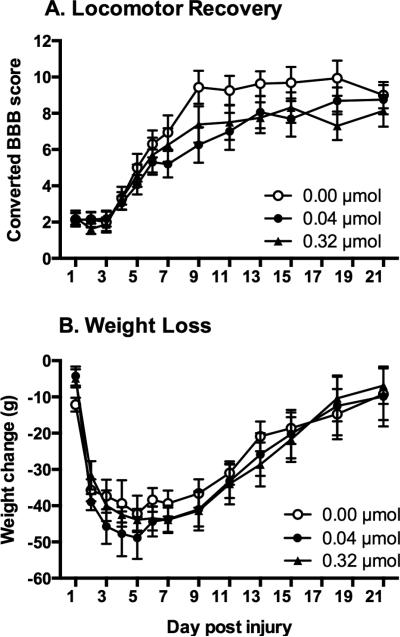
All agonists for the classic opioid receptors, but not the [+]- morphine enantiomer, produced antinociception at a concentration equivalent to a dose of morphine previously shown to produce strong analgesic effects (0.32 μmol). DAMGO and [+]- morphine did not affect long-term recovery. GR89696, however, significantly undermined the recovery of locomotor function at all doses tested.
On the basis of these data, we hypothesize that the analgesic efficacy of morphine is primarily mediated by binding to the classic μ-opioid receptor. Conversely, the adverse effects of morphine may be linked to activation of the κ-opioid receptor. Ultimately, elucidating the molecular mechanisms underlying the effects of morphine is imperative to develop safe and effective pharmacological interventions in a clinical setting.
USA.
Grant DA31197 to MA Hook and the NIDA Drug Supply Program.
本研究旨在评估特定阿片受体系统对吗啡镇痛及有害作用的贡献,这些作用在先前研究的脊髓损伤后已被观察到。
我们使用特定的阿片受体激动剂,评估μ-(DAMGO)、δ-(DPDPE)和κ-(GR89696)阿片受体激活对啮齿动物挫伤模型(T12)运动功能(Basso、Beattie和Bresnahan评分、渐变梁和阶梯试验)和感觉功能(束带、触觉和甩尾试验)恢复的影响。我们还使用[+]-吗啡测试了非经典阿片结合的作用。
首先,为每种阿片激动剂生成镇痛效果的剂量反应曲线。在损伤后24小时评估基线运动和感觉反应性。然后给受试者鞘内注射特定激动剂,并在30分钟后重新测试。为了评估对恢复的影响,给受试者单次注射激动剂,并对运动和感觉功能进行21天的监测。
所有经典阿片受体激动剂,但不包括[+]-吗啡对映体,在相当于先前显示产生强镇痛作用的吗啡剂量(0.32μmol)的浓度下产生镇痛作用。DAMGO和[+]-吗啡不影响长期恢复。然而,GR89696在所有测试剂量下均显著损害运动功能的恢复。
基于这些数据,我们假设吗啡的镇痛效果主要通过与经典μ-阿片受体结合介导。相反,吗啡的不良反应可能与κ-阿片受体的激活有关。最终,阐明吗啡作用的分子机制对于在临床环境中开发安全有效的药物干预措施至关重要。
美国。
授予MA Hook的DA31197资助以及美国国立药物滥用研究所药物供应计划。