
一项关于异麦芽糖酐铁静脉注射与硫酸亚铁口服治疗非髓系恶性肿瘤合并贫血且正在接受化疗患者的随机非劣效性试验:PROFOUND试验
A Randomized Noninferiority Trial of Intravenous Iron Isomaltoside versus Oral Iron Sulfate in Patients with Nonmyeloid Malignancies and Anemia Receiving Chemotherapy: The PROFOUND Trial.
作者信息
Birgegård Gunnar, Henry David, Glaspy John, Chopra Rakesh, Thomsen Lars L, Auerbach Michael
机构信息
Institute for Medical Sciences, Uppsala University Hospital, Uppsala, Sweden.
Joan Karnell Cancer Center, Pennsylvania Hospital, Philadelphia, PA.
出版信息
Pharmacotherapy. 2016 Apr;36(4):402-14. doi: 10.1002/phar.1729. Epub 2016 Apr 1.
STUDY OBJECTIVE
A safe alternative to erythropoiesis-stimulating agents to treat anemia is warranted in patients with cancer and anemia; thus the objective of this trial was to compare the efficacy and safety of intravenous (IV) iron isomaltoside with oral iron in patients with cancer and anemia by testing the noninferiority of IV versus oral iron.
DESIGN
Phase III, prospective, open-label, comparative, randomized, noninferiority, multicenter trial.
SETTING
Forty-seven hospitals or private cancer clinics in Asia, the United States, and Europe.
PATIENTS
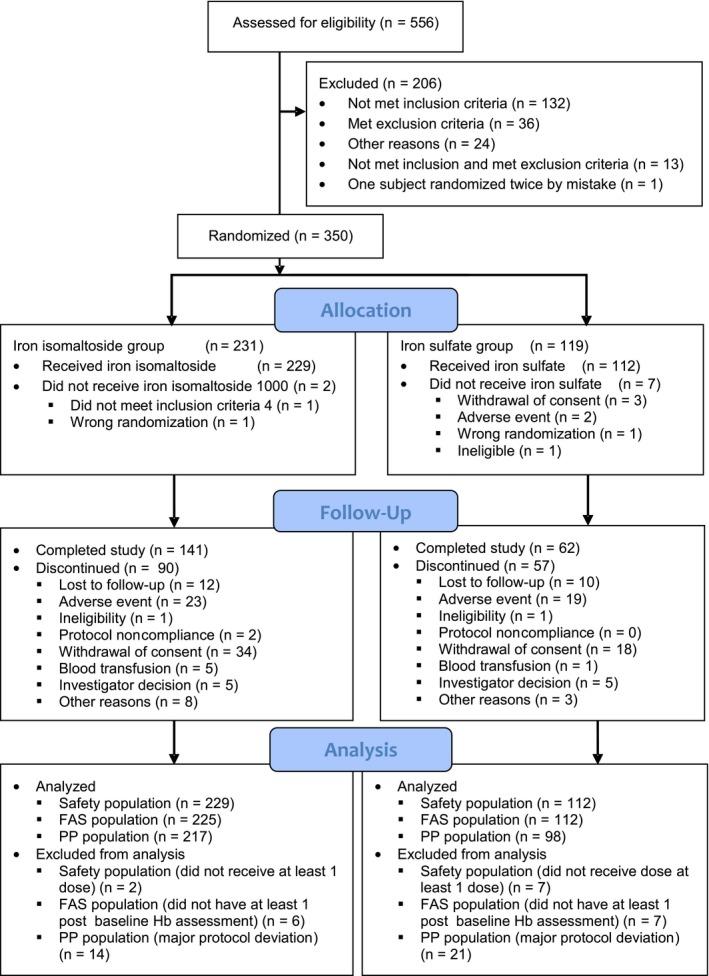
A total of 350 patients with cancer and anemia.
INTERVENTION
Patients were randomized in a 2:1 ratio to either intravenous iron isomaltoside or oral iron sulfate. Patients in the iron isomaltoside group were then randomized into an infusion subgroup (single intravenous infusions of a maximum dose of 1000 mg over 15 min) or a bolus injection subgroup (bolus injections of 500 mg over 2 min).
MEASUREMENTS AND MAIN RESULTS
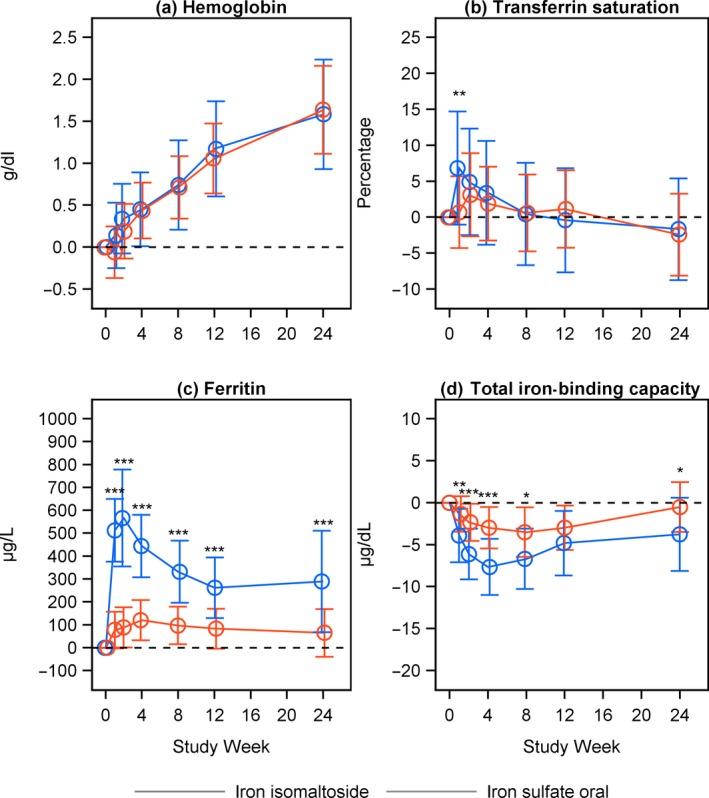
The primary efficacy outcome was change in hemoglobin concentration from baseline to week 4. Changes in other relevant hematology variables, effect on quality of life, and safety outcomes were also assessed. The primary efficacy outcome was tested for noninferiority, whereas the remaining outcomes were tested for superiority. Iron isomaltoside was noninferior to oral iron in change in hemoglobin concentration from baseline to week 4 (difference estimate 0.016, 95% confidence interval -0.26 to 0.29, p<0.001). A faster onset of the hemoglobin response was observed with infusion of iron isomaltoside (superiority test: p=0.03 at week 1), and a sustained effect on hemoglobin level was shown in both the iron isomaltoside and oral iron treatment groups until week 24. A significant mean decrease in fatigue score was observed from baseline to week 12 in the iron isomaltoside group (p<0.001) but not in the oral iron group (p=0.057). A higher proportion of patients treated with oral iron experienced adverse drug reactions (18.8% vs 6.6%, p<0.001) and discontinued the trial due to intolerance (8.0% vs 0.9%, p=0.001). Transient hypophosphatemia (phosphate level less than 2 mg/dl) was reported at similar low frequencies among the groups: 7.1% in the iron isomaltoside infusion subgroup versus 8.5% in the iron isomaltoside bolus injection subgroup versus 5.4% in the oral iron group.
CONCLUSION
This trial demonstrated comparable sustained increases in hemoglobin concentration over time with both iron isomaltoside and oral iron. Iron isomaltoside was better tolerated than oral iron, and fatigue was significantly decreased with iron isomaltoside. Low rates of clinically insignificant hypophosphatemia were reported in patients receiving both treatments.
研究目的
对于癌症合并贫血患者,有必要找到一种比促红细胞生成素更安全的治疗贫血的方法;因此,本试验的目的是通过检测静脉注射异麦芽糖铁与口服铁剂的非劣效性,比较二者在癌症合并贫血患者中的疗效和安全性。
设计
III期前瞻性开放标签对照随机非劣效性多中心试验。
地点
亚洲、美国和欧洲的47家医院或私立癌症诊所。
患者
共350例癌症合并贫血患者。
干预措施
患者按2:1比例随机分为静脉注射异麦芽糖铁组或口服硫酸亚铁组。异麦芽糖铁组患者再随机分为输注亚组(15分钟内单次静脉输注最大剂量1000mg)或推注亚组(2分钟内推注500mg)。
测量指标及主要结果
主要疗效指标为从基线到第4周血红蛋白浓度的变化。还评估了其他相关血液学变量的变化、对生活质量的影响以及安全性指标。对主要疗效指标进行非劣效性检验,其余指标进行优效性检验。从基线到第4周,异麦芽糖铁在血红蛋白浓度变化方面不劣于口服铁剂(差异估计值0.016,95%置信区间-0.26至0.29,p<0.001)。输注异麦芽糖铁后血红蛋白反应起效更快(优效性检验:第1周p=0.03),异麦芽糖铁组和口服铁剂治疗组在第24周前血红蛋白水平均有持续影响。异麦芽糖铁组从基线到第12周疲劳评分显著降低(p<0.001),而口服铁剂组未降低(p=0.057)。口服铁剂治疗的患者发生药物不良反应的比例更高(18.8%对6.6%,p<0.001),因不耐受而退出试验的比例也更高(8.0%对0.9%,p=0.001)。各组短暂性低磷血症(磷酸盐水平低于2mg/dl)的报告频率相似:异麦芽糖铁输注亚组为7.1%,异麦芽糖铁推注亚组为8.5%,口服铁剂组为5.4%。
结论
本试验表明,异麦芽糖铁和口服铁剂随时间推移均可使血红蛋白浓度持续升高且效果相当。异麦芽糖铁的耐受性优于口服铁剂,且使用异麦芽糖铁可显著减轻疲劳。接受两种治疗的患者中临床意义不大的低磷血症发生率均较低。

 Zotero 插件