Uebbing Severin, Künstner Axel, Mäkinen Hannu, Backström Niclas, Bolivar Paulina, Burri Reto, Dutoit Ludovic, Mugal Carina F, Nater Alexander, Aken Bronwen, Flicek Paul, Martin Fergal J, Searle Stephen M J, Ellegren Hans
Department of Evolutionary Biology, Evolutionary Biology Centre, Uppsala University, Norbyvägen 18D, SE-752 36 Uppsala, Sweden.
European Molecular Biology Laboratory, European Bioinformatics Institute, Wellcome Trust Genome Campus, Hinxton, Cambridge, UK.
Mol Ecol. 2016 May;25(9):2015-28. doi: 10.1111/mec.13596. Epub 2016 Apr 2.
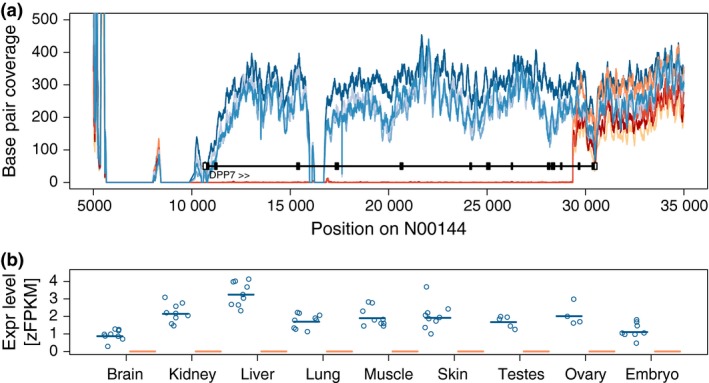
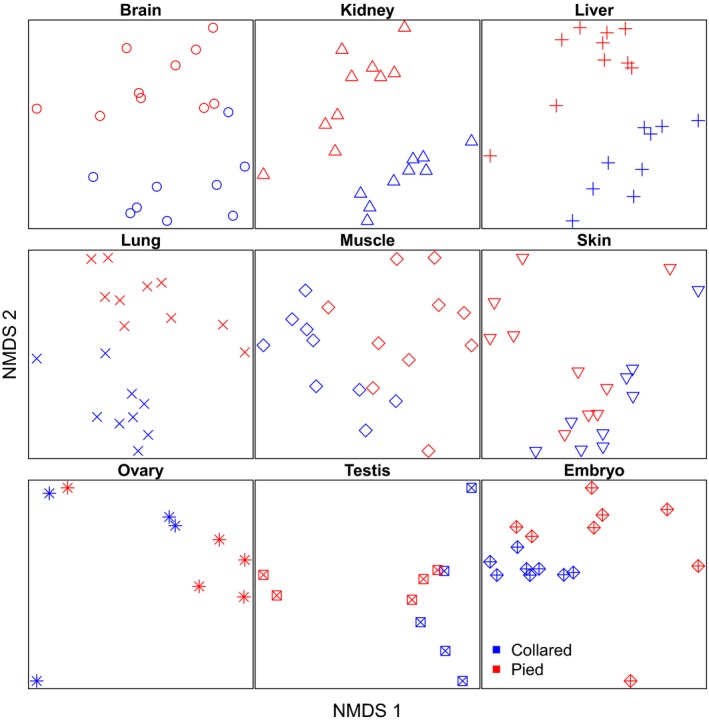
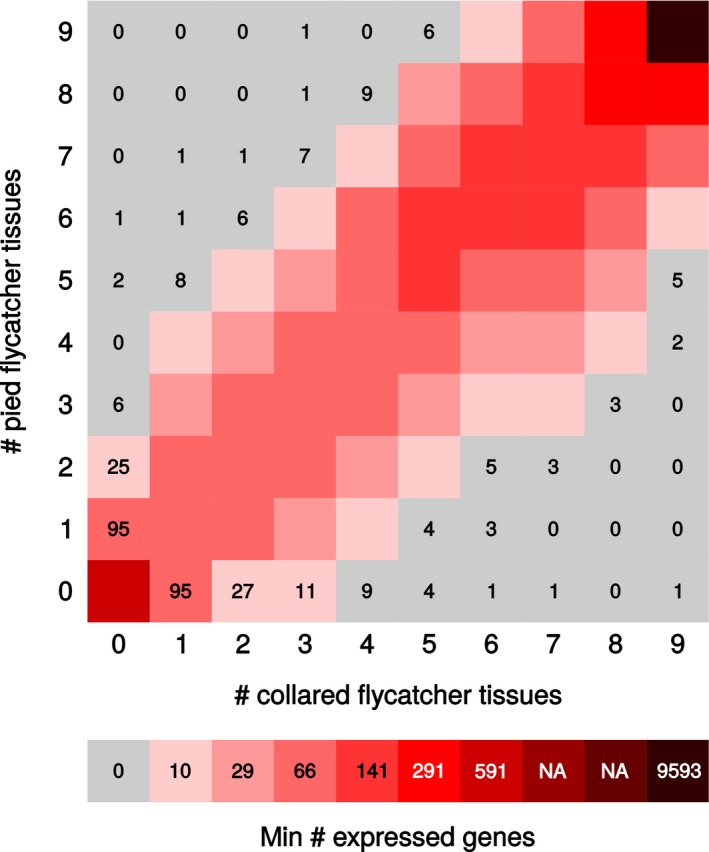
Relatively little is known about the character of gene expression evolution as species diverge. It is for instance unclear if gene expression generally evolves in a clock-like manner (by stabilizing selection or neutral evolution) or if there are frequent episodes of directional selection. To gain insights into the evolutionary divergence of gene expression, we sequenced and compared the transcriptomes of multiple organs from population samples of collared (Ficedula albicollis) and pied flycatchers (F. hypoleuca), two species which diverged less than one million years ago. Ordination analysis separated samples by organ rather than by species. Organs differed in their degrees of expression variance within species and expression divergence between species. Variance was negatively correlated with expression breadth and protein interactivity, suggesting that pleiotropic constraints reduce gene expression variance within species. Variance was correlated with between-species divergence, consistent with a pattern expected from stabilizing selection and neutral evolution. Using an expression PST approach, we identified genes differentially expressed between species and found 16 genes uniquely expressed in one of the species. For one of these, DPP7, uniquely expressed in collared flycatcher, the absence of expression in pied flycatcher could be associated with a ≈20-kb deletion including 11 of 13 exons. This study of a young vertebrate speciation model system expands our knowledge of how gene expression evolves as natural populations become reproductively isolated.
关于物种分化时基因表达进化的特征,我们了解得相对较少。例如,目前尚不清楚基因表达总体上是否以类似时钟的方式进化(通过稳定选择或中性进化),或者是否存在频繁的定向选择事件。为了深入了解基因表达的进化分歧,我们对白领姬鹟(Ficedula albicollis)和斑姬鹟(F. hypoleuca)种群样本的多个器官进行了转录组测序和比较,这两个物种的分化时间不到100万年。排序分析是按器官而非物种对样本进行分类的。不同器官在物种内的表达方差程度以及物种间的表达分歧存在差异。方差与表达广度和蛋白质相互作用呈负相关,这表明多效性限制降低了物种内的基因表达方差。方差与物种间分歧相关,这与稳定选择和中性进化所预期的模式一致。使用表达PST方法,我们鉴定了物种间差异表达的基因,并发现16个基因在其中一个物种中独特表达。对于其中一个基因DPP7,它在白领姬鹟中独特表达,在斑姬鹟中不表达可能与一个约20 kb的缺失有关,该缺失包含13个外显子中的11个。这项对一个年轻脊椎动物物种形成模型系统的研究扩展了我们对自然种群生殖隔离时基因表达如何进化的认识。