Younessi Heravi Mohamad Amin, Yaghubi Mohsen, Joharinia Simin
Department of Basic Sciences, Medicine School, North Khorasan University of Medical Sciences, Bojnurd, Iran.
Department of Cardiology, Torbat Heydariyeh University of Medical Sciences, Torbat Heydariyeh, Iran.
J Res Med Sci. 2015 Oct;20(10):937-43. doi: 10.4103/1735-1995.172767.
One of the most common and important diagnostic methods for the detection of heart diseases is coronary angiography. The aim of this study was to determine the optimum angle of the bed by using vital signals to optimize the patient's position after the angiography.
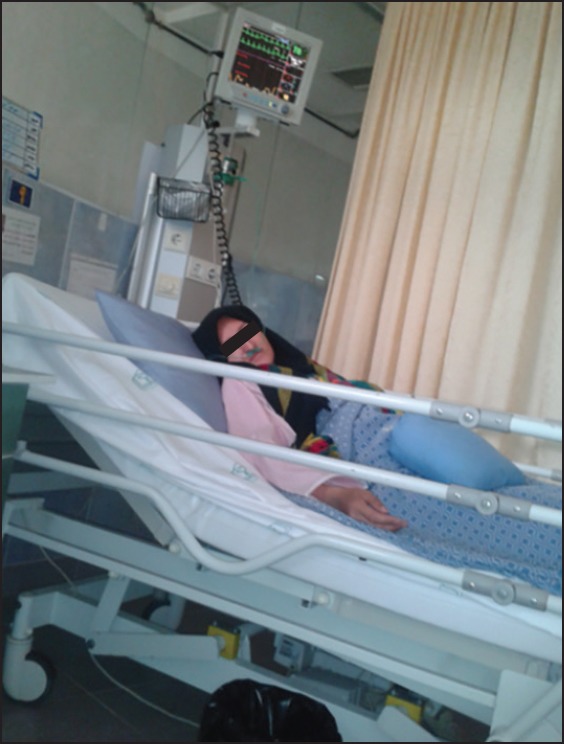
This study was a randomized clinical trial (RCT) on participants after angiography who were divided into five groups. The first group was placed routinely in a supine position. In the other groups, all of the patients were placed in bed by angle 15°, 30°, 45°, and 60° upward. In each group, vital signals were measured that included blood pressure, percent of blood oxygen saturation, heart rate, respiratory rate, and temperature. All of measured data compared with the pain score has been achieved from numerical pain scale. The data were analyzed by descriptive statistics method, variance analysis, and post hoc tests in the Statistical Package for the Social Sciences (SPSS) software, version 16. Estimation of the relationship was done by MATLAB version 2011. The level of significance was considered to be 0.05.
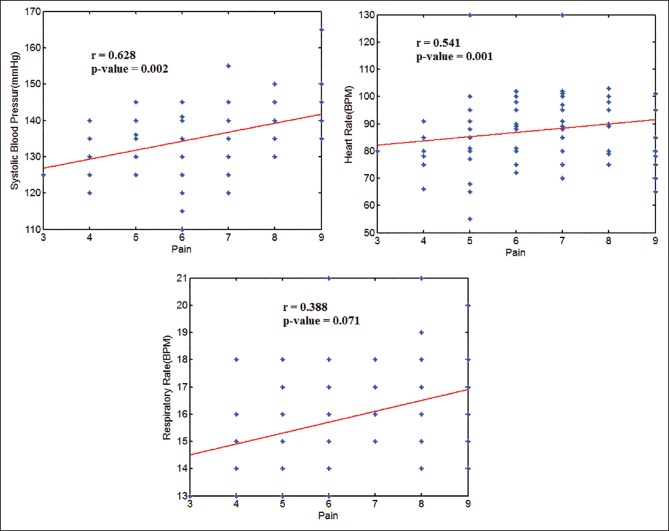
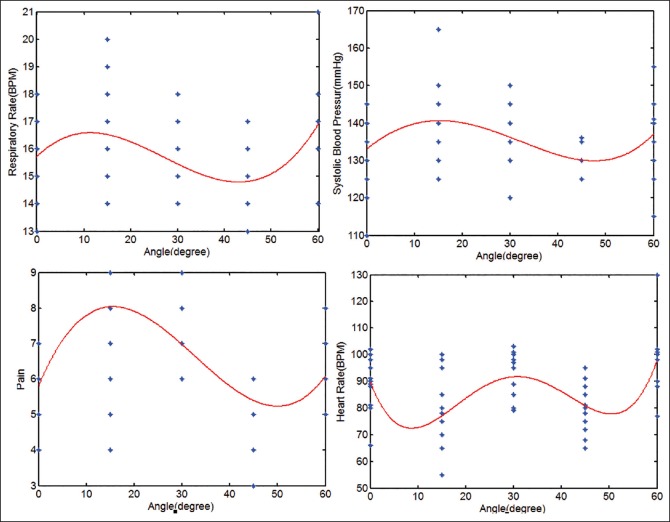
In various groups, there was no significance difference in demographic variables such as gender, age, height, and weight. The mean of pain score, heart rate, systolic blood pressure, and respiratory rate changed significantly (P < 0.05) but the temperature variation, blood oxygen saturation, and diastolic blood pressure in subjects were not significant (P > 0.05). It showed linear changes between pain and systolic blood pressure, respiratory rate, and heart rate changes. A dramatic reduction was also seen in systolic blood pressure, respiratory rate, heart rate, and also pain at an angle of 45(°).
This study showed that, 45(°) was the best angle of the bed to optimize the patient's position after the procedure, based on his/her vital signs and pain score. Thus, in order to relive pain, this change in bed angle is advised to be planned by postangiography nurses in patients after coronary angiography.
冠状动脉造影是检测心脏病最常见且重要的诊断方法之一。本研究的目的是通过使用生命体征来确定最佳的病床角度,以在血管造影术后优化患者的体位。
本研究是一项针对血管造影术后参与者的随机临床试验(RCT),参与者被分为五组。第一组常规仰卧位安置。在其他组中,所有患者以床头抬高15°、30°、45°和60°的角度安置在床上。在每组中,测量包括血压、血氧饱和度百分比、心率、呼吸频率和体温在内的生命体征。所有测量数据与通过数字疼痛量表获得的疼痛评分进行比较。数据采用描述性统计方法、方差分析和事后检验,在社会科学统计软件包(SPSS)16.0版中进行分析。关系估计通过MATLAB 2011版完成。显著性水平设定为0.05。
在不同组中,性别、年龄、身高和体重等人口统计学变量无显著差异。疼痛评分、心率、收缩压和呼吸频率的平均值有显著变化(P < 0.05),但受试者的体温变化、血氧饱和度和舒张压无显著变化(P > 0.05)。疼痛与收缩压、呼吸频率和心率变化之间呈线性变化。在45°角度时,收缩压、呼吸频率、心率以及疼痛也出现显著降低。
本研究表明,基于患者的生命体征和疼痛评分,45°是血管造影术后优化患者体位的最佳病床角度。因此,为了减轻疼痛,建议冠状动脉造影术后的护士为患者规划这种病床角度的改变。