Winkler Katrin, Ramer Robert, Dithmer Sophie, Ivanov Igor, Merkord Jutta, Hinz Burkhard
Institute of Toxicology and Pharmacology, Rostock University Medical Center, Rostock, Germany.
Oncotarget. 2016 Mar 22;7(12):15047-64. doi: 10.18632/oncotarget.7592.
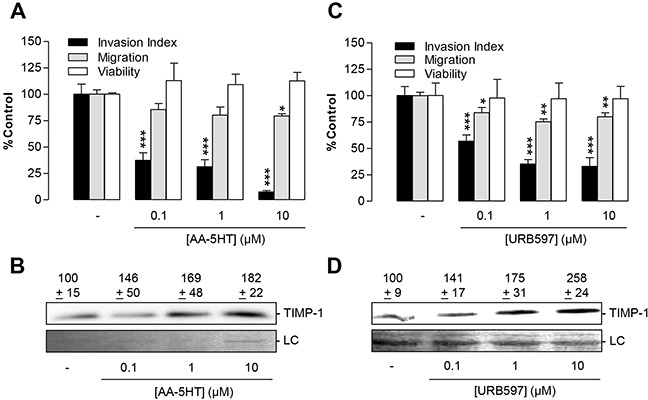
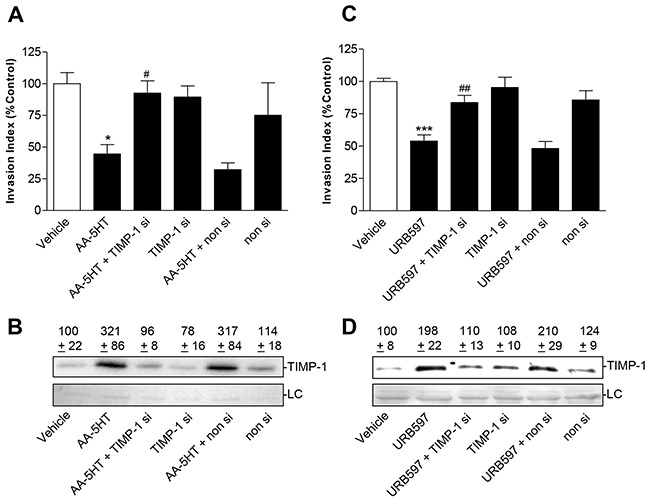
Inhibition of endocannabinoid degradation has been suggested as tool for activation of endogenous tumor defense. One of these strategies lies in blockade of fatty acid amide hydrolase (FAAH) which catalyzes the degradation of endocannabinoids (anandamide [AEA], 2-arachidonoylglycerol [2-AG]) and endocannabinoid-like substances (N-oleoylethanolamine [OEA], N-palmitoylethanolamine [PEA]). This study addressed the impact of two FAAH inhibitors (arachidonoyl serotonin [AA-5HT], URB597) on A549 lung cancer cell metastasis and invasion. LC-MS analyses revealed increased levels of FAAH substrates (AEA, 2-AG, OEA, PEA) in cells incubated with either FAAH inhibitor. In athymic nude mice FAAH inhibitors were shown to elicit a dose-dependent antimetastatic action yielding a 67% and 62% inhibition of metastatic lung nodules following repeated administration of 15 mg/kg AA-5HT and 5 mg/kg URB597, respectively. In vitro, a concentration-dependent anti-invasive action of either FAAH inhibitor was demonstrated, accompanied with upregulation of tissue inhibitor of matrix metalloproteinases-1 (TIMP-1). Using siRNA approaches, a causal link between the TIMP-1-upregulating and anti-invasive action of FAAH inhibitors was confirmed. Moreover, knockdown of FAAH by siRNA was shown to confer decreased cancer cell invasiveness and increased TIMP-1 expression. Inhibitor experiments point toward a role of CB2 and transient receptor potential vanilloid 1 in conferring anti-invasive effects of FAAH inhibitors and FAAH siRNA. Finally, antimetastatic and anti-invasive effects were confirmed for all FAAH substrates with AEA and OEA causing a TIMP-1-dependent anti-invasive action. Collectively, the present study provides first-time proof for an antimetastatic action of FAAH inhibitors. As mechanism of its anti-invasive properties an upregulation of TIMP-1 was identified.
抑制内源性大麻素降解被认为是激活内源性肿瘤防御的一种手段。其中一种策略是阻断脂肪酸酰胺水解酶(FAAH),该酶催化内源性大麻素(花生四烯酸乙醇胺[AEA]、2-花生四烯酸甘油[2-AG])和内源性大麻素样物质(N-油酰乙醇胺[OEA]、N-棕榈酰乙醇胺[PEA])的降解。本研究探讨了两种FAAH抑制剂(花生四烯酰5-羟色胺[AA-5HT]、URB597)对A549肺癌细胞转移和侵袭的影响。液相色谱-质谱分析显示,与任何一种FAAH抑制剂孵育的细胞中,FAAH底物(AEA、2-AG、OEA、PEA)水平升高。在无胸腺裸鼠中,FAAH抑制剂显示出剂量依赖性的抗转移作用,分别重复给予15mg/kg AA-5HT和5mg/kg URB597后,对肺转移结节的抑制率分别为67%和62%。在体外,证实了任何一种FAAH抑制剂都具有浓度依赖性的抗侵袭作用,并伴有基质金属蛋白酶组织抑制剂-1(TIMP-1)的上调。使用小干扰RNA方法,证实了FAAH抑制剂上调TIMP-1与抗侵袭作用之间的因果关系。此外,小干扰RNA敲低FAAH显示可降低癌细胞侵袭性并增加TIMP-1表达。抑制剂实验表明,CB2和瞬时受体电位香草酸受体1在赋予FAAH抑制剂和FAAH小干扰RNA抗侵袭作用中起作用。最后,证实了所有FAAH底物的抗转移和抗侵袭作用,AEA和OEA引起TIMP-1依赖性抗侵袭作用。总的来说,本研究首次证明了FAAH抑制剂的抗转移作用。作为其抗侵袭特性的机制,确定了TIMP-1的上调。