Byrne Hazel, Rylands Anthony B, Carneiro Jeferson C, Alfaro Jessica W Lynch, Bertuol Fabricio, da Silva Maria N F, Messias Mariluce, Groves Colin P, Mittermeier Russell A, Farias Izeni, Hrbek Tomas, Schneider Horacio, Sampaio Iracilda, Boubli Jean P
School of Environment and Life Sciences, University of Salford, Room 315, Peel Building, Salford, UK.
Conservation International, Arlington, VA USA.
Front Zool. 2016 Mar 1;13:10. doi: 10.1186/s12983-016-0142-4. eCollection 2016.
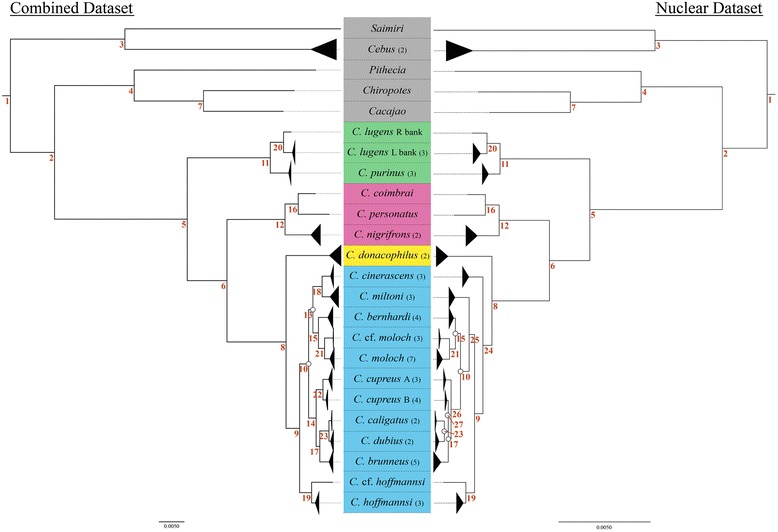
Titi monkeys, Callicebus, comprise the most species-rich primate genus-34 species are currently recognised, five of them described since 2005. The lack of molecular data for titi monkeys has meant that little is known of their phylogenetic relationships and divergence times. To clarify their evolutionary history, we assembled a large molecular dataset by sequencing 20 nuclear and two mitochondrial loci for 15 species, including representatives from all recognised species groups. Phylogenetic relationships were inferred using concatenated maximum likelihood and Bayesian analyses, allowing us to evaluate the current taxonomic hypothesis for the genus.
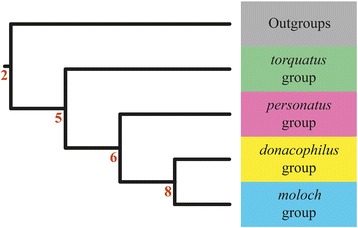
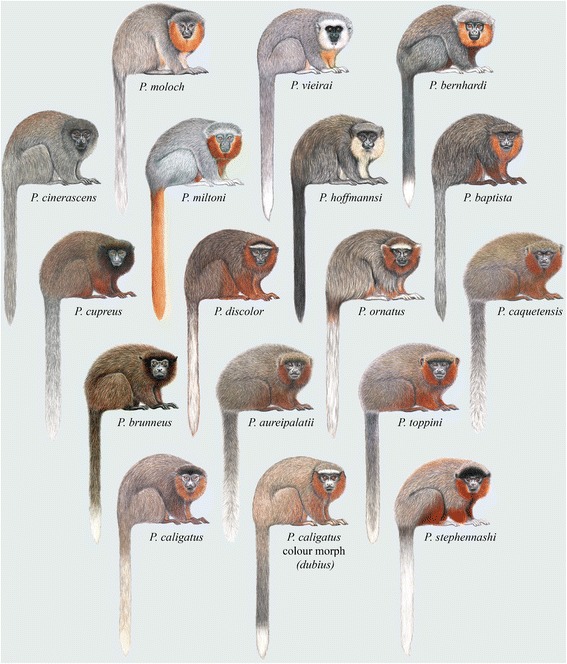
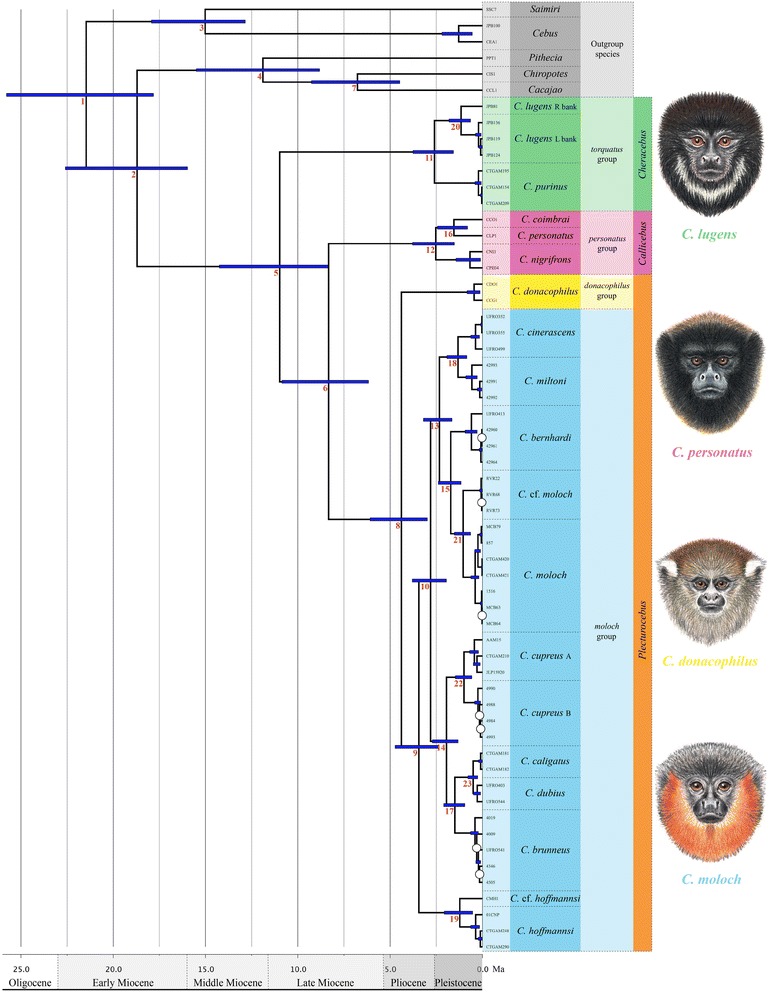
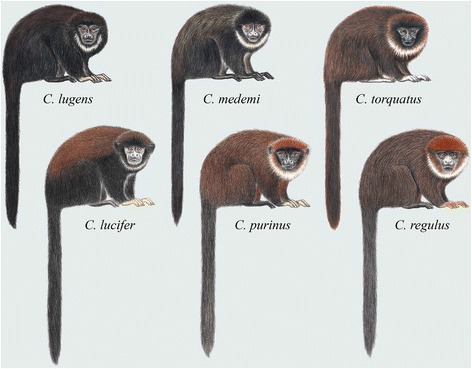
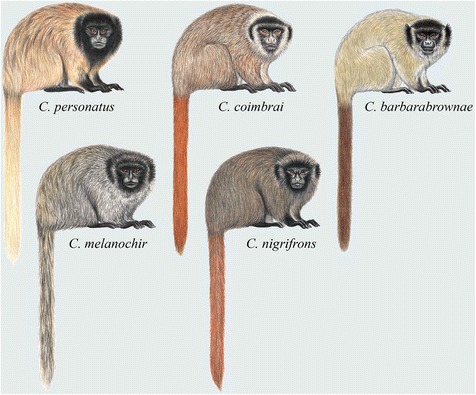
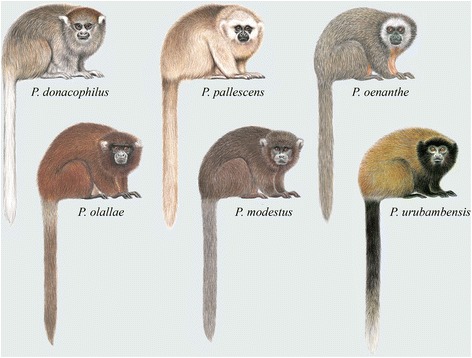
Our results show four distinct Callicebus clades, for the most part concordant with the currently recognised morphological species-groups-the torquatus group, the personatus group, the donacophilus group, and the moloch group. The cupreus and moloch groups are not monophyletic, and all species of the formerly recognized cupreus group are reassigned to the moloch group. Two of the major divergence events are dated to the Miocene. The torquatus group, the oldest radiation, diverged c. 11 Ma; and the Atlantic forest personatus group split from the ancestor of all donacophilus and moloch species at 9-8 Ma. There is little molecular evidence for the separation of Callicebus caligatus and C. dubius, and we suggest that C. dubius should be considered a junior synonym of a polymorphic C. caligatus.
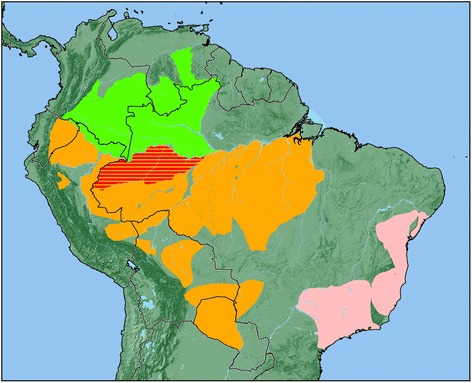
Considering molecular, morphological and biogeographic evidence, we propose a new genus level taxonomy for titi monkeys: Cheracebus n. gen. in the Orinoco, Negro and upper Amazon basins (torquatus group), Callicebus Thomas, 1903, in the Atlantic Forest (personatus group), and Plecturocebus n. gen. in the Amazon basin and Chaco region (donacophilus and moloch groups).
伶猴属(Callicebus)包含种类最为丰富的灵长类动物——目前已识别出34个物种,其中5个是2005年以来描述的。伶猴缺乏分子数据意味着人们对它们的系统发育关系和分化时间了解甚少。为了阐明它们的进化历史,我们通过对15个物种的20个核基因座和2个线粒体基因座进行测序,组装了一个大型分子数据集,其中包括所有已识别物种组的代表。使用串联最大似然法和贝叶斯分析推断系统发育关系,从而使我们能够评估该属目前的分类假设。
我们的结果显示了四个不同的伶猴分支,在很大程度上与目前认可的形态物种组一致——领狐猴组、饰颈狐猴组、多氏狐猴组和冕狐猴组。铜色狐猴组和冕狐猴组不是单系的,先前认可的铜色狐猴组的所有物种都被重新归类到冕狐猴组。两个主要的分化事件可追溯到中新世。最古老的辐射分支领狐猴组大约在1100万年前分化;大西洋森林饰颈狐猴组在900 - 800万年前从所有多氏狐猴和冕狐猴物种的祖先中分化出来。几乎没有分子证据支持区分饰颈伶猴和杜氏伶猴,我们建议将杜氏伶猴视为多态性饰颈伶猴的次异名。
综合分子、形态和生物地理证据,我们为伶猴提出了一个新的属级分类:奥里诺科河、内格罗河和亚马逊河上游流域的新属Cheracebus(领狐猴组),大西洋森林的Callicebus Thomas,1903(饰颈狐猴组),以及亚马逊河流域和查科地区的新属Plecturocebus(多氏狐猴和冕狐猴组)。