Hall Scott S, Dougherty Robert F, Reiss Allan L
Center for Interdisciplinary Brain Sciences Research, Department of Psychiatry and Behavioral Sciences, Stanford University School of Medicine, Stanford, CA, United States.
Center for Neurobiological Imaging (CNI), Stanford University, Stanford, CA, United States.
Neuroimage Clin. 2016 Jan 14;11:133-138. doi: 10.1016/j.nicl.2016.01.013. eCollection 2016.
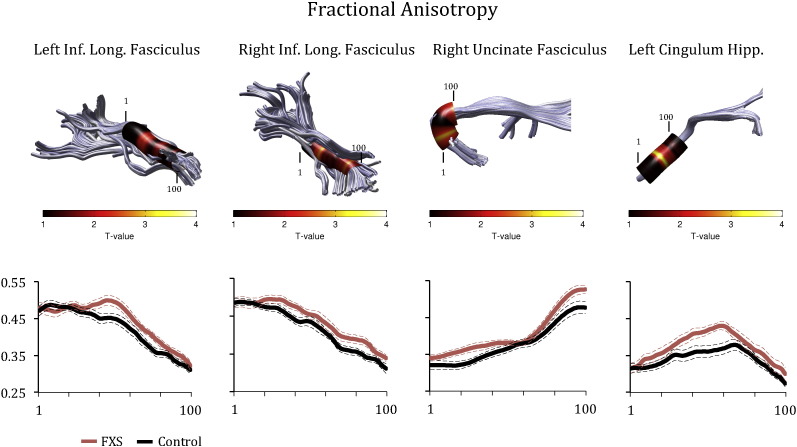
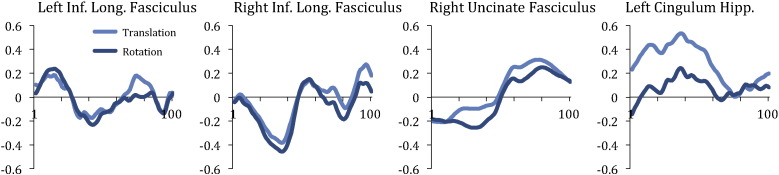
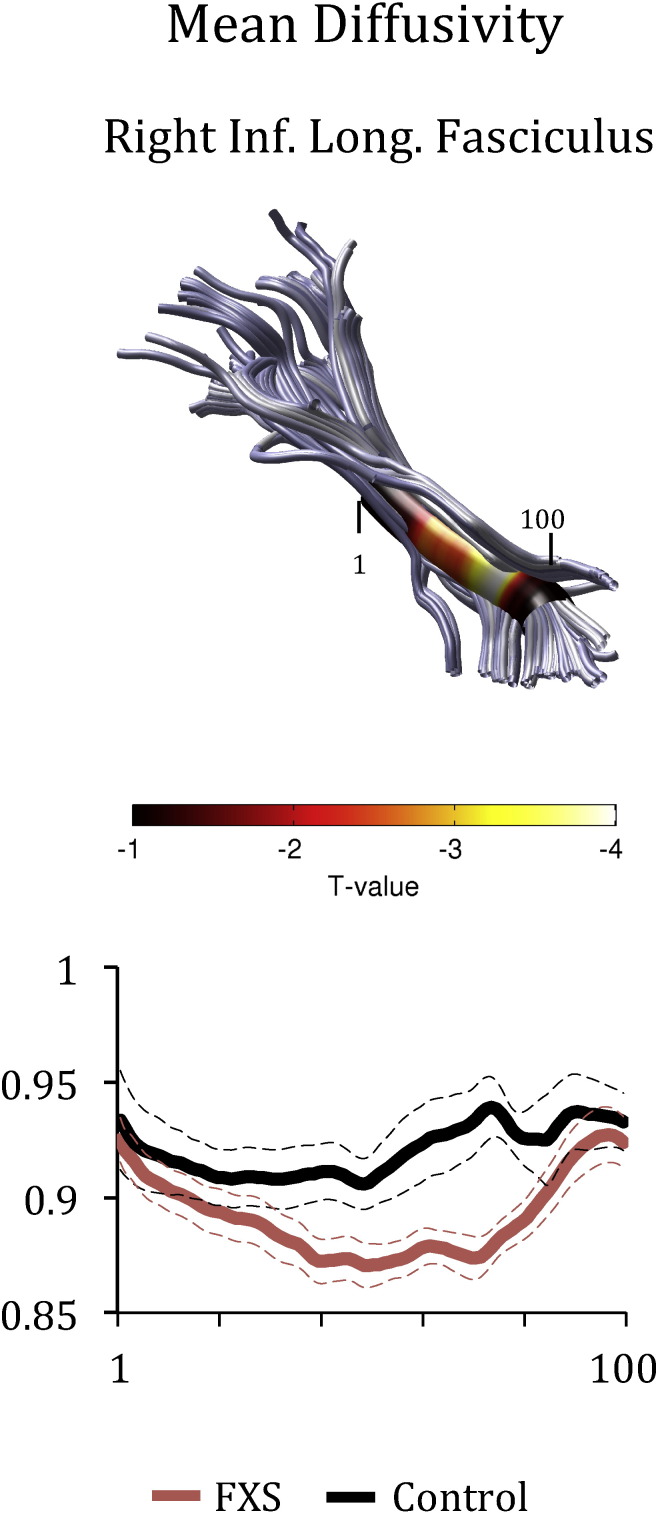
Previous studies attempting to quantify white matter (WM) microstructure in individuals with fragile X syndrome (FXS) have produced inconsistent findings, most likely due to the various control groups employed, differing analysis methods, and failure to examine for potential motion artifact. In addition, analyses have heretofore lacked sufficient specificity to provide regional information. In this study, we used Automated Fiber-tract Quantification (AFQ) to identify specific regions of aberrant WM microstructure along WM tracts in patients with FXS that differed from controls who were matched on age, IQ and degree of autistic symptoms. Participants were 20 patients with FXS, aged 10 to 23 years, and 20 matched controls. Using Automated Fiber-tract Quantification (AFQ), we created Tract Profiles of fractional anisotropy and mean diffusivity along 18 major WM fascicles. We found that fractional anisotropy was significantly increased in the left and right inferior longitudinal fasciculus (ILF), right uncinate fasciculus, and left cingulum hippocampus in individuals with FXS compared to controls. Conversely, mean diffusivity was significantly decreased in the right ILF in patients with FXS compared to controls. Age was significantly negatively associated with MD values across both groups in 11 tracts. Taken together, these findings indicate that FXS results in abnormal WM microstructure in specific regions of the ILF and uncinate fasciculus, most likely caused by inefficient synaptic pruning as a result of decreased or absent Fragile X Mental Retardation Protein (FMRP). Longitudinal studies are needed to confirm these findings.
以往试图量化脆性X综合征(FXS)患者白质(WM)微观结构的研究结果并不一致,这很可能是由于所采用的对照组各不相同、分析方法存在差异以及未能检测潜在的运动伪影。此外,迄今为止的分析缺乏足够的特异性来提供区域信息。在本研究中,我们使用自动纤维束定量(AFQ)来识别FXS患者沿白质束的白质微观结构异常的特定区域,这些区域与在年龄、智商和自闭症症状程度上相匹配的对照组有所不同。参与者为20名年龄在10至23岁之间的FXS患者以及20名匹配的对照组。我们使用自动纤维束定量(AFQ),沿着18条主要白质束创建了分数各向异性和平均扩散率的纤维束剖面图。我们发现,与对照组相比,FXS患者的左右下纵束(ILF)、右侧钩束和左侧扣带海马的分数各向异性显著增加。相反,与对照组相比,FXS患者右侧ILF的平均扩散率显著降低。在11条纤维束中,年龄与两组的平均扩散率值均呈显著负相关。综上所述,这些发现表明,FXS导致ILF和钩束特定区域的白质微观结构异常,这很可能是由于脆性X智力低下蛋白(FMRP)减少或缺失导致突触修剪效率低下所致。需要进行纵向研究来证实这些发现。