Neuroscience and Mental Health Research Institute, MRC Centre for Neuropsychiatric Genetics and Genomics, Cardiff, United Kingdom; Cardiff University Brain Research Imaging Centre School of Psychology, Cardiff University, Cardiff, United Kingdom; School for Mental Health and Neuroscience, Department of Psychiatry and Neuropsychology, Faculty of Health, Medicine and Life Sciences, Maastricht University, Maastricht, the Netherlands.
Neuroscience and Mental Health Research Institute, MRC Centre for Neuropsychiatric Genetics and Genomics, Cardiff, United Kingdom.
Biol Psychiatry. 2021 Sep 1;90(5):307-316. doi: 10.1016/j.biopsych.2021.02.969. Epub 2021 Mar 3.
Copy number variations at the 15q11.2 BP1-BP2 locus are present in 0.5%-1.0% of the population, and the deletion is associated with several neurodevelopmental disorders. Previously, we showed a reciprocal effect of 15q11.2 copy number variation on fractional anisotropy, with widespread increases in deletion carriers. We aim to expand these findings using a larger sample of participants (N = 29,166) and higher resolution imaging and by examining the implications for cognitive performance.
Diffusion tensor imaging measures from participants with no neurological or psychiatric diagnoses were obtained from the UK Biobank database. We compared 15q11.2 BP1-BP2 deletion (n = 102) and duplication (n = 113) carriers to a large cohort of control individuals with no neuropsychiatric copy number variants (n = 28,951). Additionally, we assessed how changes in white matter mediated the association between carrier status and cognitive performance.
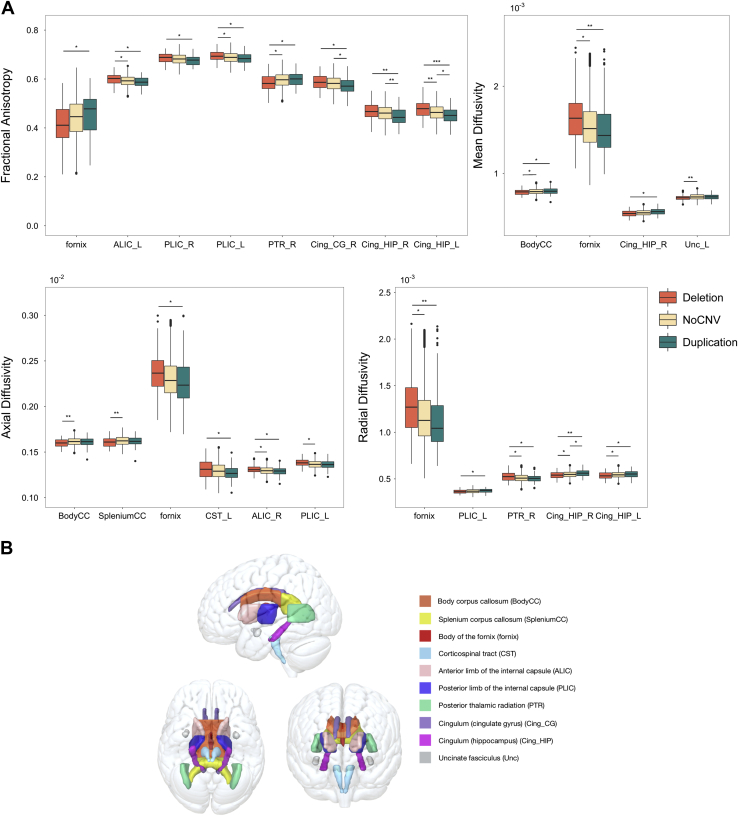
Deletion carriers showed increases in fractional anisotropy in the internal capsule and cingulum and decreases in the posterior thalamic radiation compared with both duplication carriers and control subjects (who had intermediate values). Compared with control subjects, deletion carriers had lower scores across cognitive tasks, which were partly influenced by white matter. Reduced fractional anisotropy in the posterior thalamic radiation partially contributed to worse cognitive performance in deletion carriers.
These results, together with our previous findings, provide convergent evidence for an effect of 15q11.2 BP1-BP2 on white matter microstructure, this being more pronounced in deletion carriers. Additionally, changes in white matter were found to partially mediate cognitive ability in deletion carriers, providing a link between white matter changes in 15q11.2 BP1-BP2 carriers and cognitive function.
15q11.2 位 BP1-BP2 点的拷贝数变异存在于 0.5%-1.0%的人群中,缺失与几种神经发育障碍有关。先前,我们发现 15q11.2 拷贝数变异对分数各向异性有相互影响,缺失携带者的分数各向异性广泛增加。我们旨在使用更大的参与者样本(N=29166)和更高分辨率的成像来扩展这些发现,并研究对认知表现的影响。
从英国生物银行数据库获得无神经或精神科诊断的参与者的弥散张量成像测量值。我们将 15q11.2 BP1-BP2 缺失(n=102)和重复(n=113)携带者与一个没有神经精神拷贝数变异的大对照组(n=28951)进行比较。此外,我们评估了白质变化如何介导携带者状态与认知表现之间的关联。
与重复携带者和对照组(具有中间值)相比,缺失携带者的内囊和扣带回的分数各向异性增加,后丘脑辐射的分数各向异性降低。与对照组相比,缺失携带者在认知任务中的得分较低,这部分受到白质的影响。后丘脑辐射的分数各向异性降低部分导致缺失携带者的认知表现更差。
这些结果与我们之前的发现一起,为 15q11.2 BP1-BP2 对白质微观结构的影响提供了一致的证据,缺失携带者的影响更为明显。此外,白质的变化被发现部分介导了缺失携带者的认知能力,为 15q11.2 BP1-BP2 携带者的白质变化与认知功能之间建立了联系。