
通过更好地利用标准临床数据提高预后预测能力——以诺丁汉预后指数为例
Improving the Prognostic Ability through Better Use of Standard Clinical Data - The Nottingham Prognostic Index as an Example.
作者信息
Winzer Klaus-Jürgen, Buchholz Anika, Schumacher Martin, Sauerbrei Willi
机构信息
Charité-Universitätsmedizin Berlin, Klinik für Gynäkologie mit Brustzentrum, Berlin, Germany.
Universitätsklinikum Freiburg, Institut für Medizinische Biometrie und Statistik, Department für Medizinische Biometrie und Medizinische Informatik, Freiburg, Germany.
出版信息
PLoS One. 2016 Mar 3;11(3):e0149977. doi: 10.1371/journal.pone.0149977. eCollection 2016.
BACKGROUND
Prognostic factors and prognostic models play a key role in medical research and patient management. The Nottingham Prognostic Index (NPI) is a well-established prognostic classification scheme for patients with breast cancer. In a very simple way, it combines the information from tumor size, lymph node stage and tumor grade. For the resulting index cutpoints are proposed to classify it into three to six groups with different prognosis. As not all prognostic information from the three and other standard factors is used, we will consider improvement of the prognostic ability using suitable analysis approaches.
METHODS AND FINDINGS
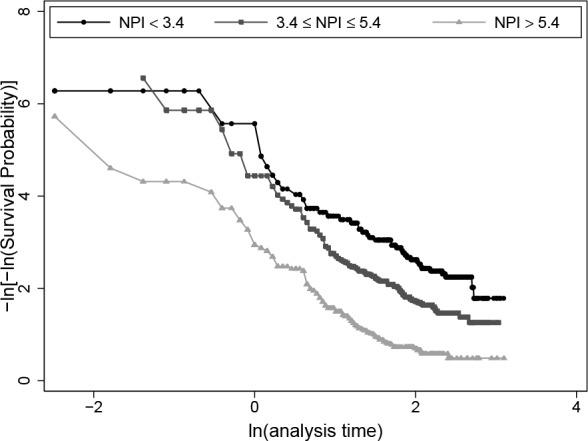
Reanalyzing overall survival data of 1560 patients from a clinical database by using multivariable fractional polynomials and further modern statistical methods we illustrate suitable multivariable modelling and methods to derive and assess the prognostic ability of an index. Using a REMARK type profile we summarize relevant steps of the analysis. Adding the information from hormonal receptor status and using the full information from the three NPI components, specifically concerning the number of positive lymph nodes, an extended NPI with improved prognostic ability is derived.
CONCLUSIONS
The prognostic ability of even one of the best established prognostic index in medicine can be improved by using suitable statistical methodology to extract the full information from standard clinical data. This extended version of the NPI can serve as a benchmark to assess the added value of new information, ranging from a new single clinical marker to a derived index from omics data. An established benchmark would also help to harmonize the statistical analyses of such studies and protect against the propagation of many false promises concerning the prognostic value of new measurements. Statistical methods used are generally available and can be used for similar analyses in other diseases.
背景
预后因素和预后模型在医学研究和患者管理中起着关键作用。诺丁汉预后指数(NPI)是一种成熟的乳腺癌患者预后分类方案。它以非常简单的方式结合了肿瘤大小、淋巴结分期和肿瘤分级的信息。针对所得指数提出了切点,将其分为三到六个预后不同的组。由于并非所有来自这三个及其他标准因素的预后信息都被使用,我们将考虑使用合适的分析方法来提高预后能力。
方法与结果
通过使用多变量分数多项式和进一步的现代统计方法,重新分析来自临床数据库的1560例患者的总生存数据,我们阐述了合适的多变量建模以及推导和评估指数预后能力的方法。使用REMARK类型的概述,我们总结了分析的相关步骤。加入激素受体状态信息并利用NPI三个组成部分的全部信息,特别是关于阳性淋巴结数量的信息,得出了具有更高预后能力的扩展NPI。
结论
通过使用合适的统计方法从标准临床数据中提取全部信息,即使是医学中最成熟的预后指数之一的预后能力也可以得到提高。这个扩展版的NPI可作为一个基准,用于评估新信息的附加值,范围从新的单一临床标志物到组学数据得出的指数。一个既定的基准也将有助于协调此类研究的统计分析,并防止关于新测量预后价值的许多虚假承诺的传播。所使用的统计方法一般都有,可用于其他疾病的类似分析。



 Zotero 插件